

How Do We Talk About Entering and Exiting Vehicles?
English uses different verbs for entering and exiting, depending on the type of vehicle. It’s important to learn these pairs.
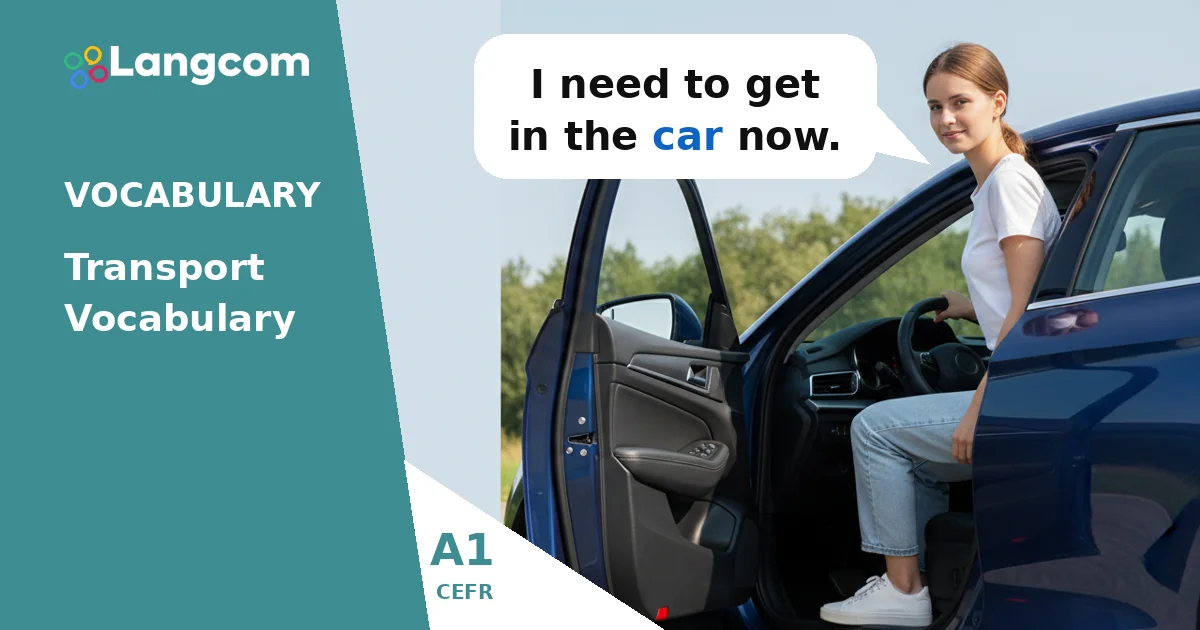
- For small vehicles like cars and taxis, we use get in to enter and get out of to exit.
- For larger vehicles like buses, trains, planes, and ferries, we use get on to enter and get off to exit.
🎓 Aprende inglés con el método mixto
Grupos reducidos · Tutor de IA disponible las 24 horas del día, los 7 días de la semana · Preparación para los exámenes de Cambridge
Planes de $39 $79 al mes
How Do We Talk About Starting and Ending a Journey?
When you travel, there are specific verbs to describe the beginning and end of your trip.
- To talk about catching public transport on time, use catch. If you are late, you miss eso.
- For planes, when they leave the ground, they take off. When they return to the ground, they land.
- Generally, when you reach your destination, you arrive at a place. When you leave a place to start a journey, you depart from eso.
What About Giving and Receiving Rides?
Sometimes you drive someone somewhere, or someone drives you. We have verbs for these actions too.
- When you go to a place to collect someone in your car, you pick them up.
- When you take someone to their destination in your car, you drop them off.
| Action | Small Vehicles (e.g., Car, Taxi) | Large Vehicles (e.g., Bus, Train, Plane, Ferry) |
|---|---|---|
| Enter | get in | get on |
| Exit | get out of | get off |
Ejemplos
- I need to get in the car now.
- She got out of the taxi quickly.
- Let's get on the bus at the next stop.
- They got off the train in London.
- He always tries to catch the 8 AM train.
- Oh no, I missed my flight!
- The plane will take off in ten minutes.
- Our flight landed safely.
- We will arrive at the hotel around 5 PM.
- The bus departs from platform 3.
- Can you pick me up from work?
- I will drop you off at the station.
Práctica
💬 ¿Necesitas asesoramiento personalizado?
Como centro autorizado de preparación para los exámenes de Cambridge, podemos orientarte para que elijas el curso y la certificación más adecuados. Habla hoy mismo con nuestros asesores.
Chatea con un asesor por WhatsAppErrores habituales de los hispanohablantes
Confuso get in y get on
Many Spanish speakers might use enter for all vehicles, or confuse get in y get on because Spanish often uses one verb like 'subir' or 'entrar'. Remember the size rule:
- Incorrecto: I get on the car.
- Correcto: I get in the car.
- Incorrecto: I get in the bus.
- Correcto: I get on the bus.
Uso de take en lugar de catch
While you can take a bus (meaning to use it as transport), catch a bus specifically means to get on it successfully before it leaves. If you are talking about the action of getting it on time, use catch.
- Correcto: I need to catch the bus. (Meaning: I need to get on it before it leaves.)
- Correcto: I take the bus to work every day. (Meaning: I use the bus for transport.)
Preguntas más frecuentes
Why are there two different verbs for entering/exiting vehicles?
English uses get in/get out of for small vehicles where you usually bend down to enter, like a car or taxi. We use get on/get off for larger vehicles where you can stand up and walk around, like a bus, train, or plane.
Can I use 'take' instead of 'catch' for public transport?
Sí, se puede decir I take the bus to work to mean you use it regularly. However, catch the bus specifically means to get on a particular bus or train at a specific time, usually implying you need to be on time.
What is the difference between 'arrive at' and 'arrive in'?
Utilizamos arrive at for specific places like the station o the airport. Utilizamos arrive in for larger places like a city o a country. Por ejemplo, I arrived at the airport, pero I arrived in Paris.




0 Comentarios