

What Are Adverbs of Frequency?
Adverbs of frequency tell us how often an action happens. They describe how many times something takes place.
We use them to talk about routines, habits, and regular activities.
🎓 Aprende inglés con el método mixto
Grupos reducidos · Tutor de IA disponible las 24 horas del día, los 7 días de la semana · Preparación para los exámenes de Cambridge
Planes de $39 $79 al mes
What Are the Most Common Adverbs of Frequency?
Here are the most common adverbs of frequency, from 100% to 0%:
- Always: This means 100% of the time. For example, I always brush my teeth in the morning.
- Usually: This means most of the time, almost 100%. For example, She usually walks to school.
- Often: This means many times, but not always. For example, We often eat pizza on Fridays.
- Sometimes: This means only a few times, not regularly. For example, He sometimes plays video games.
- Never: This means 0% of the time, not at all. For example, They never drink soda.
Where Do Adverbs of Frequency Go in a Sentence?
The position of adverbs of frequency is very important in English sentences. There are two main rules to remember.
Rule 1: Before the Main Verb
Most adverbs of frequency go before the main verb in a sentence.
- I always drink coffee. (Not I drink always coffee.)
- She usually studies in the library.
- We often watch movies.
Rule 2: After the Verb 'to be'
If the verb in the sentence is to be (am, is, are), the adverb of frequency goes after eso.
- He is always happy. (Not He always is happy.)
- They are usually late.
- I am never bored.
Special Case: 'Sometimes'
The adverb sometimes can be more flexible. It can go at the beginning, in the middle, or at the end of a sentence.
- Sometimes I eat breakfast.
- I sometimes eat breakfast.
- I eat breakfast sometimes.
How Do We Ask About Frequency?
To ask about how often someone does something, we use the question word How often...?
- How often do you go to the gym?
- How often does she visit her grandparents?
- How often are they busy?
| Adverb | How Often |
|---|---|
| Always | 100% of the time |
| Usually | About 80-90% of the time |
| Often | About 50-70% of the time |
| Sometimes | About 20-40% of the time |
| Never | 0% of the time |
Ejemplos
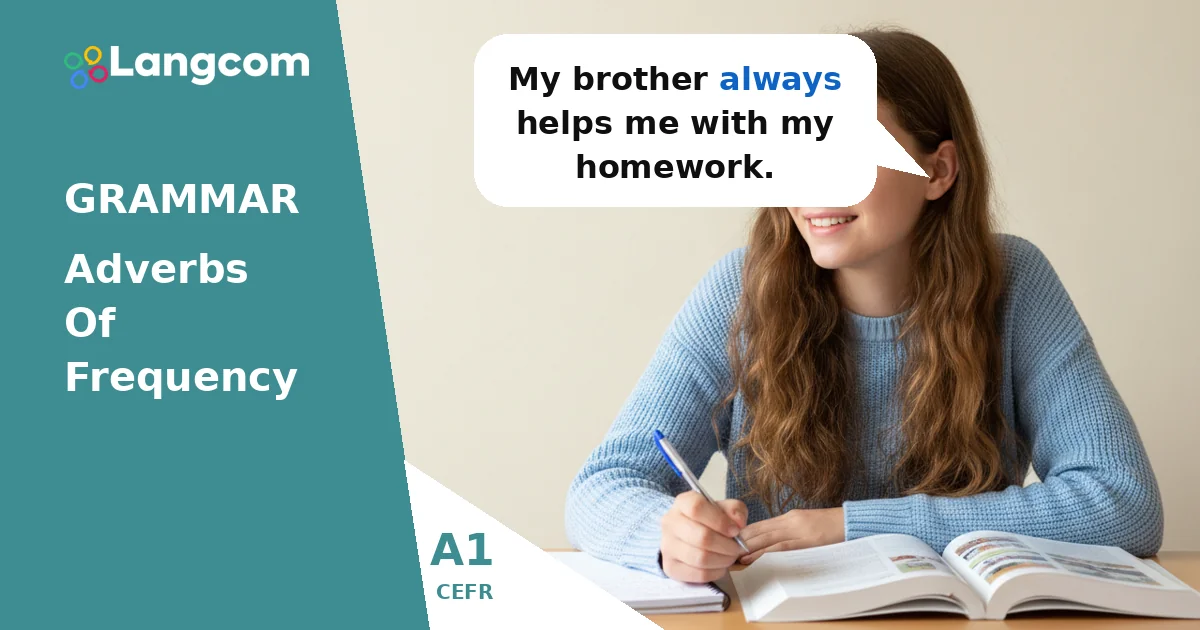
- My brother always helps me with my homework.
- We usually go to the beach in summer.
- She often reads books before bed.
- I sometimes forget my keys.
- They are never sad.
- He is usually on time for class.
Práctica
💬 ¿Necesitas asesoramiento personalizado?
Como centro autorizado de preparación para los exámenes de Cambridge, podemos orientarte para que elijas el curso y la certificación más adecuados. Habla hoy mismo con nuestros asesores.
Chatea con un asesor por WhatsAppErrores habituales de los hispanohablantes
Spanish speakers often make two common mistakes with adverbs of frequency:
1. Incorrect Position
In Spanish, adverbs can often go at the end of a sentence. In English, this is usually incorrect for adverbs of frequency.
- Incorrecto: I go to the park usually.
- Correcto: I usually go to the park.
Also, remember the rule for the verb to be:
- Incorrecto: She always is happy.
- Correcto: She is always happy.
2. Using 'Never' with a Negative Verb
In Spanish, you might use a double negative. In English, never already makes the sentence negative, so you don't need don't o doesn't.
- Incorrecto: I don't never eat meat.
- Correcto: I never eat meat.
Preguntas más frecuentes
What are the five main adverbs of frequency?
The five main adverbs of frequency are always, usually, often, sometimes, y never. They tell you how often an action happens.
Where do adverbs of frequency go in a sentence?
They usually go before the main verb (p. ej., I often read). However, they go after the verb 'to be' (p. ej., She is always happy).
Can 'sometimes' go in different places?
Sí, sometimes is flexible. It can go at the beginning (Sometimes I swim), in the middle (I sometimes swim), or at the end of a sentence (I swim sometimes).
Is 'often' the same as 'frequently'?
Sí, often y frequently have a similar meaning. Often is more common in everyday conversation for A1 learners.



0 Comentarios