

How Do We Talk About Present Wishes and Regrets?
When you want to express that you would like a present situation to be different, you use wish o if only followed by the past simple.
- This structure shows that the situation is not real or is impossible to change right now.
- If only is often stronger and more dramatic than wish.
Examples:
- I wish I had more free time. (But I don’t have enough free time now.)
- If only I were taller. (But I am not tall now.)
✍️ ¿No sabes en qué nivel estás?
Realiza nuestra prueba de nivel gratuita y recibe comentarios personalizados de examinadores certificados por Cambridge.
Realice nuestra prueba de nivel GRATUITAHow Do We Express Annoyance or Desire for Change?
To complain about someone's current behavior or a situation you want to change, you can use wish o if only followed by would + base verb.
- This form suggests that the person or thing could change their behavior if they chose to.
- It is often used when you are annoyed or frustrated.
Examples:
- I wish you would stop making so much noise. (I'm annoyed by the noise.)
- If only the bus would arrive soon. (I'm waiting impatiently for the bus.)
How Do We Regret Things in the Past?
When you want to express regret about something that happened or didn't happen in the past, use wish o if only followed by the past perfect.
- This structure shows that you want the past to be different from what it was.
- It implies a feeling of sadness or disappointment about a past action or event.
Examples:
- I wish I hadn't said that. (I said it, and now I regret it.)
- If only I had studied harder for the exam. (I didn't study hard enough, and I failed.)
When Do We Use 'Wish to' and 'Hope'?
Aunque wish is often about unreal situations, wish to y hope have different uses.
- Wish to + infinitive: This is a more formal way to say 'want to'. It expresses a desire or intention.
Ejemplo: The director wishes to speak with you.
- Hope: Utilizamos hope for things we want to happen in the future that are possible and realistic.
Ejemplo: I hope you have a great trip!
How Do We Express Preferences with 'Would Rather' and 'Would Prefer'?
Would rather y would prefer are used to express what you would choose in a particular situation.
- For your own preference:
- Uso would rather + base verb. Example: I'd rather stay home tonight.
- Uso would prefer + to-infinitive. Example: I'd prefer to go to the cinema.
- For someone else's preference (or a situation involving another person):
- Uso would rather + subject + past simple. This refers to a present or future preference. Example: I'd rather you didn't tell anyone about this.
- Uso would prefer it if + subject + past simple. This is similar to would rather but can sound slightly more formal. Example: I'd prefer it if you came a bit later.
| Situation | Structure | Example |
|---|---|---|
| Present wish/regret (unreal) | wish / if only + past simple | I wish I spoke French. |
| Complaint about present behavior | wish / if only + would + base verb | If only he would listen! |
| Past regret (unreal) | wish / if only + past perfect | I wish I had studied harder. |
| Formal desire ('want to') | wish to + infinitive | We wish to inform you. |
| Future possible desire | hope + present/future verb | I hope you succeed. |
| Personal preference | would rather + base verb | I'd rather stay in. |
| Personal preference | would prefer + to-infinitive | I'd prefer to watch a movie. |
| Preference for another's action | would rather + subject + past simple | I'd rather you didn't go. |
| Preference for another's action | would prefer it if + subject + past simple | I'd prefer it if she called. |
Ejemplos
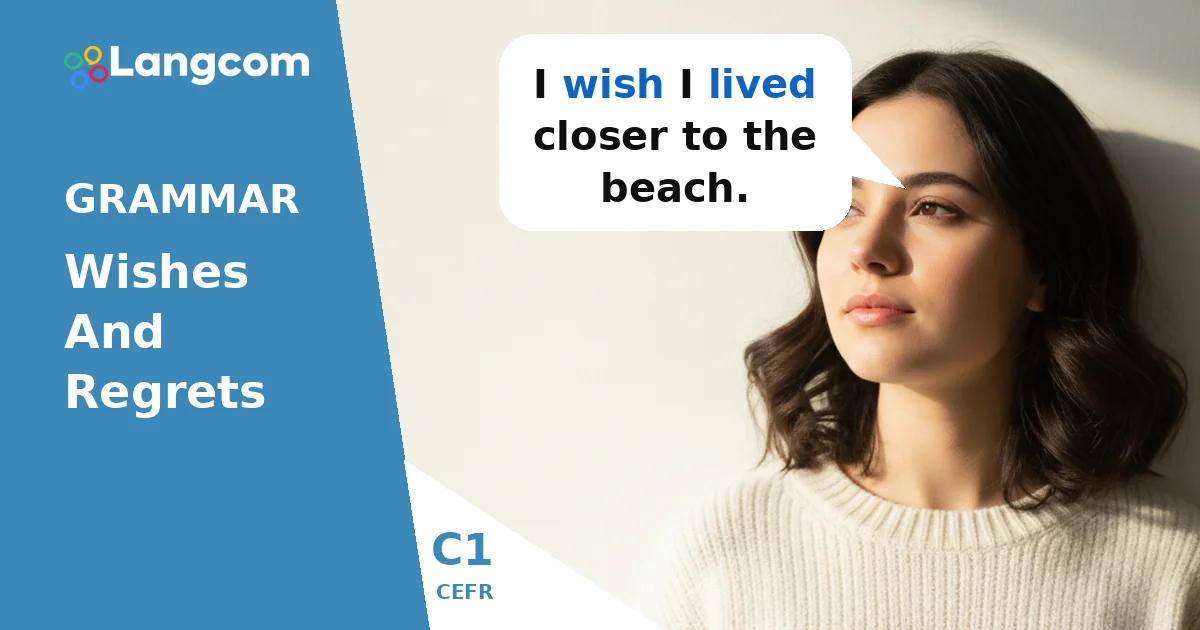
- I wish I lived closer to the beach.
- If only I had known about the party earlier!
- She wishes her cat would stop scratching the furniture.
- We wish we hadn't missed the last train.
- The committee wishes to postpone the meeting until next week.
- I hope it doesn't rain tomorrow.
- He'd rather work from home than commute every day.
- They'd prefer to eat Italian food tonight.
- My boss would rather I finished the report by Friday.
- I'd prefer it if you didn't smoke inside the house.
Práctica
¿Estás listo para obtener tu certificado?
El curso Langcom prepara a los alumnos para los exámenes de Cambridge, IELTS, TOEFL, DELE, SIELE y Michigan.
Empieza a utilizar LangcomErrores habituales de los hispanohablantes
Errores habituales de los hispanohablantes
- Using present tense after wish for present regrets: Spanish speakers might incorrectly use a present tense verb. Remember to use the past simple for present wishes.
- Incorrect: I wish I am taller.
- Correct: I wish I were taller. (o I wish I was taller.)
- Confuso wish y hope: Wish is for unreal or impossible situations, while hope is for possible future events.
- Incorrect: I wish you have a good day.
- Correct: I hope you have a good day.
- Incorrect tense after would rather with a subject: When expressing a preference for someone else's action, use the past simple, not the present.
- Incorrect: I'd rather she goes with us.
- Correct: I'd rather she went with us.
Preguntas más frecuentes
What is the main difference between 'wish' and 'if only'?
Ambos wish y if only express desires for things to be different. If only is generally stronger and more emphatic, conveying a deeper sense of regret or longing.
Can I use 'was' instead of 'were' after 'wish' for present situations?
Yes, in informal English, it is common to use was después de I/he/she/it wish. However, were is grammatically more traditional and often preferred in formal contexts, especially in the phrase if I were you.
How are these structures tested in the C1 Advanced (CAE) exam?
In the C1 Advanced (CAE) exam, you might encounter these structures in the Use of English Part 4 (Key Word Transformation), where you need to rephrase sentences using a given word. For example, you might have to transform a sentence about regret into one using wish o if only, ensuring correct tense usage.
When should I use 'would rather' versus 'would prefer'?
Would rather y would prefer are often interchangeable for expressing personal preferences. Would rather is typically followed by a base verb (I'd rather go), while would prefer is followed by a to-infinitive (I'd prefer to go). When expressing a preference for someone else's action, both use the past simple after the subject (I'd rather you went o I'd prefer it if you went).



0 Comentarios