

Why is Referencing Important in English?
Good referencing is a hallmark of advanced English. It shows you can connect ideas logically and efficiently.
- It makes your writing clearer and easier to read.
- It helps your sentences flow smoothly, creating a more natural rhythm.
- It demonstrates a higher level of linguistic control and sophistication.
- It is vital for academic and professional contexts where precision and conciseness are valued.
✍️ ¿No sabes en qué nivel estás?
Realiza nuestra prueba de nivel gratuita y recibe comentarios personalizados de examinadores certificados por Cambridge.
Realice nuestra prueba de nivel GRATUITAHow Do We Use 'This' and 'That' for Referencing?
This y that are powerful tools for referring to ideas, situations, or entire clauses, not just single nouns.
- Utilizamos this to refer to something recently mentioned or something that is psychologically 'closer' to the speaker/writer. It often introduces a consequence or reaction to the previous statement. For example: The company announced record profits. This led to a surge in stock prices.
- Utilizamos that to refer to something mentioned earlier, or something more general or distant in context. It can also imply a shared understanding. For example: Many people are working from home now. That has changed the way we commute.
- Both can be used with a noun (this problem, that idea) or stand alone as pronouns.
When Should You Use 'It' for Referencing?
It is one of the most versatile referencing words in English, used in several ways at C1 level.
- Referring to a specific noun: If the noun is clear from the context, it replaces a singular, non-human noun. For example: I bought a new book. It's very interesting.
- Referring to a general statement or situation: It can stand for a whole idea or fact. For example: He failed the exam. It was very disappointing.
- As an anticipatory or 'dummy' subject: It often introduces a clause, especially with adjectives or verbs of opinion. For example: It's important to study regularly. (Here, it refers forward to to study regularly).
- In impersonal expressions: For time, weather, distance. For example: It's raining. It's 5 o'clock.
How Do 'One' and 'Ones' Help Avoid Repetition?
One y ones are used to replace countable nouns, especially when you are talking about a type of thing or making a choice.
- Utilizamos one for singular countable nouns. For example: I need a new phone. I want a fast one. (meaning 'a fast phone').
- Utilizamos ones for plural countable nouns. For example: These shoes are old. I need new ones. (meaning 'new shoes').
- They are often used after adjectives or in phrases like the one(s) that... o which one(s). For example: Which car do you prefer? The red one.
Referencing Actions with Auxiliary Verbs and 'The Same'
To avoid repeating entire verb phrases, we can use auxiliary verbs or the phrase the same.
- Auxiliary verbs: Utilizamos do, be, o have (in the correct tense) to stand in for a previously mentioned verb phrase. For example: She loves to travel, and I do too. (meaning 'I love to travel too'). They haven't finished the report, but he has. (meaning 'he has finished the report').
- The same: This phrase can refer to a previously mentioned action or state. For example: He decided to quit his job. His sister did the same. (meaning 'his sister also decided to quit her job').
- Similar + noun: Sometimes we use similar followed by a noun to refer to a type of thing or result. For example: Standing desks improve focus. Treadmill desks offer similar benefits.
| Referencing Device | Primary Use | Example |
|---|---|---|
| This | Refers to a recent idea, situation, or a whole clause (closer) | The project was successful. This proves our strategy works. |
| That | Refers to an earlier, more general idea, situation, or a whole clause (more distant) | He resigned last month. That was unexpected. |
| It | Refers to a specific singular noun, a general statement, or as an anticipatory subject | I read the report; it was insightful. It's crucial to act now. |
| One / Ones | Replaces countable nouns to avoid repetition, often after adjectives or for types/choices | I prefer the red one. These old chairs need new ones. |
| Auxiliary verbs (do, be, have) | Replaces a full verb phrase to avoid repetition, matching original tense/aspect | She can sing, and I can too. They haven't seen it, but we have. |
| The same | Refers to a previously mentioned action or situation, emphasizing identity | He complained about the service. I did the same. |
Ejemplos
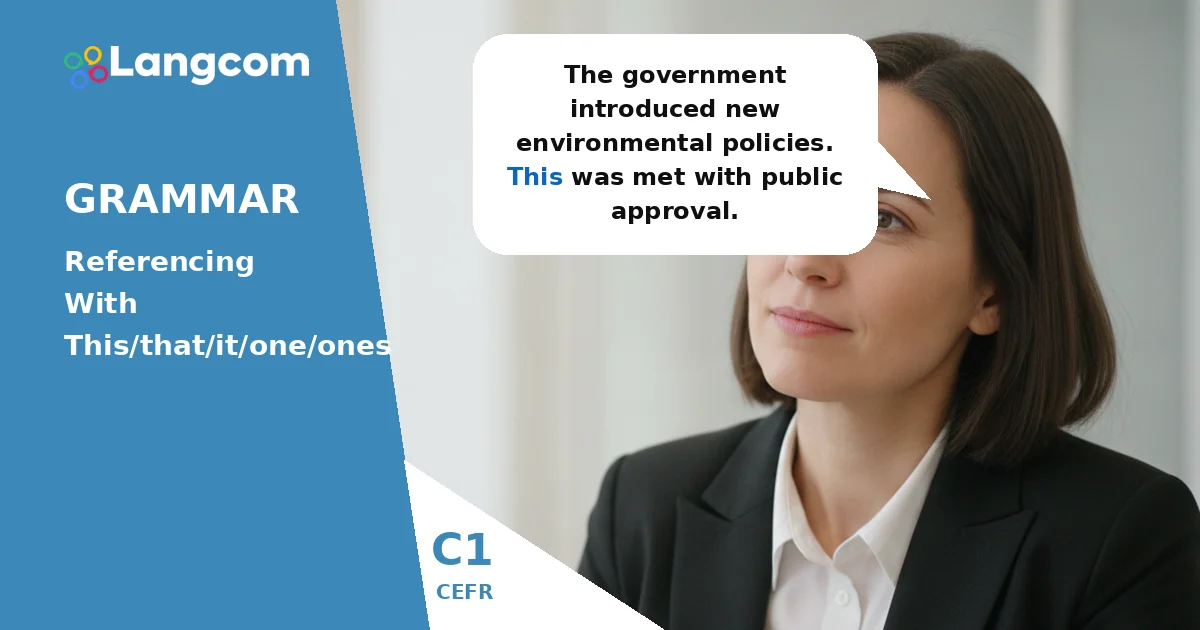
- The government introduced new environmental policies. This was met with public approval.
- Many students struggle with time management. That is a common challenge.
- I found a great article online. It explains the topic perfectly.
- It's vital to consider all perspectives before making a decision.
- Do you prefer the blue jacket or the black one?
- These old files need to be archived. We should get some new ones.
- She said she would help, and she did.
- They haven't visited the new museum yet, but I have.
- The team developed a new marketing strategy. Competitors tried to do the same.
Práctica
¿Estás listo para obtener tu certificado?
El curso Langcom prepara a los alumnos para los exámenes de Cambridge, IELTS, TOEFL, DELE, SIELE y Michigan.
Empieza a utilizar LangcomErrores habituales de los hispanohablantes
Spanish speakers often encounter specific challenges when mastering English referencing:
- Confuso it y one: In Spanish, 'uno' can be used more broadly. Remember, it refers to a specific, identifiable thing or idea, while one replaces a countable noun when you're talking about a type or choice. For example, don't say: I need a new car. I want an expensive it. (Incorrect) Say: I need a new car. I want an expensive one. (Correct)
- Uso excesivo it for broad ideas: Aunque it can refer to general statements, this o that are often more appropriate for referring to entire preceding clauses or complex situations. For example, instead of: The economy is struggling. It is a major concern. (Acceptable, but less precise) Consider: The economy is struggling. This is a major concern. (More precise, referring to the whole situation).
- Incorrect auxiliary verb tense: When replacing verb phrases, ensure the auxiliary verb matches the tense and aspect of the original verb. Don't say: She studied hard, and I have too. (Incorrect tense match) Say: She studied hard, and I did too. (Correct)
Preguntas más frecuentes
What is the main purpose of referencing in English?
The main purpose of referencing is to avoid unnecessary repetition of words, phrases, or ideas, making your communication more concise, clear, and cohesive. It helps your text flow naturally.
Can 'this' and 'that' refer to people?
En general, this y that as pronouns refer to things, ideas, or situations. When referring to people, we typically use he, she, they, o who. However, in informal speech, you might hear This is John when introducing someone.
Is 'it' always singular?
Yes, the pronoun it is always singular. Its plural form is they o them when referring to specific nouns. However, when it is used as a 'dummy' subject (e.g., It's important...), it doesn't have a plural form in that context.
When should I use 'the same' instead of an auxiliary verb?
Se utiliza the same when you want to emphasize that an action or situation is identical to a previously mentioned one. Auxiliary verbs simply replace the verb phrase. For example: He left early, and I did too. (simple replacement) vs. He left early, and I did the same. (emphasizes the identical action).



0 Comentarios