

What are Common Fruits in English?
Fruits are delicious and healthy foods. Learning their names helps you talk about food in English.
- A banana is a long, yellow fruit. I like bananas.
- Un apple is a round fruit, often red or green. She eats an apple.
- Grapes are small, round fruits that grow in bunches. We have green grapes.
- A pear is a sweet fruit, wider at the bottom. He likes pears.
- A kiwi is a small, brown fruit with green inside. Kiwi is good.
- A pineapple is a large, sweet, tropical fruit. I want pineapple juice.
- A watermelon is a big, green fruit with red inside. Watermelon is fresh.
- A coconut is a large, hard fruit from a palm tree. I drink coconut water.
🎓 Aprende inglés con el método mixto
Grupos reducidos · Tutor de IA disponible las 24 horas del día, los 7 días de la semana · Preparación para los exámenes de Cambridge
Planes de $39 $79 al mes
Food Words: Fruits and Vegetables
Sometimes, we learn words for fruits and vegetables together because they are all important foods. In English, some foods are called 'fruits' and some are called 'vegetables'.
Here are some other food words you might learn:
- A carrot is a long, orange vegetable. I eat carrots.
- A pea is a small, green, round vegetable. Peas are small.
- A potato is a round vegetable that grows in the ground. I like potatoes.
It's okay to learn them all as 'food words' for now!
Using 'a' or 'an' with Fruit Names
In English, we use a o an before singular nouns. This is important for Pre-A1 learners.
- Uso a before words that start with a consonant sound (b, c, d, f, g, etc.). For example: a banana, a pear, a kiwi.
- Uso an before words that start with a vowel sound (a, e, i, o, u). For example: an apple.
Remember, we do not use a o an with plural words like grapes.
| Singular | Plural |
|---|---|
| an apple | apples |
| a banana | bananas |
| a carrot | carrots |
| a coconut | coconuts |
| a grape | grapes |
| a kiwi | kiwis |
| a pea | peas |
| a pear | pears |
| a pineapple | pineapples |
| a potato | potatoes |
| a watermelon | watermelons |
Ejemplos
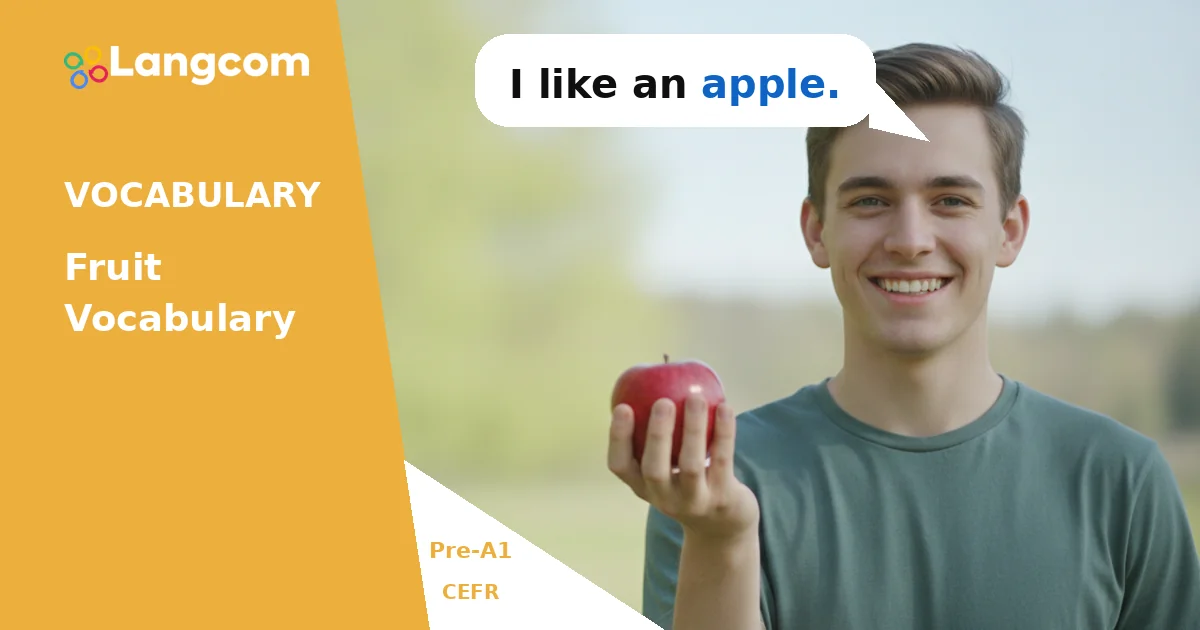
- I like an apple.
- Do you eat bananas?
- She has a pineapple.
- We want some grapes.
- He likes carrots.
Práctica
💬 ¿Necesitas asesoramiento personalizado?
Como centro autorizado de preparación para los exámenes de Cambridge, podemos orientarte para que elijas el curso y la certificación más adecuados. Habla hoy mismo con nuestros asesores.
Chatea con un asesor por WhatsAppErrores habituales de los hispanohablantes
Spanish speakers sometimes forget to use a o an before a singular fruit name, or they forget the plural -s.
- Incorrecto: I like apple.
- Correcto: I like an apple.
- Incorrecto: I eat banana.
- Correcto: I eat a banana.
- Incorrecto: She likes grape. (if talking about many)
- Correcto: She likes grapes.
Preguntas más frecuentes
What is the difference between 'a' and 'an'?
Utilizamos a before words starting with a consonant sound (like a banana). Utilizamos an before words starting with a vowel sound (like an apple).
How do I say I like a fruit?
You can say I like apples. o I like a banana. If you like many, use the plural. If you like one specific fruit, use a o an.
Are all the words in this lesson fruits?
No, some words like carrot, pea, y potato are technically vegetables. But we often learn them together as important food vocabulary for beginners.



0 Comentarios