

What are Prepositions of Place?
Prepositions of place are words that show the position or location of something. They answer the question ‘Where?’
These small words are very important for making clear sentences in English. They help you describe where objects, people, or animals are.
🎓 Learn English with the Blended method
Small groups · 24/7 AI Tutor · Cambridge preparation
Plans from $39 $79 per month
Using 'In'
We use in to talk about something that is inside a container, a room, a building, or a large area.
- Use in for things inside a box, bag, or room.
- Think of in as 'inside'.
Using 'On'
We use on to talk about something that is on a surface.
- Use on for things on a table, a wall, or the floor.
- Think of on as 'touching the top surface'.
Using 'Under'
We use under to talk about something that is below another object or surface.
- Use under for things below a table, a bed, or a tree.
- Think of under as 'below something else'.
Using 'Behind'
We use behind to talk about something that is at the back of another object.
- Use behind for things at the back of a door, a person, or a building.
- Think of behind as 'at the back'.
Using 'In Front Of'
We use in front of to talk about something that is at the forward part of another object or person.
- Use in front of for things at the front of a car, a house, or a screen.
- Think of in front of as 'at the face side'.
Using 'Next To'
We use next to to talk about something that is beside another object or person.
- Use next to for things very close to a chair, a window, or a friend.
- Think of next to as 'beside' or 'very near'.
Using 'Between'
We use between to talk about something that is in the middle of two other objects or people.
- Use between for things in the middle of two books, two people, or two buildings.
- Think of between as 'in the middle of two things'.
| Preposition | Meaning | Example |
|---|---|---|
| in | Inside a space or container | The book is in the bag. |
| on | On a surface | The cat is on the chair. |
| under | Below something else | The ball is under the table. |
| behind | At the back of something | The teacher is behind the desk. |
| in front of | At the forward part of something | The dog is in front of the door. |
| next to | Beside or very near something | The lamp is next to the bed. |
| between | In the middle of two things | The shop is between the bank and the cafe. |
Examples
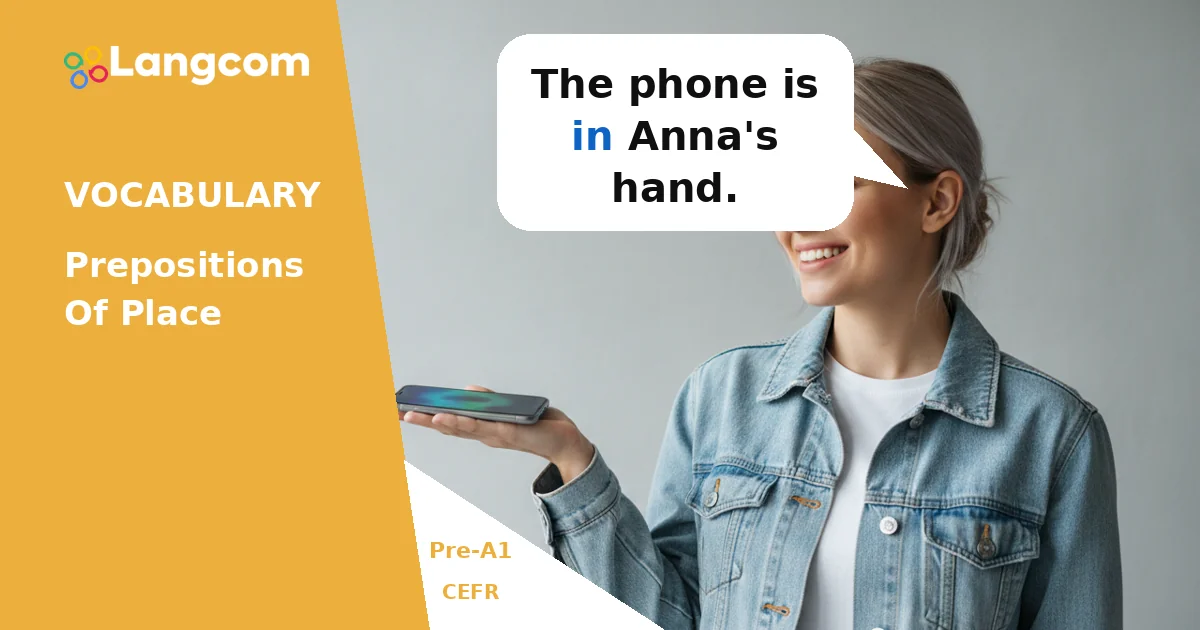
- The phone is in Anna's hand.
- The table is under the mirror.
- The monster is behind Anna.
- The chair is between the table and the blue door.
- The big lamp is next to the white door.
- The mat is in front of the monster.
- The books are next to the small lamp.
- My keys are in my bag.
- The picture is on the wall.
- The cat is under the bed.
Practice
💬 Need personalized guidance?
As an Authorized Cambridge Preparation Centre, we can guide you to the right course and certification. Chat with our advisors today.
Chat with an Advisor on WhatsAppCommon mistakes for Spanish speakers
Sometimes, Spanish speakers use in when English uses on, or vice-versa. It is important to remember the difference.
- In vs. On for surfaces: In Spanish, you might say 'en la mesa' for 'on the table'. But for things on a surface, English always uses on.
- The book is on the table. (Correct)
- The book is in the table. (Incorrect)
- In vs. On for rooms/buildings: You say in the room, in the house. Not on the room.
- I am in the classroom. (Correct)
- I am on the classroom. (Incorrect)
Remember, in means inside a space, and on means on a surface.
Frequently asked questions
What is a preposition of place?
A preposition of place is a word that tells you the location or position of something. For example, in, on, under.
When do I use 'in'?
You use in when something is inside a container, a room, or a large area. For example, The apple is in the box.
When do I use 'on'?
You use on when something is on a surface. For example, The pen is on the desk.
What is the difference between 'behind' and 'in front of'?
Behind means at the back of something. In front of means at the forward part of something. For example, The tree is behind the house, but The car is in front of the house.


0 Comments