

What Are Prepositions of Place?
Prepositions of place are words that help us describe the exact position of a person, object, or place. They answer the question “Where?”
In English, at, in, and on are the most common prepositions of place. They have specific uses that are important to learn.
✍️ Not sure which level you are?
Take our free placement test and get personalized feedback from certified Cambridge examiners.
Take our FREE Placement TestWhen Do We Use 'At' for Place?
We use at when we talk about a specific point or location. Think of it as a precise address or a general area around a point.
- Specific points or addresses:
She is waiting at the bus stop.
The meeting is at 10 Downing Street. - Public places (as a general location, not inside):
I saw him at the cinema.
They are having lunch at a restaurant. - Events:
We met at a party.
Are you going to be at the concert? - Home/Work/University (general location):
I'm at home.
She's at work right now.
When Do We Use 'In' for Place?
We use in when something is inside an enclosed space, a container, a room, or a larger geographical area.
- Enclosed spaces or containers:
The keys are in my bag.
There's milk in the fridge. - Rooms or buildings:
He's in the living room.
The books are in the library. - Cities, countries, continents:
I live in Madrid.
She was born in Spain. - Vehicles (cars, taxis):
Are you in the car?
He's in a taxi.
When Do We Use 'On' for Place?
We use on when something is on a surface, a line, or a specific floor of a building.
- Surfaces:
The laptop is on the desk.
There's a picture on the wall. - Lines (streets, rivers, coast):
Our house is on Main Street.
The city is on the coast. - Public transport (buses, trains, planes, ships):
She's on the bus.
They are on a plane to New York. - Floors of a building:
My office is on the third floor.
| Preposition | Main Use | Examples |
|---|---|---|
| At | Specific point, address, general location (home, work), events | at the corner, at 23 Park Road, at the party, at home |
| In | Enclosed space, container, room, building, city, country, car | in the box, in the kitchen, in London, in a car |
| On | Surface, line, public transport (bus, train), floor/level | on the table, on the street, on the bus, on the second floor |
Examples
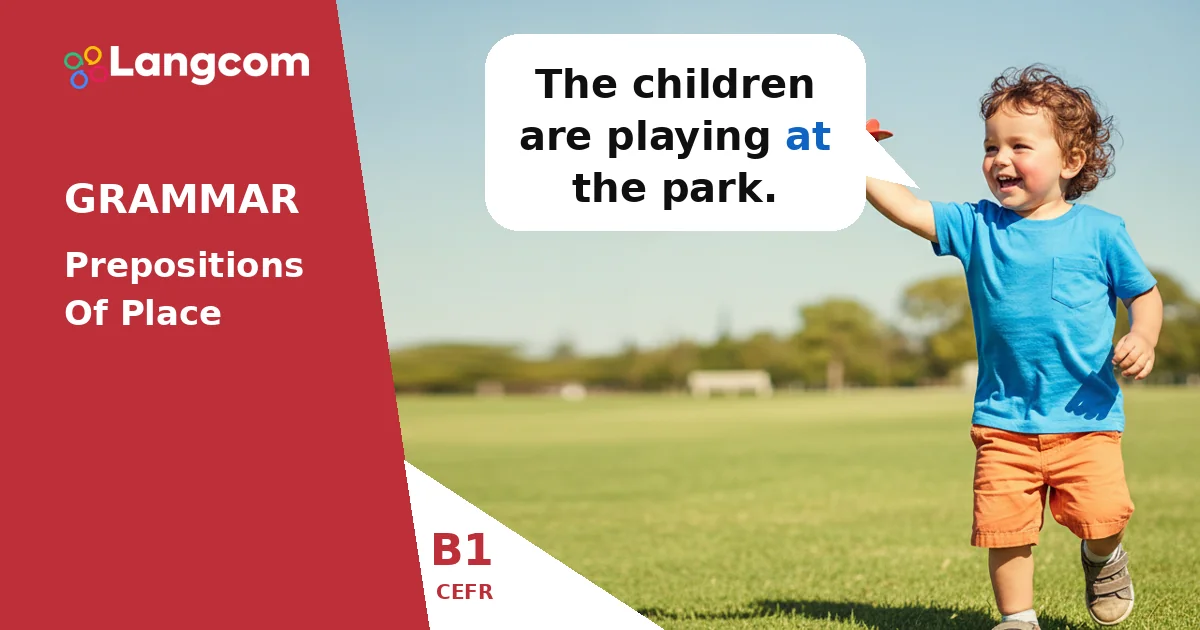
- The children are playing at the park.
- There is a spider on the ceiling.
- My phone is in my pocket.
- We met at the entrance of the building.
- She lives in a small village in the mountains.
- Please put the dishes on the shelf.
- Is there a good café at the station?
- The cat is sleeping in the armchair.
Practice
Ready to earn your certificate?
Langcom prepares students for Cambridge, IELTS, TOEFL, DELE, SIELE and Michigan exams.
Get started with LangcomCommon mistakes for Spanish speakers
Spanish speakers often confuse at, in, and on because the Spanish word "en" can cover all these meanings. It's important to remember the specific rules for English.
- Using in instead of at for specific points:
❌ I am in home. (Incorrect)
✅ I am at home. (Correct) - Using in instead of on for surfaces:
❌ The picture is in the wall. (Incorrect)
✅ The picture is on the wall. (Correct) - Using at instead of in for large areas:
❌ I live at Spain. (Incorrect)
✅ I live in Spain. (Correct)
Always think: Is it a point, an enclosed space, or a surface?
Frequently asked questions
What is the main difference between 'at', 'in', and 'on' for places?
The main difference is about specificity and type of location. At is for specific points or general locations (like at the door). In is for enclosed spaces, containers, or large areas (like in the room, in Spain). On is for surfaces or lines (like on the table, on the street).
Can I use both 'at' and 'in' for a building?
Yes, but with different meanings. At a building means you are at that location, possibly outside or just inside the entrance (e.g., I'm at the bank). In a building means you are inside it, within its walls (e.no-translation.g., I'm in the bank, talking to a teller).
How can I remember these prepositions more easily?
Think of them like a target: at is the bullseye (a specific point), in is inside the larger target area (an enclosed space), and on is on the surface of the target. Practice with many examples and try to visualize the location.
Are prepositions of place important for the B1 Preliminary exam?
Absolutely! Prepositions of place are frequently tested in the B1 Preliminary exam, especially in the Reading and Writing parts, such as in gap-fill exercises or when writing emails or stories where you need to describe locations accurately. Correct usage shows good grammatical control.




0 Comments