
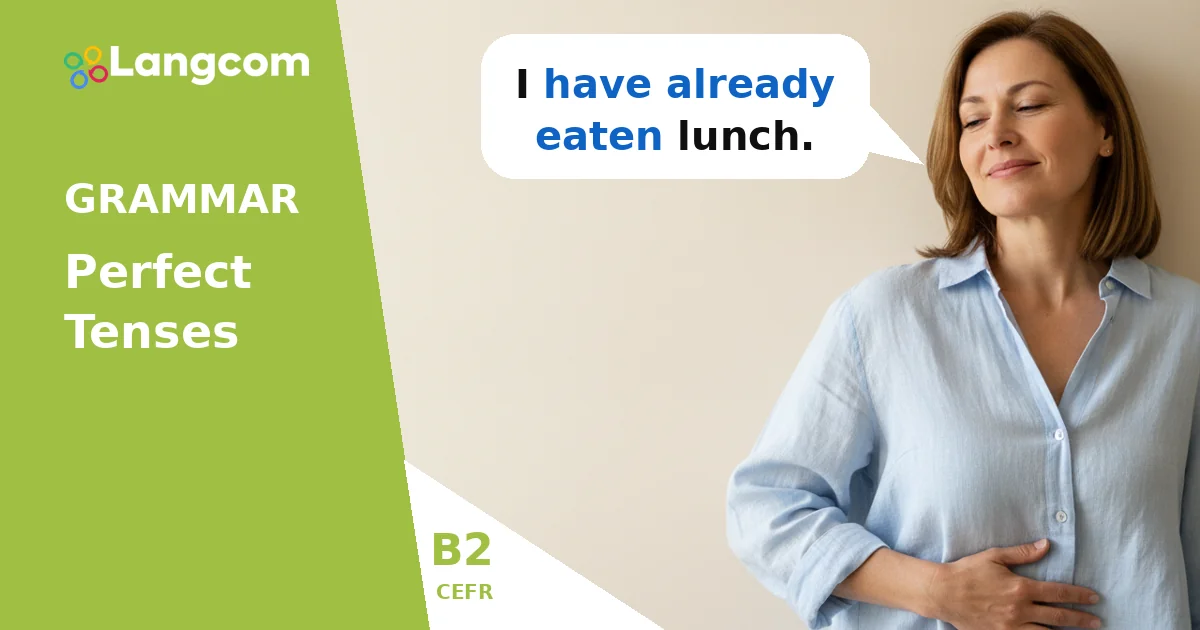

What are Perfect Tenses in English?
Perfect tenses describe actions or states that have a connection between two different points in time. They link a past event to the present, another past event, or a future point.
Unlike simple tenses, which focus on a single action at a specific time, perfect tenses highlight the result, experience, or duration of an action up to another point.
- The basic structure for all perfect tenses is have + past participle.
- The auxiliary verb have changes form to indicate present, past, or future.
✍️ Not sure which level you are?
Take our free placement test and get personalized feedback from certified Cambridge examiners.
Take our FREE Placement TestPresent Perfect Simple vs. Continuous (B2 Review)
The present perfect tense connects the past to the present. It's used for actions that started in the past and are still relevant now.
- Present Perfect Simple: have/has + past participle
We use it for:
- Experiences or actions completed at an unspecified time in the past, with a result in the present: I have visited London three times.
- Actions that started in the past and continue up to the present, often with for or since: She has lived here for ten years.
- Recent actions with a present result: I have finished my homework.
- Present Perfect Continuous: have/has + been + -ing verb
We use it for:
- Actions that started in the past and are still ongoing, emphasizing duration: They have been studying all morning.
- Actions that recently stopped, but their effects are still visible: My eyes are tired because I have been reading.
Past Perfect Simple vs. Continuous (B2 Review)
The past perfect tense describes an action that happened before another action or point in the past. It helps to show the sequence of past events.
- Past Perfect Simple: had + past participle
We use it for:
- An action completed before a specific time or another action in the past: When I arrived, the train had already left.
- To explain why something happened in the past: He was tired because he hadn't slept well.
- Past Perfect Continuous: had + been + -ing verb
We use it for:
- An action that continued for a period up to another point in the past, emphasizing duration: She had been waiting for an hour before he arrived.
- To explain the cause of a past situation: The ground was wet because it had been raining.
Future Perfect Simple vs. Continuous (B2 Review)
The future perfect tense talks about actions that will be completed by a certain time in the future.
- Future Perfect Simple: will have + past participle
We use it for:
- An action that will be finished before a specific point in the future: By next year, I will have saved enough money for a car.
- To express an assumption about something that has probably already happened: They will have arrived by now.
- Future Perfect Continuous: will have + been + -ing verb
We use it for:
- An action that will be ongoing up to a specific point in the future, emphasizing duration: By 5 o'clock, I will have been working for eight hours.
- To talk about the duration of an action leading up to a future event: In June, she will have been teaching for twenty years.
Why are Perfect Tenses Important for B2 First?
At B2 level, especially for the B2 First exam, using perfect tenses correctly shows a higher level of grammatical control.
- They are essential for expressing complex ideas related to time, cause, and effect.
- In the Writing paper, using a variety of tenses, including perfect forms, can improve your score for grammatical range and accuracy.
- In the Speaking paper, you might need to describe past experiences or future plans that involve these tenses naturally. For example, I've been learning English for five years or By the end of my course, I will have improved a lot.
- In the Reading and Use of English paper, you may encounter questions that test your understanding and application of perfect tenses, such as sentence transformations or gap-fill exercises.
| Tense | Form (Simple) | Form (Continuous) | Key Use |
|---|---|---|---|
| Present Perfect | have/has + past participle | have/has been + -ing | Connects past to present; experience, result, or ongoing action. |
| Past Perfect | had + past participle | had been + -ing | Action completed before another past action; duration up to a past point. |
| Future Perfect | will have + past participle | will have been + -ing | Action completed by a future point; duration up to a future point. |
Examples
- I have already eaten lunch.
- She has been waiting for you since 2 PM.
- He had finished his work before the deadline.
- They had been living in Spain for five years when they moved to Italy.
- By the time you wake up, I will have left.
- Next month, we will have been married for twenty years.
Practice
Ready to earn your certificate?
Langcom prepares students for Cambridge, IELTS, TOEFL, DELE, SIELE and Michigan exams.
Get started with LangcomCommon mistakes for Spanish speakers
Spanish speakers often make mistakes with perfect tenses due to direct translation or confusion with similar Spanish structures.
- Using Simple Past instead of Present Perfect: In Spanish, the simple past can sometimes cover situations where English uses the present perfect. For example, saying I went to London three times last year (simple past) instead of I have been to London three times (present perfect) when talking about life experiences up to now.
- Confusing Present Perfect Simple and Continuous: Remember, the continuous form emphasizes duration, while the simple form often focuses on the result or completion. For example, I have read that book (result: I know the story) vs. I have been reading that book (duration: I'm still reading it or just finished).
- Overusing Past Perfect: Sometimes, the past perfect is used when a simple past is sufficient, especially when the sequence of events is clear. Only use past perfect when it's crucial to show one action happened *before* another past action. For example, I ate breakfast, then I went to work (simple past is fine) vs. I went to work after I had eaten breakfast (past perfect clarifies the order).
- Incorrect Auxiliary Verb: Always remember to use have/has/had/will have as the auxiliary verb, not be. For example, I have gone (correct) not I am gone (incorrect for perfect tenses).
Frequently asked questions
What is the main difference between simple and perfect tenses?
Simple tenses focus on the action itself at a specific point in time (e.g., I eat, I ate, I will eat). Perfect tenses connect an action from one point in time to another, emphasizing its completion, experience, or duration (e.g., I have eaten, I had eaten, I will have eaten).
When should I use the present perfect continuous instead of the simple?
Use the present perfect continuous (have/has been + -ing) to emphasize the duration of an action that started in the past and is still continuing or has recently stopped with visible results. Use the present perfect simple (have/has + past participle) for completed actions with a present result, experiences, or states that have continued up to now.
How do perfect tenses appear in the B2 First exam?
Perfect tenses are frequently tested in the B2 First exam. You might find them in the 'Use of English' section (e.g., Part 2: Open Cloze, Part 3: Word Formation, Part 4: Key Word Transformations) where you need to choose the correct tense or transform sentences. They are also crucial for demonstrating accurate grammar in the 'Writing' and 'Speaking' papers.
Can I use 'for' and 'since' with all perfect tenses?
You primarily use for (duration) and since (starting point) with the present perfect simple and continuous. They can also be used with past perfect continuous to show duration up to a point in the past, like She had been studying for three hours when I called.



0 Comments