

What exactly is the /ŋ/ sound in English?
The /ŋ/ sound is a voiced nasal consonant. This means your vocal cords vibrate, and air comes out through your nose.
It is a single sound, not two separate sounds like /n/ followed by /g/. Think of it as the “ng” sound in words like sing or long.
Many languages, including Spanish, do not have an exact equivalent, which can make it challenging for learners.
✍️ Not sure which level you are?
Take our free placement test and get personalized feedback from certified Cambridge examiners.
Take our FREE Placement TestHow do you produce the /ŋ/ sound correctly?
To make the /ŋ/ sound, follow these steps:
- Tongue Position: Raise the very back of your tongue until it touches the soft palate (the soft part at the back of the roof of your mouth).
- Mouth Closure: Keep your lips slightly open, but ensure no air escapes through your mouth.
- Nasal Release: Let the air flow out through your nose. You should feel a vibration in your nose and the back of your throat.
- Vocal Cords: Turn on your voice – it's a voiced sound.
Practice feeling this position and nasal release with words like king, ring, and strong.
What are the common spellings for the /ŋ/ sound?
The /ŋ/ sound is most frequently represented by the letters ng at the end of a word or syllable.
- Examples: sing, song, long, thing, going.
It also appears when the letter n comes before k or g.
- Before k: think, bank, drink, thank. Here, the n is pronounced as /ŋ/.
- Before g: This is more complex. Sometimes it's just /ŋ/, and sometimes it's /ŋg/.
- Just /ŋ/: In words derived from verbs ending in ng, like singer (from sing) or hanger (from hang).
- Both /ŋ/ and /g/: In words where the g is clearly pronounced, such as finger, anger, longer, stronger, language.
How is /ŋ/ different from /n/ and /g/?
Distinguishing /ŋ/ from similar sounds is key for C1 pronunciation.
- From /n/: Both are nasal sounds, but /n/ is made with the front of your tongue touching the alveolar ridge (behind your front teeth). For /ŋ/, the back of your tongue touches the soft palate.
- Compare: sin /sɪn/ vs. sing /sɪŋ/.
- From /g/: Both /ŋ/ and /g/ are made at the back of the mouth. However, /g/ is an oral stop, meaning air is completely blocked and then released through the mouth. /ŋ/ is a nasal sound, with air flowing out through the nose.
- Compare: ran /ræn/ vs. rang /ræŋ/ vs. rag /ræɡ/.
| Word | Pronunciation | Meaning |
|---|---|---|
| sin | /sɪn/ | pecado |
| sing | /sɪŋ/ | cantar |
| ran | /ræn/ | corrió |
| rang | /ræŋ/ | sonó |
| win | /wɪn/ | ganar |
| wing | /wɪŋ/ | ala |
| thin | /θɪn/ | delgado |
| thing | /θɪŋ/ | cosa |
| ban | /bæn/ | prohibir |
| bang | /bæŋ/ | golpe |
Examples
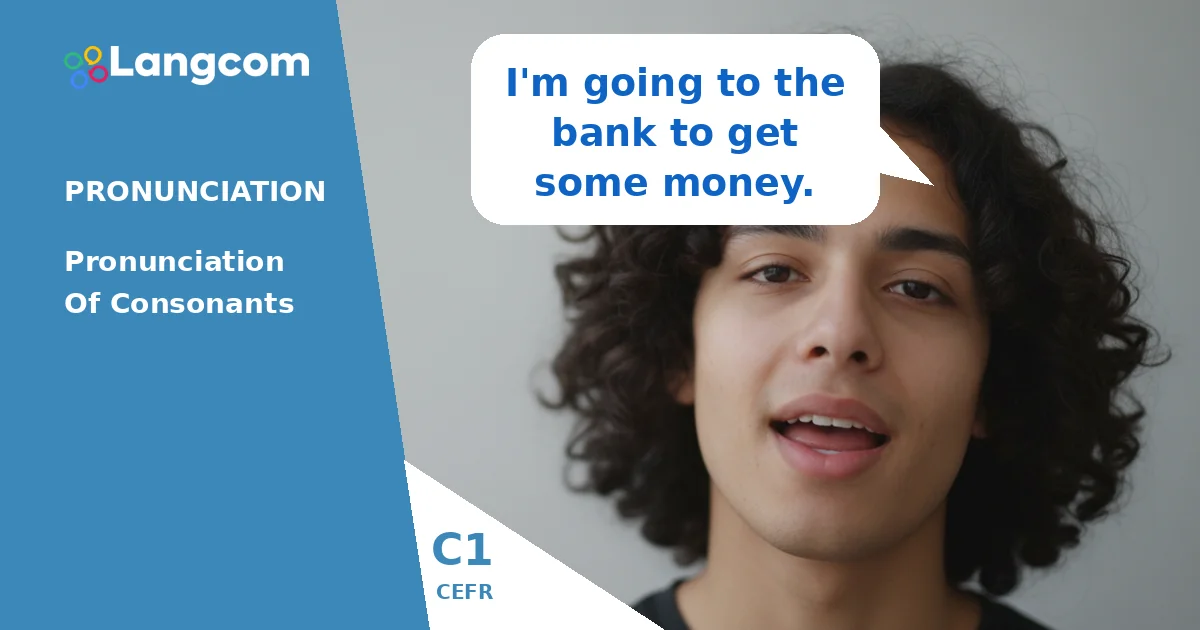
- I'm going to the bank to get some money.
- She loves singing in the shower every morning.
- What a long and interesting story that was!
- He's thinking about changing his career path.
- The strong wind was blowing all night long.
- Do you think this ring is too big for my finger?
- Learning a new language can be challenging but rewarding.
- The singer performed beautifully, captivating the audience.
Practice
Ready to earn your certificate?
Langcom prepares students for Cambridge, IELTS, TOEFL, DELE, SIELE and Michigan exams.
Get started with LangcomCommon mistakes for Spanish speakers
Adding a hard /g/ sound: Many Spanish speakers tend to add a distinct /g/ sound after /ŋ/, especially at the end of words.
- Incorrect: I'm sing-g-ing.
- Correct: I'm singing. (The /g/ is silent here, only /ŋ/ is pronounced).
Confusing /ŋ/ with /n/: Substituting /n/ for /ŋ/ can change the meaning of words.
- Incorrect: I saw a thin. (meaning 'thing')
- Correct: I saw a thing.
Not making it nasal enough: If air escapes through your mouth, it won't sound like /ŋ/. Ensure the air is directed entirely through your nose.
- Focus on the nasal resonance to avoid sounds like sin instead of sing.
Frequently asked questions
Is the /ŋ/ sound always spelled "ng"?
No, while ng is the most common spelling, the /ŋ/ sound also occurs when n comes before k (e.no-translation. think) or sometimes before g (e.no-translation. singer).
How can I practice the /ŋ/ sound effectively?
Listen carefully to native speakers, use minimal pairs (like sin vs. sing), and record yourself to compare your pronunciation. Pay attention to tongue position and nasal airflow.
Are there words where "ng" is pronounced as /nɡ/ (both sounds)?
Yes, in words like finger, anger, longer, and language, both the /ŋ/ and a distinct /g/ sound are pronounced. This is a common point of confusion for C1 learners.
Why is it important to master the /ŋ/ sound at a C1 level?
At C1, accurate pronunciation, including subtle sounds like /ŋ/, significantly enhances clarity, reduces misunderstandings, and contributes to a more native-like accent, which is expected at an advanced level.



0 Comments