

What Are Modals of Deduction?
Modals of deduction are special verbs that help us make guesses or draw conclusions about situations. We use them when we don’t have all the facts but can use evidence to decide how likely something is.
These modals are different from modals of obligation (must for rules) or permission (can for ability). Here, they are about how certain you feel about a situation.
🎓 Learn English with the Blended method
Small groups · 24/7 AI Tutor · Cambridge preparation
Plans from $39 $79 per month
How Do We Use Must for Certainty?
We use must when we are almost 100% sure that something is true. We have strong evidence or a logical reason to believe it.
- Meaning: I am almost certain it is true.
- Certainty Level: High (90-100%)
- Structure: Subject + must + base form of the verb
When Do We Use Might, May, and Could for Possibility?
We use might, may, or could when we think something is possible, but we are not very certain. They all have a similar meaning for deduction.
- Meaning: It is possible; I am not sure.
- Certainty Level: Medium (30-70%)
- Structure: Subject + might/may/could + base form of the verb
May is sometimes considered slightly more formal than might or could, but for deduction, they are often interchangeable.
How Do We Use Can't for Impossibility?
We use can't when we are almost 100% sure that something is NOT true or impossible. We have strong evidence against it.
- Meaning: I am almost certain it is not true or impossible.
- Certainty Level: Very Low (0-10%)
- Structure: Subject + can't + base form of the verb
Summarizing Certainty Levels
Here is a quick summary of the certainty levels for these modals:
- Must: Almost 100% sure it's true.
- Might / May / Could: Possible, but not certain (30-70% sure).
- Can't: Almost 100% sure it's not true or impossible.
| Modal Verb | Meaning (Deduction) | Certainty Level |
|---|---|---|
| Must | Almost certain it is true | High (90-100%) |
| Might / May / Could | It is possible, not certain | Medium (30-70%) |
| Can't | Almost certain it is not true / impossible | Very Low (0-10%) |
Examples
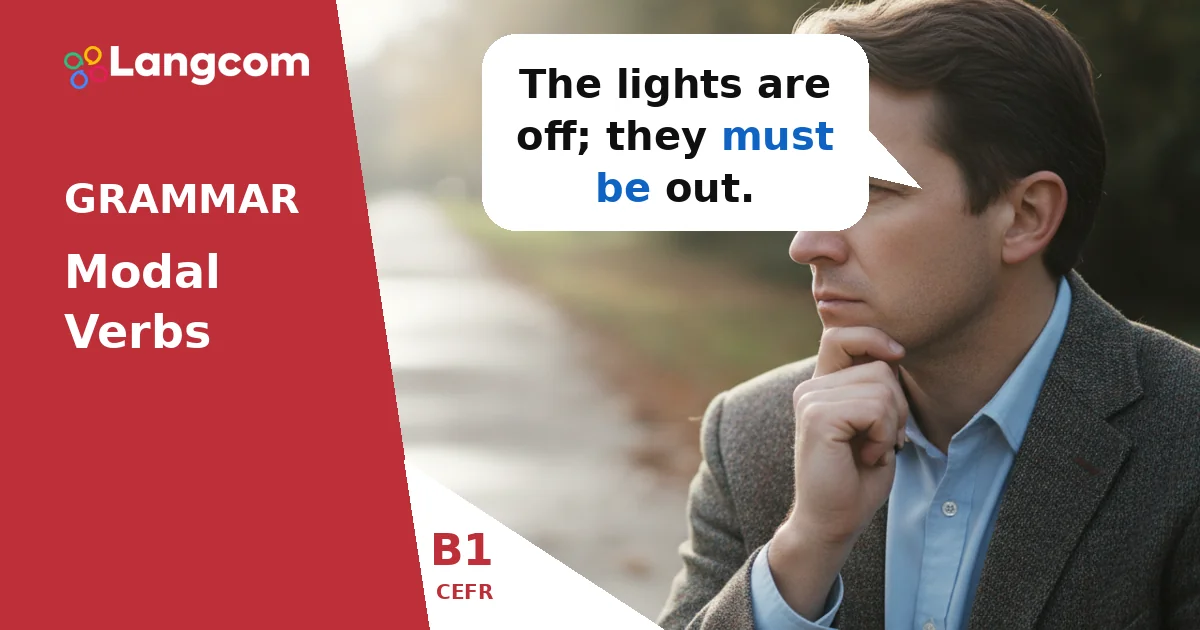
- The lights are off; they must be out.
- She's wearing a coat, so it must be cold outside.
- He hasn't arrived yet; he might be stuck in traffic.
- That could be Maria, but I'm not sure.
- It may rain later, so take an umbrella.
- You just ate; you can't be hungry already!
- That can't be his car; his is red.
Practice
✍️ Not sure which level you are?
Take our free placement test and get personalized feedback from certified Cambridge examiners.
Take our FREE Placement TestCommon mistakes for Spanish speakers
Spanish speakers sometimes make specific mistakes with modals of deduction:
- Confusing must for deduction with must for obligation: In Spanish, 'deber' can mean both. In English, must for deduction means 'I am almost certain', not 'it is necessary'.
Incorrect: You must study hard for the exam. (Obligation)
Correct: She's always reading; she must love books. (Deduction) - Using mustn't for negative deduction: Mustn't means 'it is forbidden' or 'you should not'. For negative deduction (it's impossible), always use can't.
Incorrect: That mustn't be true.
Correct: That can't be true. - Adding maybe before a modal of possibility: This is redundant because the modal already expresses possibility.
Incorrect: Maybe he might come later.
Correct: He might come later.
Frequently asked questions
What is the main difference between might, may, and could for deduction?
For deduction, might, may, and could are very similar and often interchangeable. They all express a possibility. May can be slightly more formal.
Can I use mustn't for negative deductions?
No. Mustn't means prohibition (e.g., You mustn't smoke here.). For negative deductions, meaning something is impossible or certainly not true, you must use can't (e.g., That can't be right.).
What is the difference between must (deduction) and have to?
Must for deduction means you are almost certain something is true based on evidence (e.g., He must be tired.). Have to expresses obligation or necessity (e.g., I have to go now.).


0 Comments