

What Are Modal Verbs?
Modal verbs are a special type of auxiliary (helping) verb. They add extra meaning to the main verb in a sentence.
They express ideas like possibility, ability, permission, obligation, and advice. In this lesson, we focus on can, could, may, and might.
✍️ Not sure which level you are?
Take our free placement test and get personalized feedback from certified Cambridge examiners.
Take our FREE Placement TestHow to Talk About Ability with Can and Could?
We use can to talk about ability in the present. It means "to be able to do something."
- Anna can speak French. (She has the ability now.)
- I can swim very well. (I have this skill.)
For inability in the present, we use can't (or cannot).
- She can't speak Chinese. (She doesn't have this ability.)
- I can't hear you. (I am unable to hear you now.)
To talk about ability in the past, we use could.
- Max could walk when he was one year old. (He had this ability in the past.)
- When I was younger, I could run very fast. (I had this ability then.)
For inability in the past, we use couldn't (or could not).
- He couldn't talk until he was two. (He didn't have this ability until then.)
- I couldn't find my keys yesterday. (I was unable to find them.)
To ask questions about ability, we put can or could before the subject.
- Can Anna speak French?
- Could Max walk when he was one?
How to Express Possibility with May, Might, and Could?
We use may, might, and could to talk about things that are possible in the present or future.
- It might be very hot tomorrow. (There is a possibility.)
- We may go swimming this afternoon. (It's possible we will go.)
- There could be a storm later this evening. (A storm is possible.)
May and might are very similar when expressing possibility. Might often suggests a slightly lower chance of something happening.
It is important NOT to use can for specific future possibilities. For example, do not say It can rain tomorrow if you mean it's possible it will rain. Use It might rain tomorrow instead.
For negative possibilities, we use may not or might not.
- Laura is not feeling well, so she may not go to school today. (It's possible she won't go.)
- You might not win the lottery this week. (It's possible you won't win.)
We do not use can't or couldn't for negative possibility in this way. Can't usually means inability or impossibility.
Note: The short form mightn't is very rare. Mayn't is not used at all.
Asking for Permission: May I or Could I?
When you want to ask for permission politely, you can use May I...? or Could I...?
- May I sit here? (A polite way to ask for permission.)
- Could I borrow your pen for a moment? (Also polite, slightly less formal than May I.)
Can I...? is also used for permission, but it is less formal than May I...? or Could I...?
- Can I go to the party tonight? (Common in informal situations.)
Key Rules for Modal Verbs
Remember these important rules for all modal verbs:
- No -s or -ed: Modal verbs never change their form. You cannot say He cans or They mighted.
- Base Form Verb: They are always followed by the base form of another verb (the infinitive without to). For example, She may come, not She may to come.
- No to before: You don't use to before a modal verb. For example, I want to be able to swim (using 'be able to' as a substitute), not I want to can swim.
| Modal Verb | Main Uses | Example |
|---|---|---|
| Can | Present ability; informal permission; general possibility | I can speak English. Can I sit here? |
| Could | Past ability; polite permission; present/future possibility | I could swim when I was five. Could I help you? It could rain. |
| May | Present/future possibility (stronger); formal permission | She may be late. May I come in? |
| Might | Present/future possibility (weaker/more uncertain) | He might call later. We might not go. |
Examples
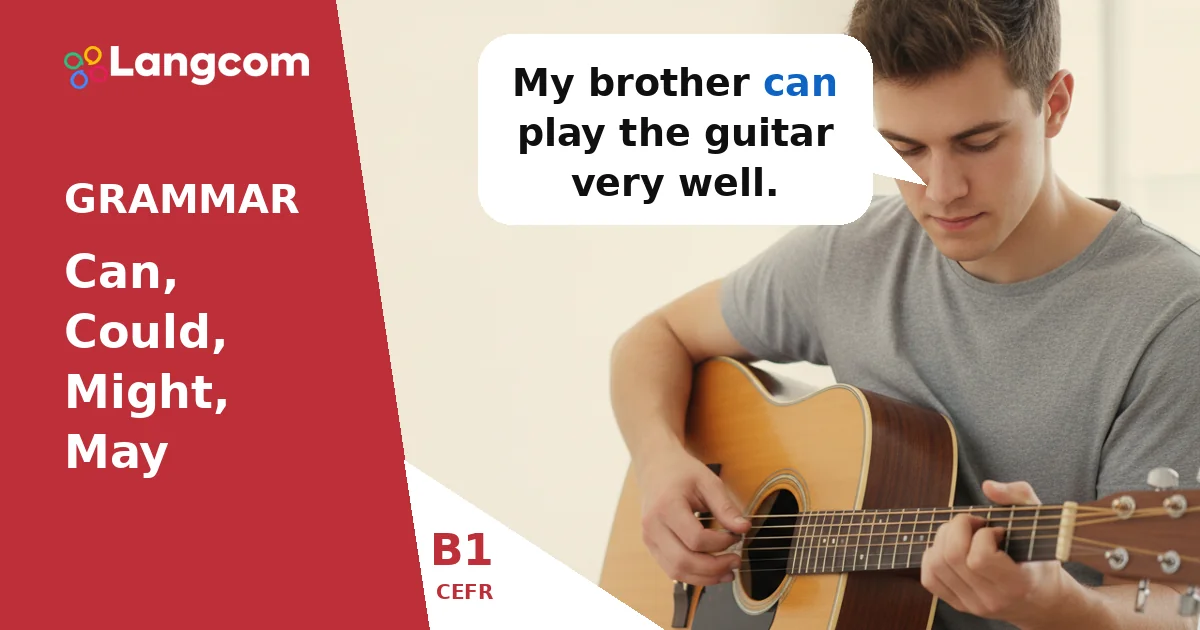
- My brother can play the guitar very well.
- When I was a child, I couldn't reach the top shelf.
- It may rain later, so take an umbrella.
- They might be at home, but I'm not sure.
- Could you please help me with this box?
- May I open the window? It's a bit warm in here.
- I can't understand what he's saying.
- She could speak three languages by the age of ten.
- We might not finish the project on time.
- The train could be delayed due to the snow.
Practice
Ready to earn your certificate?
Langcom prepares students for Cambridge, IELTS, TOEFL, DELE, SIELE and Michigan exams.
Get started with LangcomCommon mistakes for Spanish speakers
Spanish speakers often make these mistakes when using can, could, may, and might:
- Using can for future possibility: In Spanish, "poder" can mean both ability and possibility for the future. In English, use may, might, or could for specific future possibilities.
- Incorrect: It can snow tomorrow.
- Correct: It might snow tomorrow.
- Adding to after the modal verb: Remember that modal verbs are followed by the base form of the verb without to.
- Incorrect: I can to speak English.
- Correct: I can speak English.
- Changing the modal verb form: Modal verbs never change. Do not add -s, -ed, or -ing.
- Incorrect: He cans play football.
- Correct: He can play football.
- Using can't for negative possibility: For "it's possible it won't happen," use may not or might not. Can't usually means impossibility or inability.
- Incorrect: She can't come to the party, maybe.
- Correct: She might not come to the party.
Frequently asked questions
What is the main difference between can and could?
Can is used for present ability (e.g., I can run fast now), while could is used for past ability (e.g., I could run fast when I was young). Could can also express possibility or polite permission in the present/future.
When should I use may instead of might?
Both may and might express possibility. May often suggests a slightly higher chance of something happening, or it can be more formal. Might suggests a weaker or more uncertain possibility. For example, It may rain (50% chance) vs. It might rain (30% chance).
Can I use can for possibility?
Yes, but usually only for general possibilities or things that are sometimes true (e.g., It can get very cold here in winter). For specific possibilities in the present or future, use may, might, or could (e.no-translation>It might be cold tomorrow).
How can understanding these modals help me with the B1 Preliminary exam?
Mastering can, could, may, and might is crucial for the B1 Preliminary exam, especially in the Speaking and Writing parts. You'll need to express your abilities, talk about future plans and possibilities, and ask for permission clearly and correctly. For example, in Speaking Part 2, you might describe what you can or can't do in a picture, or suggest what you could do in a given situation.


0 Comments