

What is the verb ‘be’?
The verb be is one of the most important verbs in English. We use it to talk about who or what someone or something is, where they are, or how they feel.
It changes its form depending on the subject. For he, she, and they, we use specific forms.
🎓 Learn English with the Blended method
Small groups · 24/7 AI Tutor · Cambridge preparation
Plans from $39 $79 per month
How do we use 'is' with 'he' and 'she'?
When you talk about one male person, you use the pronoun he. When you talk about one female person, you use the pronoun she.
- For he and she, the form of be is is.
- We can say He is or She is.
- In spoken English and informal writing, we often use a shorter form called a contraction: he's and she's.
How do we use 'are' with 'they'?
When you talk about two or more people or things, you use the pronoun they.
- For they, the form of be is are.
- We say They are.
- The contraction for they are is they're.
Why are contractions important?
Contractions are very common in everyday English. Native speakers use them all the time when they talk.
- They make your English sound more natural.
- He is and he's mean the same thing.
- She is and she's mean the same thing.
- They are and they're mean the same thing.
| Pronoun | Full Form (+) | Contracted Form (+) |
|---|---|---|
| he | he is | he's |
| she | she is | she's |
| they | they are | they're |
Examples
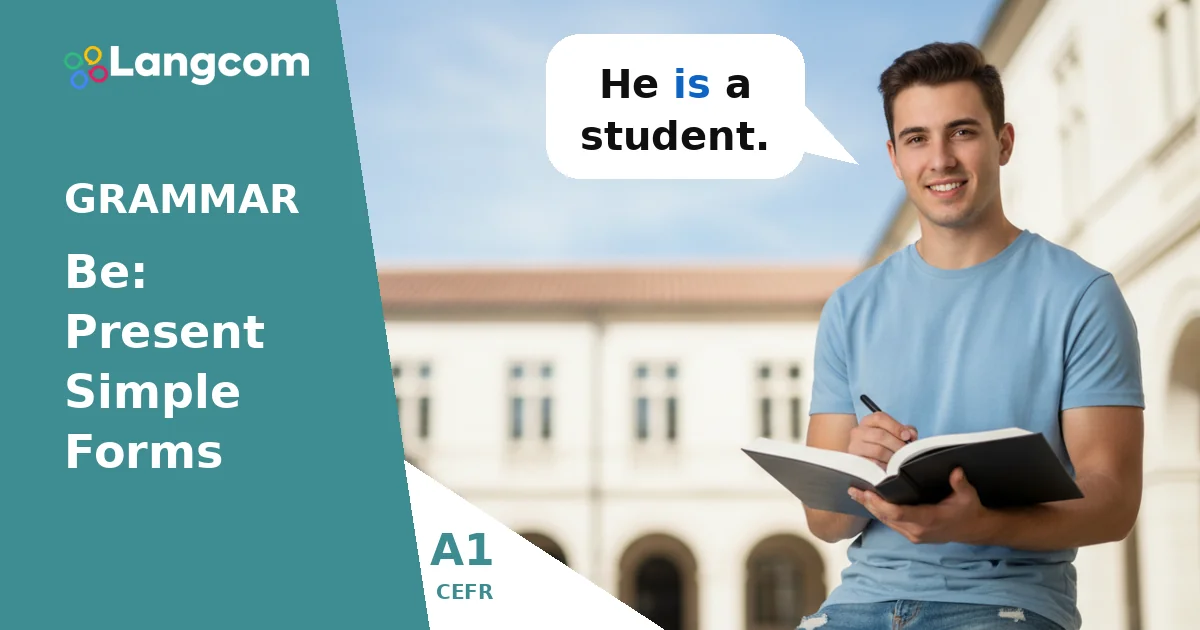
- He is a student.
- She is from Brazil.
- They are happy.
- He's my brother.
- She's at home.
- They're good friends.
- He is tall.
- She is a doctor.
- They are in the park.
Practice
💬 Need personalized guidance?
As an Authorized Cambridge Preparation Centre, we can guide you to the right course and certification. Chat with our advisors today.
Chat with an Advisor on WhatsAppCommon mistakes for Spanish speakers
Many Spanish speakers sometimes forget to use the verb be because in Spanish, you can often omit the subject pronoun and the verb 'ser/estar' is implied. However, in English, the verb be is almost always necessary.
- Incorrect: He happy.
- Correct: He is happy. or He's happy.
Another common mistake is confusing is and are:
- Incorrect: They is friends.
- Correct: They are friends. or They're friends.
Frequently asked questions
What does 'be' mean when we use 'is' or 'are'?
When we use is or are, the verb be helps us describe someone's identity (He is a teacher.), their nationality (She is Spanish.), or their location (They are here.).
Can I use 'it is' with 'be'?
Yes, you can! Just like he is and she is, we use it is (or it's) for a single thing or animal. For example, It is a book.
Is 'he's' always 'he is'?
For A1 English, yes, you can think of he's as he is. Later, you will learn that he's can also mean he has, but for now, focus on he is.
Why is it important to learn 'be' forms correctly?
Learning the correct forms of be is very important because it is a basic building block for almost all English sentences. Using it correctly helps you make clear and understandable sentences right from the start.

0 Comments