

How Do We Talk About Entering and Exiting Vehicles?
English uses different verbs for entering and exiting, depending on the type of vehicle. It’s important to learn these pairs.
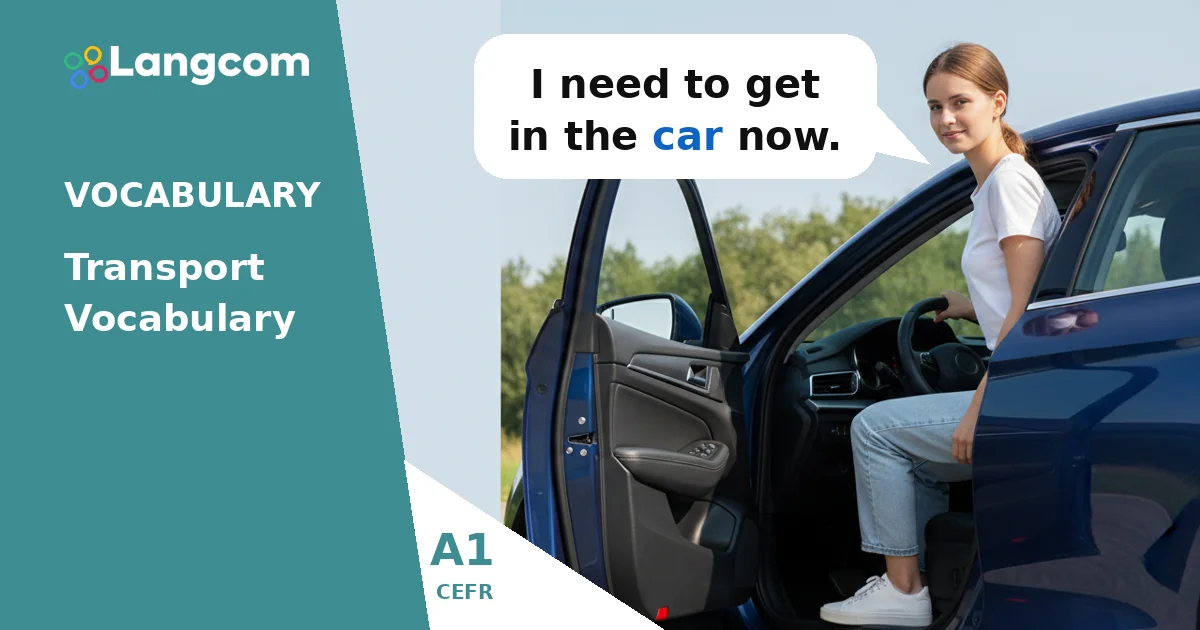
- For small vehicles like cars and taxis, we use get in to enter and get out of to exit.
- For larger vehicles like buses, trains, planes, and ferries, we use get on to enter and get off to exit.
🎓 Learn English with the Blended method
Small groups · 24/7 AI Tutor · Cambridge preparation
Plans from $39 $79 per month
How Do We Talk About Starting and Ending a Journey?
When you travel, there are specific verbs to describe the beginning and end of your trip.
- To talk about catching public transport on time, use catch. If you are late, you miss it.
- For planes, when they leave the ground, they take off. When they return to the ground, they land.
- Generally, when you reach your destination, you arrive at a place. When you leave a place to start a journey, you depart from it.
What About Giving and Receiving Rides?
Sometimes you drive someone somewhere, or someone drives you. We have verbs for these actions too.
- When you go to a place to collect someone in your car, you pick them up.
- When you take someone to their destination in your car, you drop them off.
| Action | Small Vehicles (e.g., Car, Taxi) | Large Vehicles (e.g., Bus, Train, Plane, Ferry) |
|---|---|---|
| Enter | get in | get on |
| Exit | get out of | get off |
Examples
- I need to get in the car now.
- She got out of the taxi quickly.
- Let's get on the bus at the next stop.
- They got off the train in London.
- He always tries to catch the 8 AM train.
- Oh no, I missed my flight!
- The plane will take off in ten minutes.
- Our flight landed safely.
- We will arrive at the hotel around 5 PM.
- The bus departs from platform 3.
- Can you pick me up from work?
- I will drop you off at the station.
Practice
💬 Need personalized guidance?
As an Authorized Cambridge Preparation Centre, we can guide you to the right course and certification. Chat with our advisors today.
Chat with an Advisor on WhatsAppCommon mistakes for Spanish speakers
Confusing get in and get on
Many Spanish speakers might use enter for all vehicles, or confuse get in and get on because Spanish often uses one verb like 'subir' or 'entrar'. Remember the size rule:
- Incorrect: I get on the car.
- Correct: I get in the car.
- Incorrect: I get in the bus.
- Correct: I get on the bus.
Using take instead of catch
While you can take a bus (meaning to use it as transport), catch a bus specifically means to get on it successfully before it leaves. If you are talking about the action of getting it on time, use catch.
- Correct: I need to catch the bus. (Meaning: I need to get on it before it leaves.)
- Correct: I take the bus to work every day. (Meaning: I use the bus for transport.)
Frequently asked questions
Why are there two different verbs for entering/exiting vehicles?
English uses get in/get out of for small vehicles where you usually bend down to enter, like a car or taxi. We use get on/get off for larger vehicles where you can stand up and walk around, like a bus, train, or plane.
Can I use 'take' instead of 'catch' for public transport?
Yes, you can say I take the bus to work to mean you use it regularly. However, catch the bus specifically means to get on a particular bus or train at a specific time, usually implying you need to be on time.
What is the difference between 'arrive at' and 'arrive in'?
We use arrive at for specific places like the station or the airport. We use arrive in for larger places like a city or a country. For example, I arrived at the airport, but I arrived in Paris.




0 Comments