
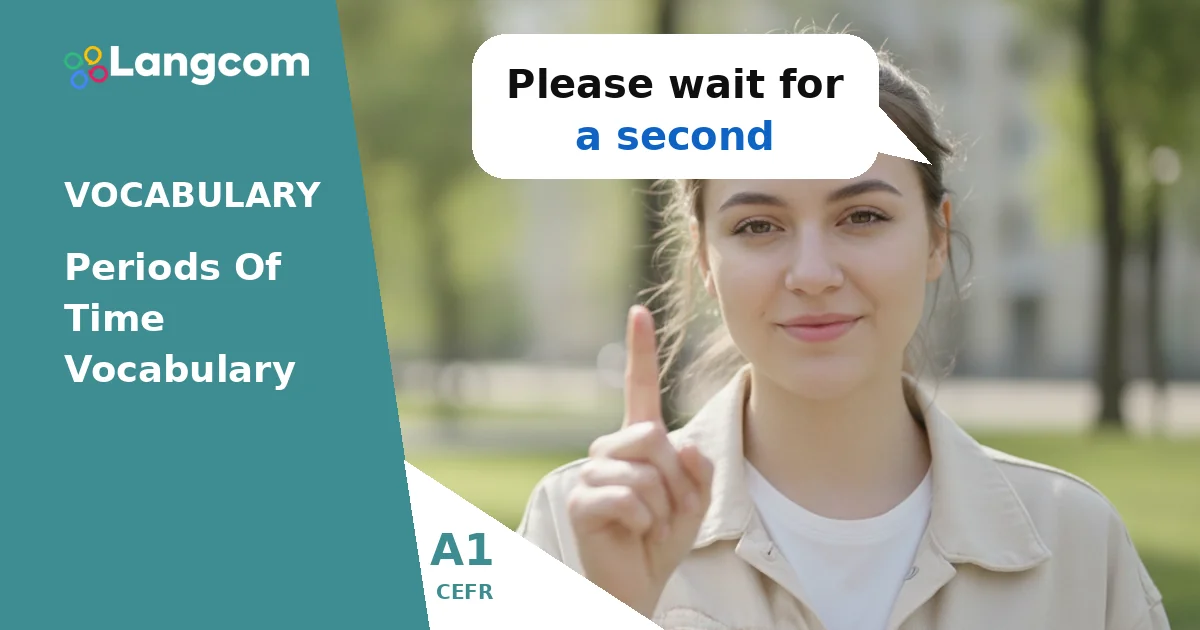

Learning words for periods of time helps you talk about when things happen and how long things last. These words describe different durations, from very short moments like a second to very long ones like a century. Knowing this vocabulary is essential for daily conversations, planning, and understanding schedules in English. For example, you can say I will meet you in an hour or My birthday is next month. This lesson will teach you common words like second, minute, hour, day, week, month, season, year, and century. Using them correctly will make your English communication much clearer and more natural, helping you express yourself confidently in many situations.
What are Periods of Time?
“Periods of time” are words we use to measure how long something is or when something happens.
They help us understand and talk about different durations, from very short to very long.
🎓 Learn English with the Blended method
Small groups · 24/7 AI Tutor · Cambridge preparation
Plans from $39 $79 per month
How Do We Measure Short Periods?
These words describe very quick moments or short durations:
- A second is a very, very short moment.
- There are 60 seconds in one minute.
- A minute is 60 seconds long.
- There are 60 minutes in one hour.
- An hour is 60 minutes long.
- There are 24 hours in one day.
How Do We Measure Medium Periods?
These words describe durations that are longer than an hour but shorter than a year:
- A day is 24 hours long.
- There are 7 days in one week.
- A week is 7 days long.
- A fortnight is two weeks, or 14 days.
- A month is about four weeks long.
- There are 12 months in one year.
- A season is a part of a year.
- There are four seasons: spring, summer, autumn (or fall), and winter.
How Do We Measure Long Periods?
These words describe very long durations:
- A year is 12 months long.
- A century is 100 years long.
Why is this vocabulary important?
Knowing these words helps you talk about many things in English.
- You can make plans: Let's meet next week.
- You can talk about your schedule: My class is for one hour.
- You can understand history: This building is from the last century.
This vocabulary is very useful for daily life and understanding conversations.
| English Word | How Long Is It? |
|---|---|
| Second | A very short moment |
| Minute | 60 seconds |
| Hour | 60 minutes |
| Day | 24 hours |
| Week | 7 days |
| Fortnight | 2 weeks (14 days) |
| Month | About 4 weeks |
| Season | Part of a year (e.g., Summer) |
| Year | 12 months |
| Century | 100 years |
Examples
- Please wait for a second.
- The movie starts in ten minutes.
- I work eight hours a day.
- We have a meeting every week.
- My vacation lasted a fortnight.
- She was born in January, the first month of the year.
- Summer is my favorite season.
- This building is over a century old.
Practice
💬 Need personalized guidance?
As an Authorized Cambridge Preparation Centre, we can guide you to the right course and certification. Chat with our advisors today.
Chat with an Advisor on WhatsAppCommon mistakes for Spanish speakers
Spanish speakers sometimes confuse hour and time.
-
Incorrect: What time is the class? It is one hour.
Correct: What time is the class? It is at one o'clock. (for the specific moment) OR The class is one hour long. (for the duration)
-
Also, be careful when talking about age.
Incorrect: I have 20 years.
Correct: I am 20 years old.
Frequently asked questions
What is the shortest period of time we learned?
The shortest period of time we learned is a second.
What is a fortnight?
A fortnight is a period of two weeks, which is 14 days.
How many years are in a century?
There are 100 years in a century.



0 Comments