

What are Some and Any?
Some and any are words that tell us about quantity. They mean ‘an unspecified amount’ or ‘a few’.
We use them with nouns to show if there is a quantity of something.
- They work with plural countable nouns (things you can count, like ‘apples’, ‘friends’).
- They also work with uncountable nouns (things you cannot count, like ‘water’, ‘money’).
[langcom_cta variant=”blended”]
When do we use Some?
We use some mainly in positive sentences. This means we are saying that something exists or that we have a quantity of it.
- Positive sentences: To say that a quantity exists. For example, There are some students in the class.
- Offers and requests: In questions when we offer something or ask for something politely. For example, Would you like some tea? or Could I have some water, please?
When do we use Any?
We use any in negative sentences and most questions. It often means ‘zero’ or ‘not one’.
- Negative sentences: To say that a quantity does not exist. For example, I don’t have any brothers.
- Questions: To ask if a quantity exists. For example, Do you have any questions?
- With ‘hardly’, ‘scarcely’, ‘barely’: These words have a negative meaning, so we use any. For example, There’s hardly any food left.
| Word | Type of Sentence | Example |
|---|---|---|
| Some | Positive sentences | I have some friends. |
| Some | Offers/Polite requests (questions) | Would you like some cake? |
| Any | Negative sentences | I don’t have any money. |
| Any | Questions | Do you have any pets? |
Examples
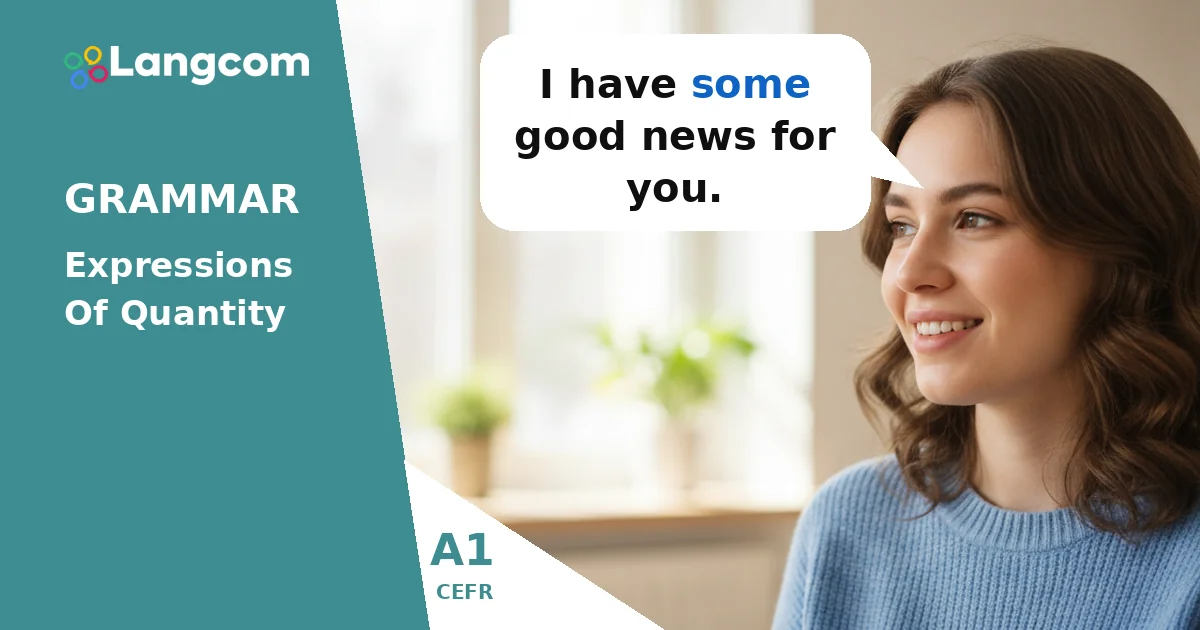
- I have some good news for you.
- There is some milk in the fridge.
- She bought some new clothes yesterday.
- We don’t have any sugar.
- Are there any problems?
- He didn’t eat any breakfast this morning.
- Do you need any help?
- Would you like some more coffee?
- Could I borrow some money?
Practice
[langcom_cta variant=”whatsapp”]
Common mistakes for Spanish speakers
Spanish speakers often make these mistakes:
- Using some in negative sentences: In Spanish, you might say “No tengo algunos libros.” But in English, you must use any.
❌ I don’t have some books.
✅ I don’t have any books. - Using any in positive sentences (unless it means ‘it doesn’t matter which’):
❌ I want any water.
✅ I want some water.
The exception is when any means ‘it doesn’t matter which’, like You can choose any book you like. (But this is more B1/B2 level.) - Forgetting to use any in questions:
❌ Do you have some questions? (Only if you expect ‘yes’ or are offering)
✅ Do you have any questions? (General question)
Frequently asked questions
Can I use some and any with singular nouns?
No, you cannot. Some and any are used with plural countable nouns (e.g., some apples) or with uncountable nouns (e.g., some water). For singular countable nouns, we use ‘a’ or ‘an’.
Are there exceptions to the rule of using some in positive sentences and any in questions?
Yes, there is one common exception for some. We use some in questions when we are offering something or making a polite request, and we expect a ‘yes’ answer. For example, Would you like some coffee? or Could I have some help?
What is the main difference between some and any?
The main difference is the type of sentence they appear in. Some is generally for positive statements, while any is for negative statements and most questions. Think of some as ‘a quantity exists’ and any as ‘no quantity exists’ or ‘is there a quantity?’

0 Comments