
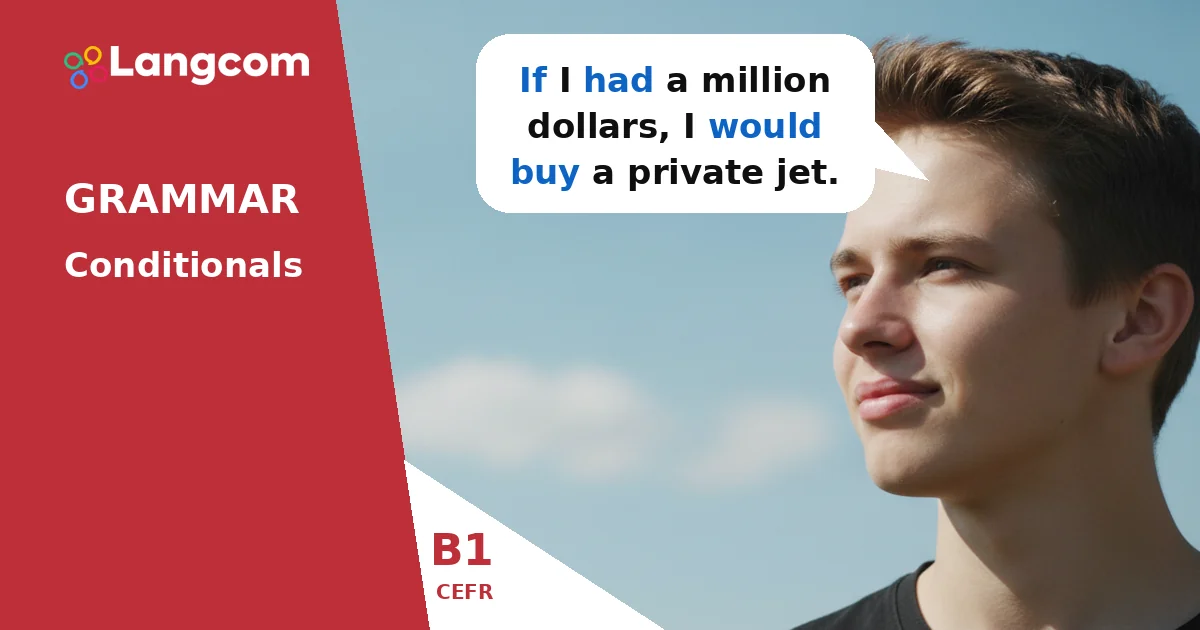

What are Second Conditionals?
We use second conditionals to talk about things that are not real now, or things that are very unlikely to happen in the future.
- They describe an imaginary situation and its imaginary result.
- Think of them as ‘what if’ sentences for dreams, wishes, or unlikely events.
🎓 Learn English with the Blended method
Small groups · 24/7 AI Tutor · Cambridge preparation
Plans from $39 $79 per month
How Do We Form Second Conditionals?
The second conditional has two main parts:
- The if-clause: This part describes the imaginary condition. We use the past simple tense here.
- The main clause: This part describes the imaginary result. We use would, could, or might followed by the base form of the verb (infinitive without 'to').
You can put the if-clause first or second. If the if-clause comes first, use a comma before the main clause.
When Do We Use Second Conditionals?
Second conditionals are useful in several situations:
- Imaginary Present Situations: To talk about things that are not true right now. For example, If I were taller, I would play basketball. (I am not tall.)
- Unlikely Future Events: To discuss things that probably won't happen. For example, If I won the lottery, I would travel the world. (Winning the lottery is unlikely.)
- Giving Advice: We often use the phrase If I were you... to offer advice. For example, If I were you, I would study more.
- Expressing Possibility: You can use could or might instead of would to show a different level of possibility in the result. For example, If I had more money, I might buy a new car. (It's possible, but not definite.)
Can I Use 'Were' for All Subjects?
Yes! In second conditional sentences, it is very common and often preferred to use were for all subjects, even I, he, she, and it.
- This special use of were emphasizes the imaginary nature of the situation.
- For example, If I were rich, I would buy an island. (Not If I was rich...)
- While was is sometimes used informally, were is always correct and sounds more formal.
| If-clause (Condition) | Main Clause (Result) |
|---|---|
| If + past simple | would / could / might + base verb |
| If I had more money, | I would buy a new car. |
| If she were here, | she could help us. |
| If they studied harder, | they might pass the exam. |
Examples
- If I had a million dollars, I would buy a private jet.
- She would be happier if she lived closer to her family.
- If it weren't raining, we could go for a walk.
- What would you do if you saw a ghost?
- If I were you, I wouldn't tell him the secret.
- They might travel more if they had more vacation time.
Practice
✍️ Not sure which level you are?
Take our free placement test and get personalized feedback from certified Cambridge examiners.
Take our FREE Placement TestCommon mistakes for Spanish speakers
Spanish speakers sometimes make specific errors with second conditionals:
- Using 'would' in the 'if-clause': A common mistake is to say If I would have more time, I would learn French. Remember, the if-clause uses the past simple: If I had more time, I would learn French.
- Using present tense in the 'if-clause' for unreal situations: You might say If I have more money, I would buy a new car. This is incorrect for an imaginary situation. The correct form is If I had more money, I would buy a new car.
- Not using 'were' for all subjects: While If I was... is sometimes heard, it's generally better to use If I were... for imaginary situations. For example, If he were here, he would help us. (Not If he was here...)
Frequently asked questions
What is the main difference between first and second conditionals?
The main difference is about likelihood. First conditionals talk about real or very likely future events (If it rains, I will stay home.). Second conditionals talk about imaginary, unreal, or very unlikely situations in the present or future (If it rained, I would stay home. – but it's not raining).
Can I use 'could' or 'might' instead of 'would' in second conditionals?
Yes, you can! Using could or might instead of would in the main clause expresses possibility rather than a definite outcome. For example, If I had more time, I might visit my friends.
Is 'If I was' correct in a second conditional?
While you might hear If I was... in informal speech, the grammatically preferred and more formal option for all subjects in second conditionals is If I were..., as in If I were you, I would take that job.
Can the 'if-clause' come second in the sentence?
Yes, absolutely! The order of the clauses does not change the meaning. If the main clause comes first, you do not need a comma. For example, I would travel the world if I won the lottery.

0 Comments