

What is the First Conditional?
The First Conditional is a grammar structure we use to talk about things that are possible in the future. It connects a condition (something that might happen) with a likely result.
It is not 100% certain that the condition will happen, but there is a real chance. If the condition is met, then the result is probable.
- If you study hard, you will pass the exam. (Studying hard makes passing the exam a real possibility.)
✍️ Not sure which level you are?
Take our free placement test and get personalized feedback from certified Cambridge examiners.
Take our FREE Placement TestHow Do We Form the First Conditional?
The First Conditional has two main parts: the 'if' clause and the main clause. We use different verb tenses in each part.
- The 'if' clause (the condition): This part starts with If and uses the present simple tense. For example: If I have time..., If she studies...
- The main clause (the result): This part uses will (or won't for negative) followed by the base form of the verb. For example: ...I will help you., ...she will pass.
You can put the 'if' clause first or second:
- When the 'if' clause comes first, we use a comma: If it's sunny, we'll go to the park.
- When the main clause comes first, we do not use a comma: We'll go to the park if it's sunny.
When Do We Use the First Conditional?
We use the First Conditional in many everyday situations to talk about future possibilities:
- To talk about future plans or decisions:
If I finish work early, I will go to the gym. - To make predictions about the future:
If the weather is good, the party will be fun. - To give warnings or threats:
If you don't hurry, you will miss the bus. - To make promises:
If you help me, I will buy you a coffee.
Can We Use Other Words Instead of 'Will'?
Yes, sometimes we can use other modal verbs in the main clause instead of will to express different meanings:
- Use can to talk about ability or possibility:
If you need help, I can assist you. - Use may or might to talk about less certain possibilities:
If it rains, we might stay inside. - Use should to give advice:
If you feel sick, you should see a doctor.
| Condition (If-clause) | Result (Main clause) |
|---|---|
| If + Present Simple | will/won't + Base Verb |
| If I study hard, | I will pass the exam. |
| If she doesn't hurry, | she will miss the train. |
Examples
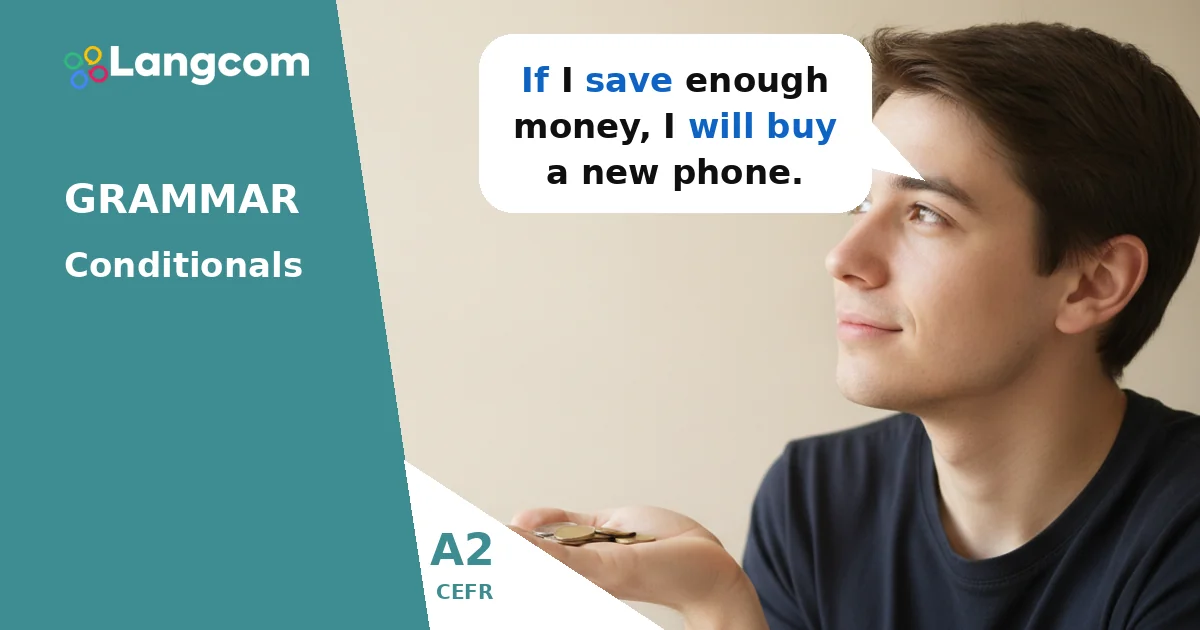
- If I save enough money, I will buy a new phone.
- She will be happy if you visit her.
- If it snows tomorrow, schools will close.
- They won't win the game if they don't practice.
- If you touch that, you might get a shock.
- We can go to the beach if the sun shines.
Practice
Ready to earn your certificate?
Langcom prepares students for Cambridge, IELTS, TOEFL, DELE, SIELE and Michigan exams.
Get started with LangcomCommon mistakes for Spanish speakers
Spanish speakers sometimes make specific mistakes with the First Conditional:
- Using 'will' in the 'if' clause: In Spanish, you might use a future tense after 'si' (if). However, in English, the 'if' clause always uses the present simple for future conditions.
- Incorrect: If it will rain, I will stay home.
- Correct: If it rains, I will stay home.
- Forgetting the comma: When the 'if' clause comes first, a comma is needed to separate the two parts of the sentence. This is a common punctuation error.
- Incorrect: If I study I will pass.
- Correct: If I study, I will pass.
Frequently asked questions
What is the First Conditional for?
It's for talking about things that are possible in the future. It connects a condition to a likely result. For example, If I work hard, I will get a promotion.
What is the structure of the First Conditional?
The structure is If + present simple in the first part (the condition), and will + base verb in the second part (the result).
Can I use 'will' in the 'if' part of the sentence?
No, you cannot use will in the if clause. Always use the present simple for the condition. For example, say If it rains, not If it will rain.
Is the comma important in First Conditional sentences?
Yes, if the if clause comes first, you need a comma before the main clause. For example, If you are hungry, I will make a sandwich. If the main clause comes first, no comma is needed: I will make a sandwich if you are hungry.
How is the First Conditional useful for the A2 Key (KET) exam?
The First Conditional is common in the A2 Key exam, especially in Reading and Writing parts. You might need to understand sentences with it or use it to complete sentences, showing you can discuss future possibilities and their outcomes.

0 Comments