
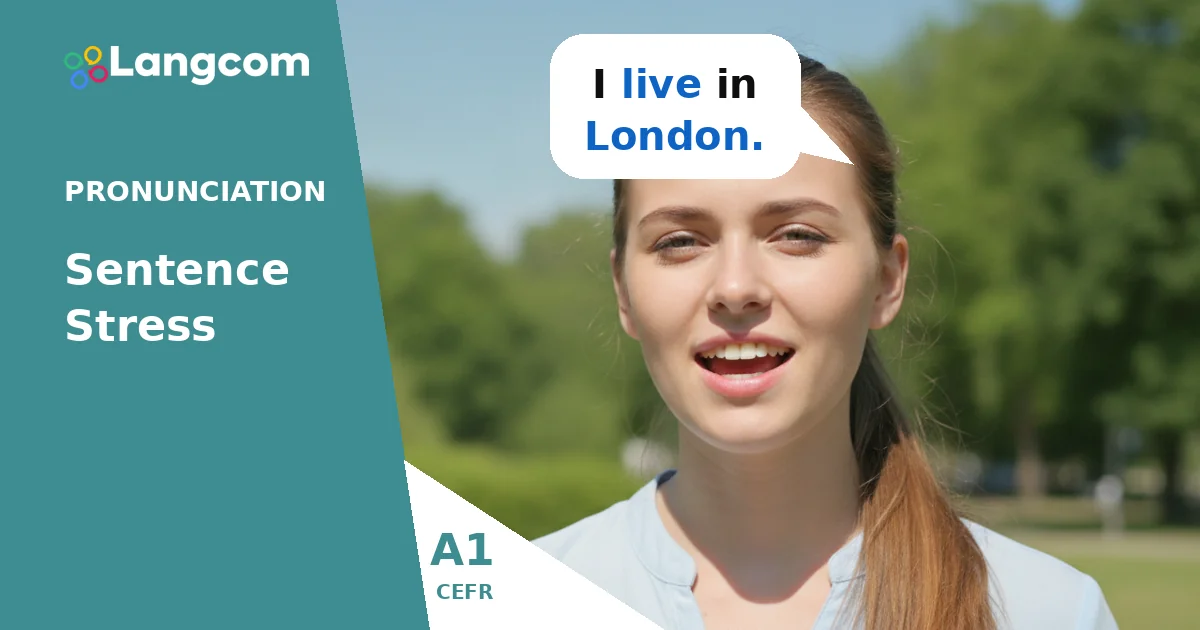

What is Sentence Stress?
Sentence stress is a key part of English pronunciation. It means that in every sentence, some words are more important than others. We say these important words with more emphasis.
- When you stress a word, your voice goes a little higher.
- You say the word a little louder.
- You also say the word a little longer.
This creates a natural rhythm in English speech.
🎓 Learn English with the Blended method
Small groups · 24/7 AI Tutor · Cambridge preparation
Plans from $39 $79 per month
Why is Sentence Stress Important?
Using sentence stress correctly helps you communicate better. It makes your English easier to understand for other people.
- Clarity: It helps listeners hear the most important information in your sentence.
- Meaning: Sometimes, changing the stress can even change the meaning of your sentence!
- Natural Sound: Your English will sound more natural and fluent, like a native speaker.
How to Use Sentence Stress in A1 English
At the A1 level, focus on stressing the 'content words'. These are the words that carry the main meaning of your sentence.
- Nouns: words for people, places, things (e.g., teacher, house, book)
- Main Verbs: action words (e.g., eat, sleep, go)
- Adjectives: words that describe nouns (e.g., big, happy, new)
- Adverbs: words that describe verbs or adjectives (e.g., quickly, very, always)
Words that are usually *not* stressed are called 'function words'. These include:
- Articles (e.g., a, an, the)
- Prepositions (e.g., in, on, at)
- Pronouns (e.g., I, you, he)
- Auxiliary verbs (e.g., is, are, do)
Listen and Repeat to Improve Your Stress
The best way to learn sentence stress is to listen carefully to native speakers and then try to copy them. Pay attention to which words they make stronger.
- Listen to English songs, movies, and podcasts.
- Try to identify the stressed words.
- Practice saying sentences aloud, focusing on the rhythm.
Don't worry about being perfect at first. Just try to make the important words stand out.
Examples
- I live in London.
- She is a good student.
- We want some coffee.
- He works very hard.
- Where is the station?
Practice
💬 Need personalized guidance?
As an Authorized Cambridge Preparation Centre, we can guide you to the right course and certification. Chat with our advisors today.
Chat with an Advisor on WhatsAppCommon mistakes for Spanish speakers
Many Spanish speakers tend to stress all words or syllables almost equally. This can make English sound flat and sometimes difficult for native speakers to understand. English needs its rhythm!
- Mistake: I want to go home. (stressing 'to' and 'go' too much)
- Correct: I want to go home. (stressing 'go' and 'home')
- Mistake: She is a teacher. (stressing 'is' and 'a')
- Correct: She is a teacher. (stressing 'teacher')
Remember to make the content words stand out more than the function words.
Frequently asked questions
What is a 'stressed' word in English?
A stressed word is a word that you say louder, longer, and with a slightly higher pitch than other words in the same sentence. It carries important meaning.
Why do we stress certain words?
We stress certain words to highlight the most important information in a sentence. This helps listeners understand your message clearly and makes your speech sound natural.
Can sentence stress change the meaning?
Yes, sometimes! For example, I didn't say that. means 'It was not me.' But I didn't say that. means 'I said something else.' At A1, focus on basic content word stress.
Is sentence stress important for English exams?
Yes, good pronunciation, including sentence stress, is important for the speaking part of many English exams. It helps you communicate clearly and score better on fluency and pronunciation criteria.



0 Comments