

What Are Different Types of Houses in English?
English uses specific words to describe various kinds of homes. These terms help us understand the structure and location of a dwelling.
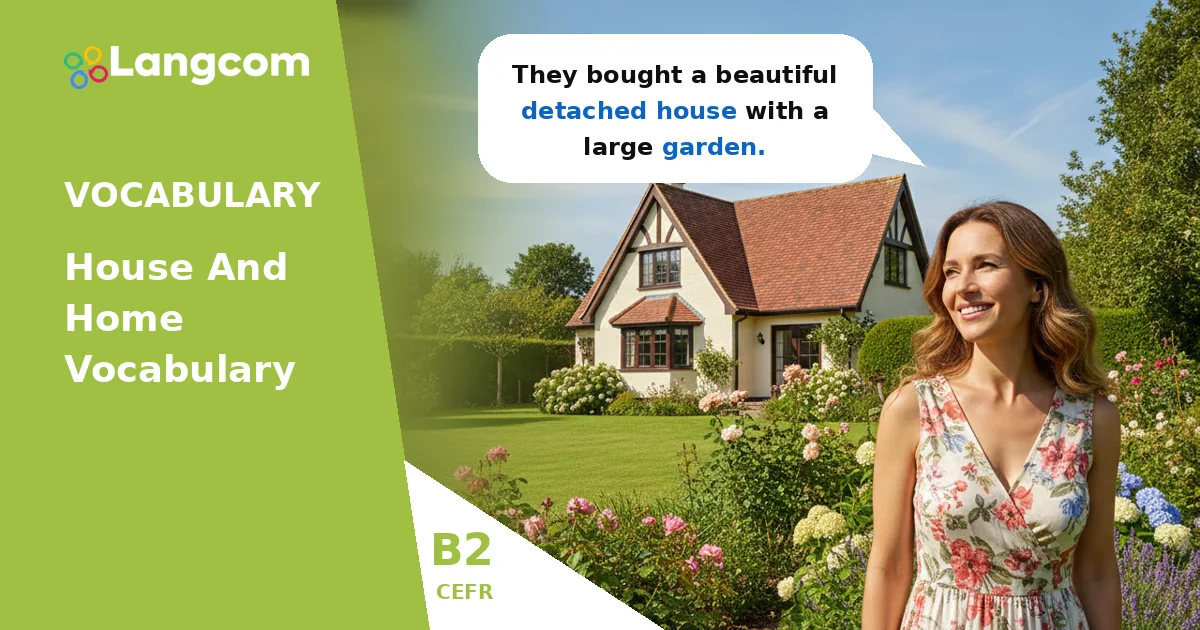
- A detached house is a single house that stands alone. It does not share any walls with other buildings.
- A semi-detached house shares one common wall with another house. It is like two houses joined together.
- A terraced house (also called a row house in American English) is one of a row of identical houses joined together by their side walls.
- A bungalow is a house that has only one floor. All the rooms are on the ground level.
- A cottage is a small, often old-fashioned house, typically found in the countryside or a small village.
✍️ Not sure which level you are?
Take our free placement test and get personalized feedback from certified Cambridge examiners.
Take our FREE Placement TestWhat Are Key Parts of a House and Property?
Beyond the type of house, it is useful to know the names for different areas and features of a home and its surrounding property.
- An attic is the space or room directly under the roof of a house. People often use it for storage.
- A cellar is an underground room, usually used for storing food, wine, or other items. A basement is also an underground floor, but it can be used as a living space, like extra bedrooms or a family room.
- A chimney is a vertical pipe or structure that carries smoke and gases from a fireplace or furnace up through the roof and into the air.
- A fence is a barrier, usually made of wood, wire, or metal, that encloses an area of land, such as a garden or field.
- A passage is a narrow way or corridor that connects different rooms or areas within a building.
- A terrace can refer to a paved outdoor area next to a house, often used for sitting or dining. It can also refer to a row of terraced houses.
Why Is Specific House Vocabulary Important for B2 English?
At B2 level, you need to express yourself with greater precision. Using the correct vocabulary for houses and their parts shows a higher level of English proficiency.
- It helps you understand property descriptions, news articles, and conversations about housing.
- It allows you to describe your own home or ideal living situation accurately and effectively.
- Knowing these terms is essential for tasks like renting or buying property, or simply discussing daily life.
| Type of House | Description |
|---|---|
| Detached house | Stands alone, not connected to other buildings. |
| Semi-detached house | Connected to one other house on one side. |
| Terraced house | One of a row of identical houses joined by side walls. |
| Bungalow | A house with only one floor. |
| Cottage | A small, often old-fashioned house, usually in the countryside. |
Examples
- They bought a beautiful detached house with a large garden.
- Our new semi-detached house has a small patio.
- Many terraced houses in the city centre were built in the 19th century.
- My grandparents prefer living in a bungalow because there are no stairs.
- We rented a charming cottage by the lake for our holiday.
- We keep old photos and boxes in the attic.
- The house has a small cellar perfect for storing wine.
- They converted their basement into a home cinema.
- Smoke was rising from the chimney on a cold morning.
- Our neighbours built a new fence between our gardens.
- The long passage led to the bedrooms at the back of the house.
- We enjoyed breakfast on the sunny terrace.
- The old terrace of houses needed renovation.
Practice
Ready to earn your certificate?
Langcom prepares students for Cambridge, IELTS, TOEFL, DELE, SIELE and Michigan exams.
Get started with LangcomCommon mistakes for Spanish speakers
Spanish speakers sometimes use the general word casa for any type of dwelling. However, English requires more specific terms.
- Using house too generally:
- Incorrect: I live in a house with one floor.
- Correct: I live in a bungalow.
- Confusing cellar and basement: While both are underground, remember a basement is often designed for living, while a cellar is more for storage.
- Incorrect: We have a cellar with a TV and sofa.
- Correct: We have a basement with a TV and sofa.
- Misunderstanding terrace: Be careful with terrace. It can be an outdoor area or refer to a type of house (terraced house).
- Incorrect: I live in a terrace.
- Correct: I live in a terraced house.
Frequently asked questions
What is the difference between a detached and a semi-detached house?
A detached house stands alone and does not share any walls with other buildings. A semi-detached house shares one wall with another house.
Can I use cellar and basement interchangeably?
Not always. A cellar is typically for storage, often cooler and darker. A basement is usually a more finished space, often used for living, like an extra bedroom or family room.
What is a bungalow?
A bungalow is a house that has only one floor. All the main living areas are on the ground level, making it accessible without stairs.
What does terraced mean in relation to houses?
A terraced house is one of a row of identical houses that are joined together by their side walls. They are common in older city areas.
Why is this vocabulary important for B2 level English?
At B2 level, you need to communicate with greater accuracy and detail. Using specific terms like detached, attic, or chimney allows you to describe homes precisely, enhancing your understanding and expression in various contexts, from property discussions to literature.




0 Comments