
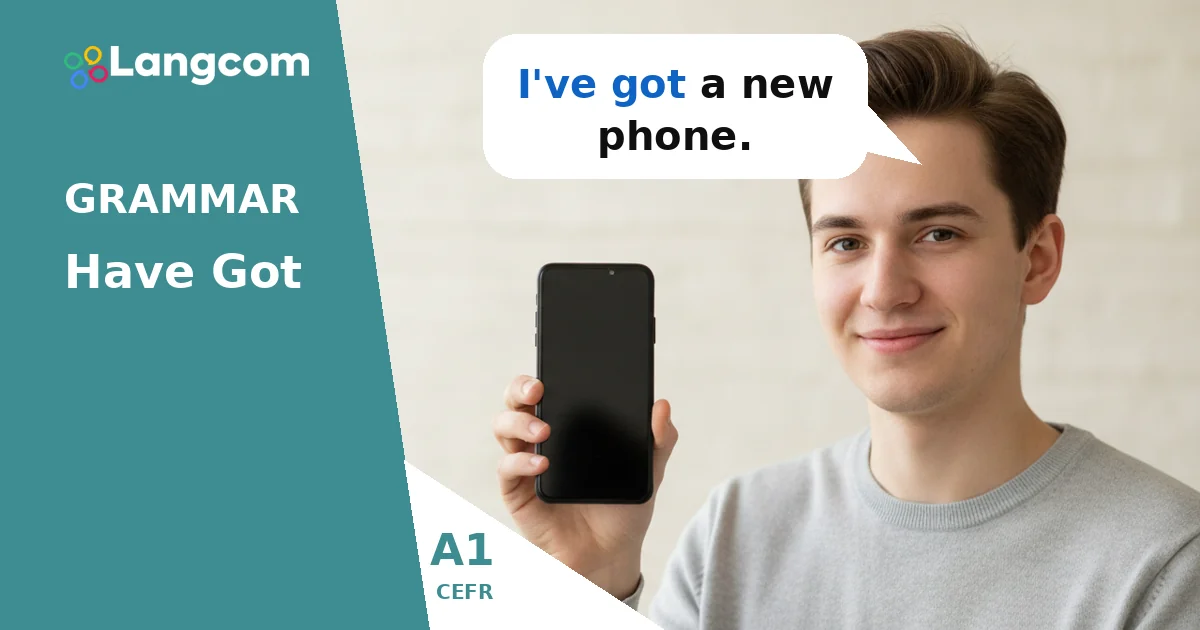

What does ‘Have Got’ mean?
Have got is a common way to express possession in English. It means to own something, to have a relationship, or to have a particular characteristic.
It is very popular in everyday conversations. You will hear it often when native speakers talk about things they own or people in their family.
🎓 Englisch lernen mit der Blended-Methode
Kleingruppen · KI-Tutor rund um die Uhr · Vorbereitung auf die Cambridge-Prüfungen
Pläne von $39 $79 pro Monat
How do we form positive sentences with 'Have Got'?
To make a positive sentence with have got, we use the subject, then have oder has, and then got.
- Für I, You, We, They, wir verwenden have got.
- Für He, She, It, wir verwenden has got.
We often use short forms in speaking and informal writing:
- I have got wird zu I've got.
- He has got wird zu He's got.
How do we form negative sentences with 'Have Got'?
To make a negative sentence, we add not between have/has und got.
- Für I, You, We, They, wir verwenden have not got.
- Für He, She, It, wir verwenden has not got.
The short forms are very common:
- I have not got wird zu I haven't got.
- He has not got wird zu He hasn't got.
How do we ask questions with 'Have Got'?
To ask a question, we put Have oder Has before the subject.
- Have I got...?
- Has he got...?
Für kurze Antworten verwenden wir Yes, I have. oder No, I haven't. (without got).
When do we use 'Have Got'?
Wir verwenden have got for several situations:
- Possession: To say what you own.
- Relationships: To talk about family or friends.
- Characteristics: To describe what someone or something looks like.
- Illnesses: To talk about health problems.
Remember, have got is very similar to just have for these meanings. Both are correct, but have got is often preferred in informal English.
| Betreff | Positive (+) | Negative (-) | Question (?) |
|---|---|---|---|
| I | I've got | I haven't got | Have I got...? |
| You | You've got | You haven't got | Have you got...? |
| He | He's got | He hasn't got | Has he got...? |
| She | She's got | She hasn't got | Has she got...? |
| It | It's got | It hasn't got | Has it got...? |
| We | We've got | We haven't got | Have we got...? |
| They | They've got | They haven't got | Have they got...? |
Beispiele
- I've got a new phone.
- She has got two brothers.
- They haven't got much time.
- Have you got a pen?
- He's got blue eyes.
- We've got a big house.
- Has it got a long tail?
- I haven't got any money.
Übung
💬 Benötigen Sie eine individuelle Beratung?
Als autorisiertes Cambridge-Vorbereitungszentrum können wir Ihnen helfen, den richtigen Kurs und die passende Zertifizierung zu finden. Chatten Sie noch heute mit unseren Beratern.
Chatten Sie mit einem Berater auf WhatsAppHäufige Fehler bei Spanischsprechern
Häufige Fehler bei Spanischsprechern
Spanish speakers sometimes make specific mistakes when using have got because of differences with 'tener'.
- Verwendung von do/does mit have got: In Spanish, you don't use an auxiliary verb like 'do' with 'tener'. However, with have got, have is already the auxiliary verb. So, do not use do oder does for questions or negatives with have got.
- Falsch: Do you have got a car?
- Richtig: Have you got a car?
- Forgetting got: While I have a car is correct, if you want to use the have got structure, remember to include got.
- Falsch: She has a new job? (if you mean has got)
- Richtig: Has she got a new job?
Häufig gestellte Fragen
What is the difference between 'have' and 'have got' for possession?
For possession, have und have got bedeuten dasselbe. Have got is more common in informal, spoken British English. Have is more common in American English and formal contexts. Both are correct: I have a car. und I have got a car.
Can I use 'have got' for actions?
Nein, das geht nicht. have got for actions. For actions, you only use have. For example, you say I have breakfast every day. (action), not I have got breakfast every day.
Is 'have got' formal or informal?
Have got is generally informal. It is very common in everyday conversation. For more formal writing or speaking, it is often better to use just have.
How do I make a short answer with 'have got'?
For short answers, you use Yes, I have. oder No, I haven't. You do not include got in the short answer. For example: Have you got a pet? Yes, I have.

0 Kommentare