

What Are the Main Meals in English?
In English, we have three main meals every day. Each meal has a special name.
-
Breakfast: This is the first meal of the day. We eat breakfast in the morning.
-
Lunch: This is the meal in the middle of the day. We usually eat lunch around noon or early afternoon.
-
Dinner: This is the last meal of the day. We eat dinner in the evening.
Sometimes, people also say supper for the evening meal, but dinner is more common.
🎓 Englisch lernen mit der Blended-Methode
Kleingruppen · KI-Tutor rund um die Uhr · Vorbereitung auf die Cambridge-Prüfungen
Pläne von $39 $79 pro Monat
How Do We Talk About Eating Meals?
To talk about eating a meal, we usually use the verb have. This is a very common way to speak in English.
-
We say have breakfast.
-
We say have lunch.
-
We say have dinner.
Remember to use have for all three main meals. For example, I have breakfast every day.
How Do We Say Meal Times?
When you want to say the time of your meal, use the preposition at before the time.
-
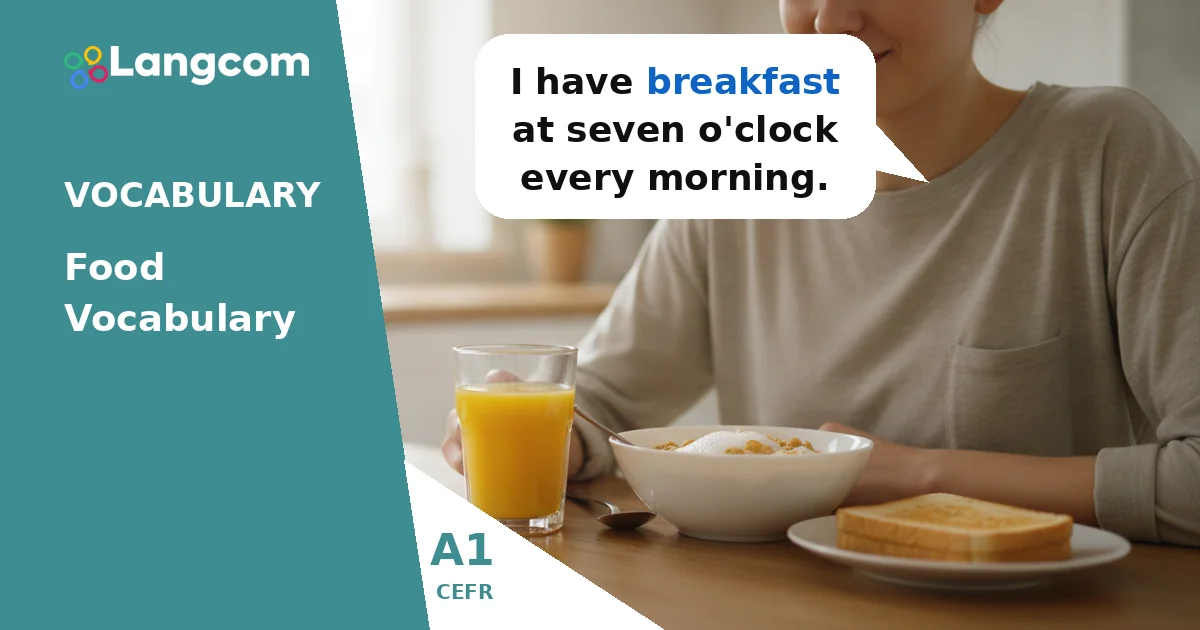
Zum Beispiel, I have breakfast at seven o'clock.
-
Or, She has lunch at one PM.
You can use exact times like seven o'clock oder one thirty. Sie können auch AM for morning and PM for afternoon/evening.
| Meal Name | Typical Time | Example Sentence |
|---|---|---|
| Breakfast | Morning (e.g., 7 AM - 9 AM) | I have breakfast at eight o'clock. |
| Lunch | Midday (e.g., 12 PM - 2 PM) | She has lunch at one PM. |
| Dinner | Evening (e.g., 6 PM - 9 PM) | We have dinner at seven thirty. |
Beispiele
- I have breakfast at seven o'clock every morning.
- She has lunch with her friends at twelve thirty.
- We usually have dinner at eight PM.
- What time do you have breakfast?
- They have dinner late on weekends.
Übung
💬 Benötigen Sie eine individuelle Beratung?
Als autorisiertes Cambridge-Vorbereitungszentrum können wir Ihnen helfen, den richtigen Kurs und die passende Zertifizierung zu finden. Chatten Sie noch heute mit unseren Beratern.
Chatten Sie mit einem Berater auf WhatsAppHäufige Fehler bei Spanischsprechern
Common Mistakes with Meal Vocabulary
Many English learners make small mistakes with meal vocabulary. Here are some common ones to avoid:
-
Using 'eat' instead of 'have': While eat is not wrong, have is more natural and common for talking about meals.
❌ I eat breakfast.
✅ I have breakfast. -
Missing 'at' for time: Always use at before a specific time.
❌ We have dinner seven o'clock.
✅ We have dinner at seven o'clock. -
Using 'the' before meal names: We usually do not use the vor breakfast, lunch, oder dinner.
❌ I have the lunch.
✅ I have lunch.
Häufig gestellte Fragen
What is the difference between breakfast, lunch, and dinner?
Breakfast is the first meal in the morning. Lunch is the meal in the middle of the day. Dinner is the last meal in the evening.
Kann ich bei Mahlzeiten 'essen' anstelle von 'haben' verwenden?
Ja, du kannst eat, aber have is more common and natural in English when talking about the whole meal. For example, I have breakfast is more typical than I eat breakfast.
Do I need 'the' before meal names?
No, usually we do not use the vor breakfast, lunch, oder dinner. You simply say have breakfast, have lunch, usw.
How do I ask about someone's meal time?
You can ask: What time do you have breakfast? oder When do you usually have dinner?



0 Kommentare