
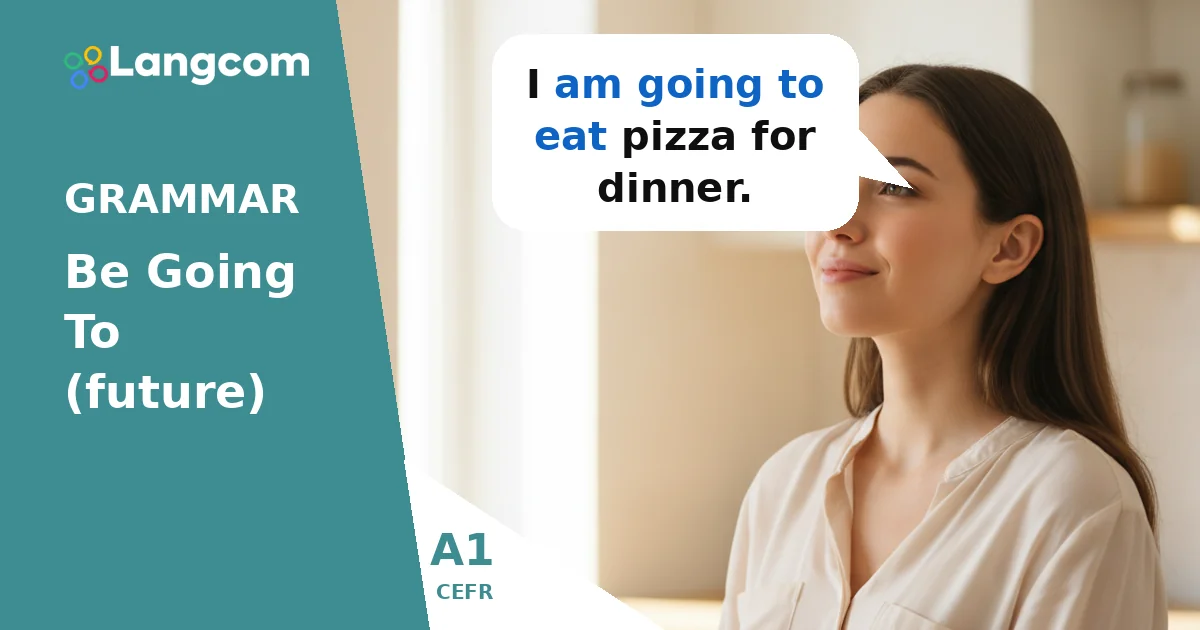

What Does ‘Be Going To’ Mean?
Be going to is a way to talk about the future. It helps us express plans or things we are sure will happen.
- It is for plans you have already made.
- It is also for predictions based on what you see or know now.
🎓 Learn English with the Blended method
Small groups · 24/7 AI Tutor · Cambridge preparation
Plans from $39 $79 per month
How Do We Form 'Be Going To'?
The structure for be going to is simple:
- Subject + verb 'to be' (am/is/are) + going to + base form of the main verb
The verb to be changes depending on the subject:
- I + am going to + verb
- You/We/They + are going to + verb
- He/She/It + is going to + verb
When Do We Use 'Be Going To'?
There are two main situations when we use be going to:
1. For Future Plans and Intentions
Use be going to when you talk about something you have already decided to do in the future.
- I am going to study English tonight. (This is my plan.)
- They are going to buy a new car next month. (They have decided this.)
2. For Predictions Based on Present Evidence
Use be going to when you see something now that tells you what will happen in the future.
- Look at those dark clouds! It is going to rain. (You see the clouds, so you predict rain.)
- Oh no, the baby is crying. She is going to wake up her brother. (You hear the crying, so you predict the brother will wake up.)
Common Time Expressions with 'Be Going To'
You can use be going to with many time expressions to show when the action will happen:
- tomorrow
- next week/month/year
- soon
- later
- this evening/weekend
| Subject | Verb 'to be' | Going to | Base Verb | Example |
|---|---|---|---|---|
| I | am | going to | eat | I am going to eat. |
| You | are | going to | study | You are going to study. |
| He/She/It | is | going to | sleep | He is going to sleep. |
| We | are | going to | watch | We are going to watch. |
| They | are | going to | travel | They are going to travel. |
Examples
- I am going to eat pizza for dinner.
- She is going to travel to London next year.
- We are going to watch a movie tonight.
- He is going to learn to play the guitar.
- They are going to visit their grandparents this weekend.
Practice
💬 Need personalized guidance?
As an Authorized Cambridge Preparation Centre, we can guide you to the right course and certification. Chat with our advisors today.
Chat with an Advisor on WhatsAppCommon mistakes for Spanish speakers
Spanish speakers sometimes make these mistakes:
- Forgetting 'be': In Spanish, you might just say 'voy a estudiar'. But in English, you need the verb to be.
- Incorrect: I going to study.
- Correct: I am going to study.
- Conjugating the main verb: The verb after going to must always be in its base form (infinitive without 'to').
- Incorrect: She is going to goes to the park.
- Correct: She is going to go to the park.
- Confusing 'going to' with physical movement: Remember going to is a future marker, not always about moving to a place.
- I am going to eat. (Not moving to eat, just planning to eat.)
Frequently asked questions
What is the main use of 'be going to'?
The main use of be going to is to talk about plans you have already made or predictions based on what you see now.
How do I make a sentence with 'be going to'?
You make a sentence with be going to by using Subject + am/is/are + going to + base verb. For example, I am going to read.
Can I use 'going to' for things that are happening right now?
No, be going to is only for future actions or predictions. For actions happening now, we use the present continuous, like I am reading.



0 Comments