
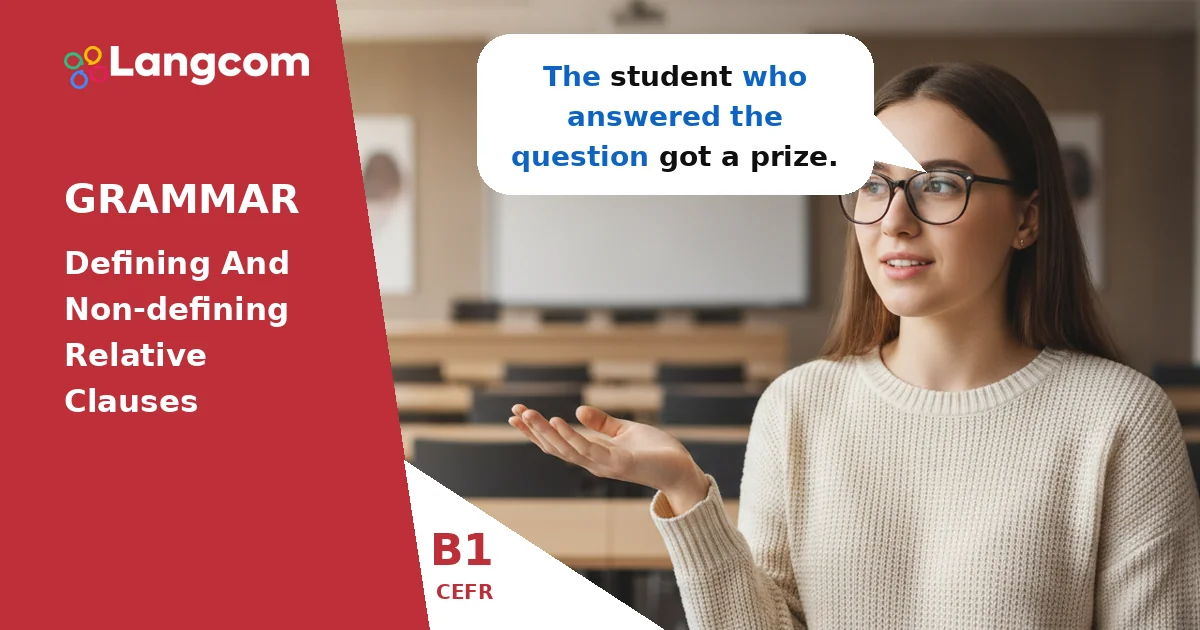

What Are Relative Clauses?
Relative clauses are parts of a sentence that give more information about a noun or pronoun. They act like adjectives, describing a person, place, thing, or idea.
They usually begin with a relative pronoun or adverb. These words connect the clause to the noun it describes.
- Common relative pronouns: who, whom, whose, which, that.
- Common relative adverbs: where, when, why.
🎓 Изучайте английский по смешанной методике
Небольшие группы · ИИ-репетитор 24/7 · Подготовка к экзаменам Кембриджского университета
Планы от $39 $79 в месяц
When Do We Use Defining Relative Clauses?
Defining relative clauses give essential information. This means the information is necessary to understand *which* person or thing you are talking about.
- If you remove a defining relative clause, the meaning of the main sentence changes or becomes unclear.
- They do NOT use commas.
- You can often use that вместо who (for people) or which (for things).
- You can sometimes omit the relative pronoun (who, which, that) if it is the object of the relative clause.
Пример: The woman who lives next door is a doctor. (If you say "The woman is a doctor," it's unclear *which* woman.)
When Do We Use Non-Defining Relative Clauses?
Non-defining relative clauses give extra information. This means the information is interesting, but not essential to identify the person or thing.
- If you remove a non-defining relative clause, the main sentence still makes sense and refers to the same noun.
- They ALWAYS use commas to separate them from the rest of the sentence.
- You CANNOT use that in a non-defining relative clause.
- You CANNOT omit the relative pronoun in a non-defining relative clause.
Пример: My sister, who lives in Paris, is visiting next week. (I only have one sister, so "My sister is visiting next week" is already clear. The clause "who lives in Paris" is extra information.)
Choosing the Right Relative Pronoun
The choice of relative pronoun depends on what you are describing and the type of clause.
- Who / Whom: For people. Whom is more formal and used when the pronoun is the object.
- Which: For things, animals, or ideas.
- That: For people, things, or animals (only in defining clauses).
- Whose: To show possession (for people or things).
- Where: For places.
- When: For times.
Помните: That is never used in non-defining clauses. Always use who или which with commas.
| Особенность | Defining Relative Clause | Non-Defining Relative Clause |
|---|---|---|
| Information | Essential (identifies the noun) | Extra (adds more detail) |
| Commas | No commas | Always uses commas |
| Pronoun 'that' | Can be used for people/things | Cannot be used |
| Pronoun omission | Yes (if object) | No (pronoun always present) |
Примеры
- The student who answered the question got a prize. (Defining – essential info)
- I read a book that was written by my favorite author. (Defining – essential info)
- The car I bought yesterday is very fast. (Defining – pronoun omitted)
- Mr. Smith, who is my English teacher, is very kind. (Non-defining – extra info)
- My new laptop, which has a very fast processor, was expensive. (Non-defining – extra info)
- London, where I was born, is a big city. (Non-defining – extra info)
- She showed me photos of her children, whose names I can't remember. (Non-defining – extra info)
Практика
✍️ Не знаете, на каком уровне вы находитесь?
Пройдите наш бесплатный тест на определение уровня и получите индивидуальные рекомендации от сертифицированных экзаменаторов Кембриджского университета.
Пройдите наш БЕСПЛАТНЫЙ тест на определение местаРаспространенные ошибки у носителей испанского языка
Spanish speakers often make mistakes with comma usage in relative clauses. In Spanish, commas are used more frequently with these clauses. In English, the comma is critical for meaning:
- Incorrect comma use: Using commas with defining clauses.
НЕПРАВИЛЬНО: The student, who passed the exam, got a certificate. (If there are many students, this is wrong. The clause is essential.)
СПРАВА: The student who passed the exam got a certificate. - Использование that in non-defining clauses: That is only for defining clauses.
НЕПРАВИЛЬНО: My brother, that lives in London, visited me.
СПРАВА: My brother, who lives in London, visited me. - Omitting the pronoun in non-defining clauses: You cannot remove the pronoun if the clause is non-defining.
НЕПРАВИЛЬНО: The film, I saw last night, was excellent.
СПРАВА: The film, which I saw last night, was excellent.
Часто задаваемые вопросы
What is the main difference between defining and non-defining relative clauses?
The main difference is whether the information is essential or extra. Defining clauses provide essential information to identify the noun, while non-defining clauses provide additional, non-essential details. This difference is shown by comma usage: defining clauses have no commas, and non-defining clauses always have commas.
Can I use 'that' in both types of relative clauses?
No. You can only use that в defining relative clauses. You cannot use that in non-defining relative clauses. For non-defining clauses, you must use who (for people) or which (for things).
When can I omit the relative pronoun?
You can omit the relative pronoun (who, which, that) only in defining relative clauses, and only when the pronoun is the object of the relative clause. You can never omit the pronoun in a non-defining relative clause.
How do commas affect the meaning of a sentence with a relative clause?
Commas change the meaning significantly. For example, "Students who study hard pass exams" means only the students who study hard pass. But "Students, who study hard, pass exams" implies *all* students study hard and *all* pass, which is usually not the intended meaning.


0 Комментариев