

Что такое прилагательные?
Adjectives are words that describe nouns. They tell us more about the quality, size, color, or feeling of a person, place, or thing.
- A noun is a person, place, or thing (e.g., film, book, friend).
- An adjective describes that noun (e.g., an interesting film, a boring book, an amazing friend).
Adjectives usually come до the noun they describe, or after verbs like be, seem, или feel.
✍️ Не знаете, на каком уровне вы находитесь?
Пройдите наш бесплатный тест на определение уровня и получите индивидуальные рекомендации от сертифицированных экзаменаторов Кембриджского университета.
Пройдите наш БЕСПЛАТНЫЙ тест на определение местаDescribing Good Things: Positive Adjectives
Here are some adjectives to describe things you like or find positive:
- Amazing: This means very surprising and wonderful. It's stronger than 'good'.
Пример: The view from the mountain was amazing. - Awesome: This means extremely good or impressive. It's often used for things that are very exciting.
Пример: The band played an awesome song. - Interesting: This means holding your attention; not boring. You want to know more about it.
Пример: I read an interesting article about space.
Describing Bad Things: Negative Adjectives
These adjectives help you talk about things you don't like or find negative:
- Boring: This means not interesting; it makes you feel tired or annoyed.
Пример: The lesson was boring, so I almost fell asleep. - Horrible: This means very bad or unpleasant. It can describe feelings, tastes, or experiences.
Пример: The weather was horrible yesterday. - Terrible: This also means very bad or of very poor quality. It's similar to 'horrible'.
Пример: The food at the restaurant was terrible.
Learning Opposites for A2 Key
Knowing opposites (antonyms) is very useful for your A2 Key exam. It helps you understand different meanings and express yourself more clearly. For example, in Part 2 of the A2 Key Speaking exam, you might need to describe two different pictures.
- Amazing is the opposite of terrible или horrible.
- Awesome is also the opposite of terrible или horrible.
- Interesting is the opposite of boring.
| Прилагательное | Opposite |
|---|---|
| amazing | terrible / boring |
| awesome | horrible / boring |
| interesting | boring |
| boring | interesting / amazing |
| horrible | amazing / awesome |
| terrible | amazing / awesome |
Примеры
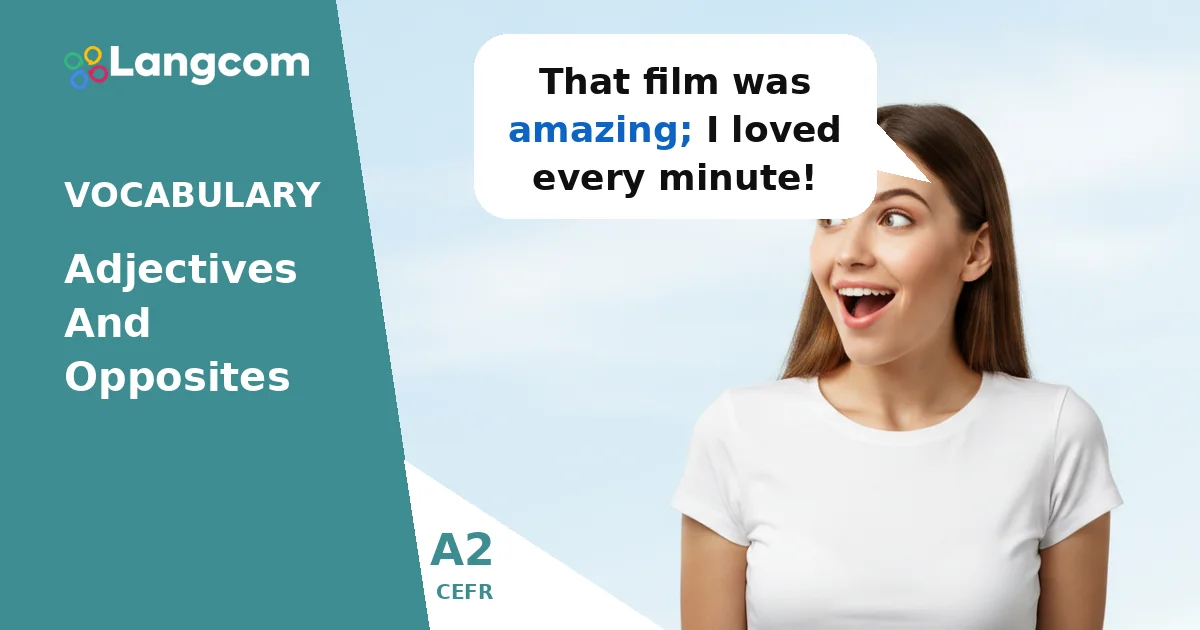
- That film was amazing; I loved every minute!
- We had an awesome time at the concert last night.
- The museum exhibition was very interesting.
- I found the book quite boring, so I didn't finish it.
- The traffic was horrible this morning.
- My internet connection is terrible today.
Практика
Готовы получить сертификат?
Курс Langcom готовит студентов к сдаче экзаменов Cambridge, IELTS, TOEFL, DELE, SIELE и Michigan.
Начните работу с LangcomРаспространенные ошибки у носителей испанского языка
Spanish speakers sometimes make these mistakes with English adjectives:
- Word Order: In English, adjectives usually come до the noun. In Spanish, they often come after.
Неправильно: a film interesting
Справа: an interesting film - Agreement: English adjectives do not change for plural or gender.
Неправильно: two amazings films
Справа: two amazing films - Использование very with strong adjectives: Adjectives like amazing, awesome, horrible, и terrible are already very strong. Do not use very with them. Instead, use words like really или absolutely.
Неправильно: The food was very terrible.
Справа: The food was really terrible. или The food was absolutely terrible.
Часто задаваемые вопросы
Что такое прилагательное?
An adjective is a word that describes a noun or pronoun. It tells you more about its qualities, like big, small, happy, или boring.
Where do I put adjectives in a sentence?
Most often, adjectives go before the noun they describe, like an amazing book. They can also come after verbs like be, seem, или feel, for example: The film was interesting.
Why are opposites important for the A2 Key exam?
Knowing opposites helps you understand a wider range of vocabulary and express contrasts. For example, in A2 Key Reading Part 2, you might need to match descriptions with different opinions, where understanding opposites like amazing vs. terrible is key.
Can I use 'very' with all adjectives?
No. You can use very with normal adjectives like good или bad. But for strong adjectives like amazing, awesome, horrible, или terrible, use words like really или absolutely instead.

0 Комментариев