
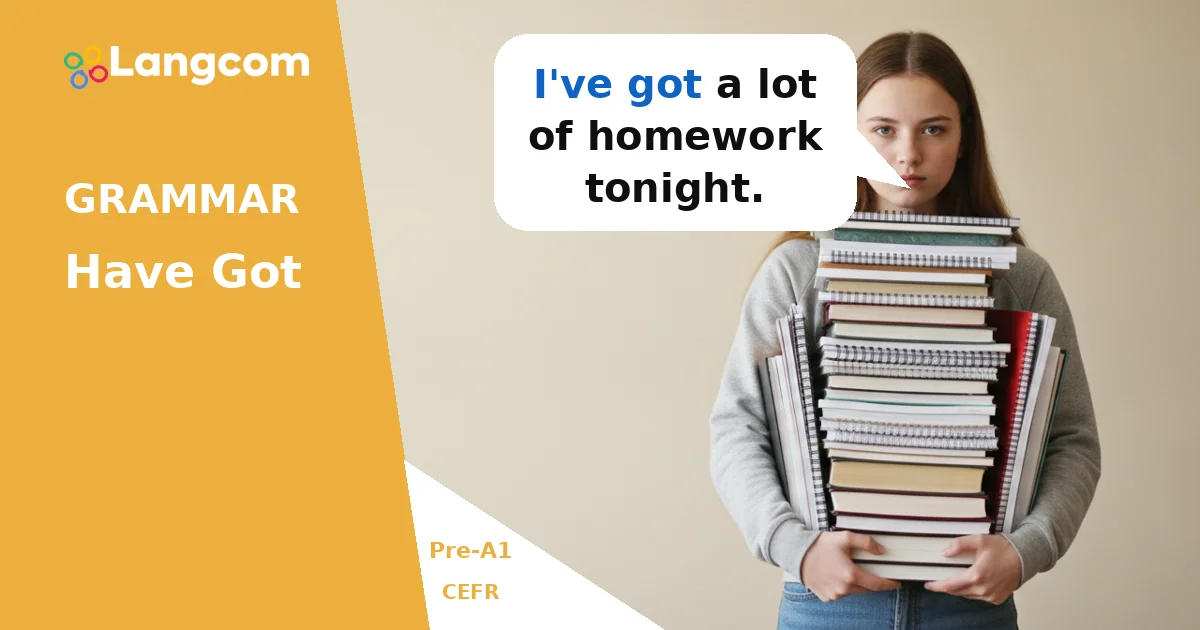

What does ‘have got’ mean?
Have got means “to own” or “to possess” something. It is a very common way to talk about possession in English.
It is similar to using only have for possession. For example, I have got a bicycle means the same as I have a bicycle.
🎓 Изучайте английский по смешанной методике
Небольшие группы · ИИ-репетитор 24/7 · Подготовка к экзаменам Кембриджского университета
Планы от $39 $79 в месяц
How do I use 'have got'?
Мы используем have got with specific subjects:
- With I, you, we, they.
The full form is have got. The short form (contraction) is 've got.
- I have got a new phone. / I've got a new phone.
- You have got a nice smile. / You've got a nice smile.
- We have got a big family. / We've got a big family.
- They have got two dogs. / They've got two dogs.
How do I use 'has got'?
Мы используем has got with specific subjects:
- With he, she, it.
The full form is has got. The short form (contraction) is 's got.
- He has got a red car. / He's got a red car.
- She has got long hair. / She's got long hair.
- It has got a small window. / It's got a small window.
When do we use 'have got' and 'has got'?
Мы используем have got и has got to talk about different types of possession:
- Things you own: I've got a new computer.
- Relationships: She's got a brother and a sister.
- Characteristics of people or things: He's got blue eyes. Our house has got a big garden.
These forms are very common in everyday, informal conversations.
| Тема | Full Form | Contraction |
|---|---|---|
| I, You, We, They | have got | 've got |
| He, She, It | has got | 's got |
Примеры
- I've got a lot of homework tonight.
- You have got a beautiful smile.
- He's got a new bicycle.
- She has got a very friendly cat.
- We've got a meeting at 10 AM.
- They have got three children.
- It's got a broken leg.
Практика
💬 Нужна индивидуальная консультация?
Являясь официальным центром подготовки к экзаменам Кембриджского университета, мы поможем вам выбрать подходящий курс и программу сертификации. Свяжитесь с нашими консультантами уже сегодня.
Общайтесь с консультантом в WhatsAppРаспространенные ошибки у носителей испанского языка
Many Spanish speakers make these common mistakes:
- Forgetting the subject: In English, you always need a subject. You cannot say Has got a dog. You must say He has got a dog.
- Using 'have' instead of 'has' with 'he', 'she', 'it': Не забудьте использовать has got for singular subjects like he, she, it.
Неправильно: She have got a new bag.
Правильно: She has got a new bag.
- Using 'has' instead of 'have' with 'I', 'you', 'we', 'they':
Неправильно: I has got a headache.
Правильно: I have got a headache.
Часто задаваемые вопросы
What is the difference between 'have' and 'have got'?
И то, и другое have и have got mean possession. Have got is very common in informal, spoken English, especially in British English. Have is more general and can be used in all situations. For possession, they are often interchangeable.
Can I use 'have got' for actions?
No. We only use have got to talk about possession (things you own), relationships, or characteristics. For actions, we use other verbs, like have breakfast или have a shower.
Is 'have got' formal or informal?
Have got is generally informal. It is very common in everyday conversations. For more formal writing or speaking, have is usually preferred.
Why do we use 'got'?
Got is part of the fixed phrase have got. It does not mean "to receive" in this phrase. It simply completes the expression for possession. Think of have got as one unit.

0 Комментариев