

What are ‘What’s’ and ‘It’s’?
What’s e It’s are contractions. A contraction is a short way to say or write two words together.
- What’s is the short form of What is.
- It’s is the short form of It is.
We use an apostrophe ( ‘ ) to show that a letter is missing. This makes speaking and writing faster and more natural.
🎓 Aprenda inglês com o método misto
Grupos pequenos · Tutor de IA 24 horas por dia, 7 dias por semana · Preparação para os exames de Cambridge
Planos de $39 $79 por mês
How Do We Use 'What's'?
Utilizamos What's...? to ask about things, names, or information.
- It is a common way to start questions in English.
- You can ask about a person's name, an object, or a situation.
Pense em What's...? as asking 'What is this thing?' or 'What is the name of this?'.
How Do We Use 'It's'?
Utilizamos It's... to give an answer about a thing, a name, or a situation.
- It is a common way to start an answer.
- You use It's when the subject of your answer is 'it'.
For example, if someone asks What's your name?, you can answer It's [your name].
Common Uses of What's...? and It's...
You will hear and use these contractions often in daily conversations.
- Asking for names:
What's your name?
It's Carlos. - Asking about objects:
What's this?
It's a book. - Asking about colors:
What's your favorite color?
It's blue. - Asking about time:
What's the time?
It's three o'clock.
| Full Form | Contraction |
|---|---|
| What is | What's |
| It is | It's |
Exemplos
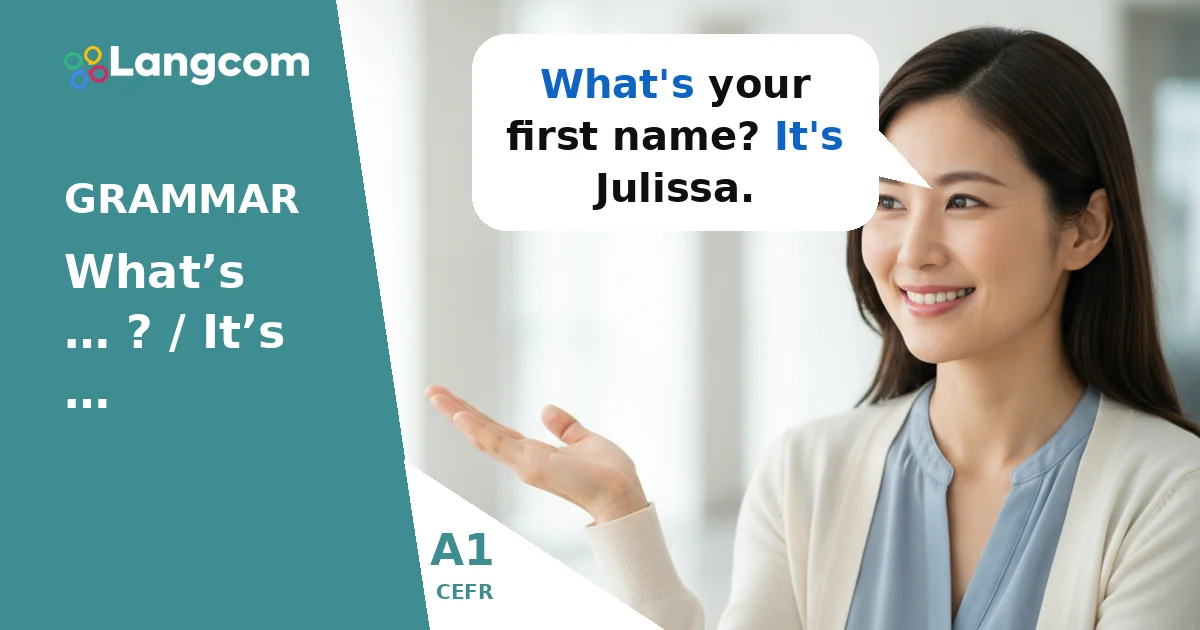
- What's your first name? It's Julissa.
- What's the name of your college? It's Hunter College.
- What's your email address? It's [email protected].
- What's your last name? It's Mendes.
- What's the name of your company? It's Altar Homes.
Prática
💬 Precisa de orientação personalizada?
Como Centro Autorizado de Preparação para os Exames de Cambridge, podemos orientá-lo na escolha do curso e da certificação mais adequados. Entre em contato com nossos orientadores hoje mesmo.
Converse com um consultor pelo WhatsAppErros comuns entre falantes de espanhol
A very common mistake for learners is forgetting the apostrophe ( ' ). The apostrophe is important because it shows that letters are missing.
- Incorreto: Whats your name?
Correto: What's your name? - Incorreto: Its a pen.
Correto: It's a pen.
Remember, its (without an apostrophe) is a possessive word, like 'his' or 'her'. For example: The dog wagged its tail. This is different from It's (it is).
Perguntas frequentes
Why do English speakers use 'What's' and 'It's' instead of 'What is' and 'It is'?
English speakers use What's e It's because they are quicker and sound more natural in everyday conversation. They are common contractions.
Can I always use 'What's' and 'It's'?
Yes, for A1 level, you can almost always use What's e It's in questions and answers. In very formal writing, you might use the full forms What is e It is, but contractions are fine for most situations.
What is the difference between 'It's' and 'Its'?
It's (with an apostrophe) is a contraction of It is ou It has. Its (without an apostrophe) shows possession, meaning 'belonging to it', like in The cat ate its food.

0 Comentários