
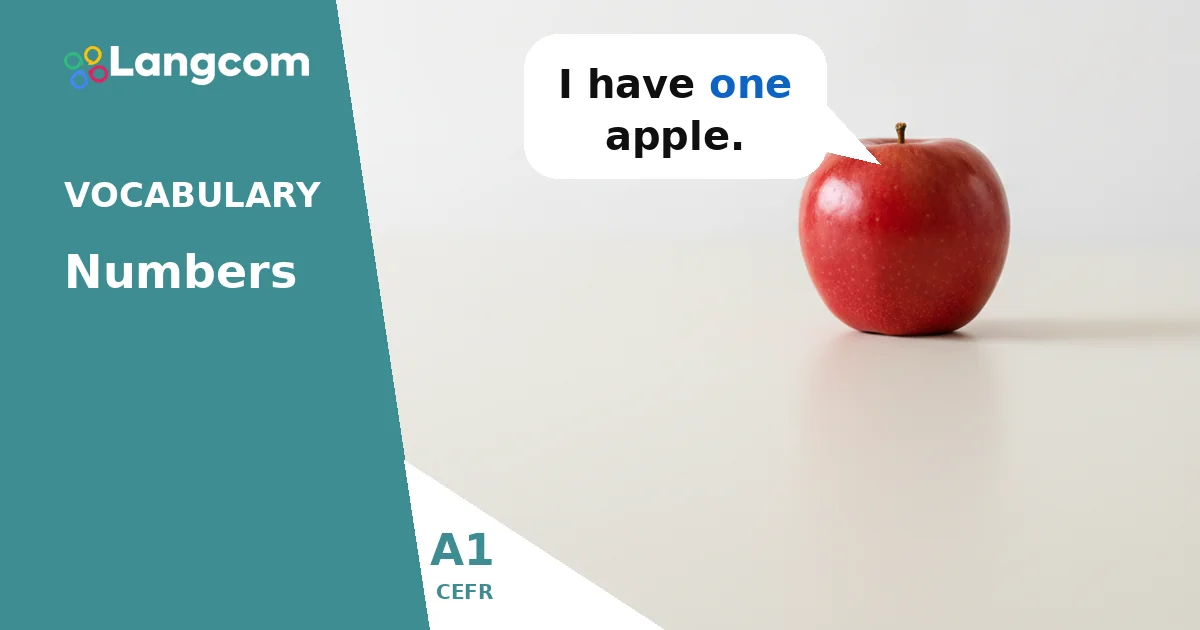

Here are the numbers you need to know:
- one (1)
- two (2)
- three (3)
- four (4)
- five (5)
- six (6)
- seven (7)
- eight (8)
- nine (9)
- ten (10)
- eleven (11)
- twelve (12)
Practice saying them aloud to improve your pronunciation.
Why are Numbers 1-12 Essential?
Números 1-12 are the foundation for counting in English. They help you communicate basic information every day.
You will use them for many common situations:
- Age: Pode-se dizer que I am ten years old.
- Time: Pode-se dizer que It’s seven o’clock.
- Quantity: Pode-se dizer que I have two books.
- Phone numbers: You use these digits when saying your phone number, for example, My number is five, five, five…
🎓 Aprenda inglês com o método misto
Grupos pequenos · Tutor de IA 24 horas por dia, 7 dias por semana · Preparação para os exames de Cambridge
Planos de $39 $79 por mês
How Do I Use Numbers 1-12 in Sentences?
You can use these numbers to say "how many" of something you have. Place the number before the noun.
- I have one cat.
- She has three pens.
- There are twelve students in the class.
You also use them to talk about time and age.
- The meeting is at ten.
- He is eight years old.
Tips for Remembering English Numbers 1-12
Learning new vocabulary is easier with good strategies. Try these tips to master numbers 1-12:
- Listen and Repeat: Pay attention to how native speakers pronounce each number. Repeat them often.
- Count Everyday Objects: Look around you and count things. For example, say one window, two chairs.
- Use Flashcards: Write the number on one side and the word on the other.
- Sing Songs: Many children's songs teach numbers and can be very helpful for adults too!
| Número | Palavra |
|---|---|
| 1 | one |
| 2 | two |
| 3 | three |
| 4 | four |
| 5 | five |
| 6 | six |
| 7 | seven |
| 8 | eight |
| 9 | nine |
| 10 | ten |
| 11 | eleven |
| 12 | twelve |
Exemplos
- I have one apple.
- There are two dogs.
- She is three years old.
- We need four chairs.
- The clock shows five o'clock.
- He has six books.
- There are seven days in a week.
- My brother is eight.
- I see nine birds.
- The bus arrives at ten.
- She bought eleven flowers.
- There are twelve months in a year.
Prática
💬 Precisa de orientação personalizada?
Como Centro Autorizado de Preparação para os Exames de Cambridge, podemos orientá-lo na escolha do curso e da certificação mais adequados. Entre em contato com nossos orientadores hoje mesmo.
Converse com um consultor pelo WhatsAppErros comuns entre falantes de espanhol
Spanish speakers sometimes make a few common mistakes with English numbers 1-12, mainly with pronunciation.
- The 'th' sound in three: This sound does not exist in Spanish. Many learners pronounce it like an 'f' or a 't'.
- Incorreto: tree (sounds like a plant)
- Correto: three (tongue between teeth, blowing air)
- The 'v' sound in five e seven: In Spanish, 'v' often sounds like 'b'. In English, 'v' is pronounced with your top teeth on your bottom lip.
- Incorreto: bive (para five)
- Correto: five
- Confuso nine e ten: Practice these two carefully to avoid mixing them up.
- nine (ends with 'n' sound)
- ten (ends with 'n' sound, but a distinct 't' at the start)
Perguntas frequentes
Why is it important to learn numbers 1-12 first?
These numbers are the building blocks for all other numbers. They are used daily for telling time, age, and basic counting. Mastering 1-12 helps you with more complex numbers later.
How can I practice pronunciation of numbers?
Listen to native speakers, repeat aloud, and use online tools or apps that offer pronunciation guides. Focus on specific sounds like 'th' in three and 'v' in five.
Are there any special rules for numbers 1-12?
For A1, the main rule is to learn their names and how to say them correctly. They are unique words, not combinations of other numbers. Just memorize each one!


0 Comentários