
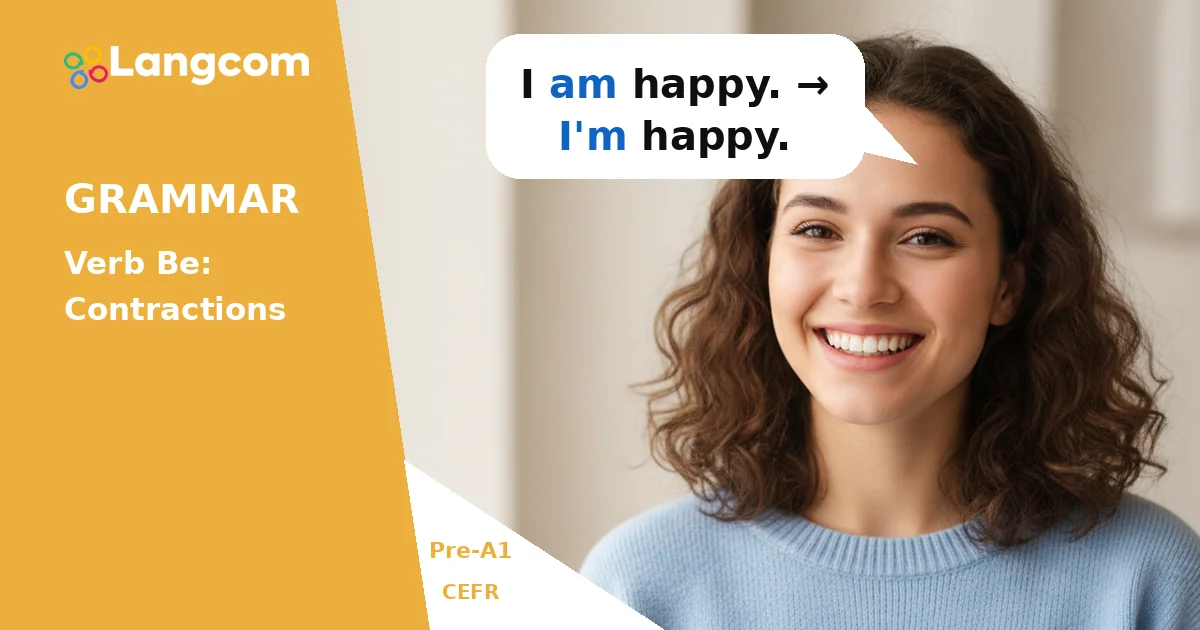

What Are ‘To Be’ Contractions?
Contractions are short ways to say or write two words together. For the verb to be, we combine the subject pronoun with the verb. This makes one shorter word.
We use a special mark called an apostrophe (‘). The apostrophe replaces the missing letters.
- Instead of I am, we say I’m.
- Instead of you are, we say you’re.
- Instead of he is, we say he’s.
🎓 Aprenda inglês com o método misto
Grupos pequenos · Tutor de IA 24 horas por dia, 7 dias por semana · Preparação para os exames de Cambridge
Planos de $39 $79 por mês
Why Do We Use Contractions?
English speakers use contractions all the time. They are very common in daily life.
- Sound Natural: Contractions help your English sound more like a native speaker's.
- Speak Faster: They make sentences shorter and quicker to say.
- Common in Conversation: You will hear them in almost every conversation, movie, or song.
- Informal Writing: We use them often in emails, messages, and casual writing.
How Do We Form 'To Be' Contractions?
It is simple to form contractions with to be. You just combine the pronoun and the verb, and add an apostrophe.
- Para I: I am torna-se I'm.
- Para you: You are torna-se You're.
- Para he, she, it:
- He is torna-se He's.
- She is torna-se She's.
- It is torna-se It's.
- Para we, they:
- We are torna-se We're.
- They are torna-se They're.
| Long Form | Short Form (Contraction) |
|---|---|
| I am | I'm |
| You are | You're |
| He is | He's |
| She is | She's |
| It is | It's |
| We are | We're |
| They are | They're |
Exemplos
- I am happy. → I'm happy.
- You are a student. → You're a student.
- He is my brother. → He's my brother.
- She is from Spain. → She's from Spain.
- It is a big dog. → It's a big dog.
- We are friends. → We're friends.
- They are in the park. → They're in the park.
Prática
💬 Precisa de orientação personalizada?
Como Centro Autorizado de Preparação para os Exames de Cambridge, podemos orientá-lo na escolha do curso e da certificação mais adequados. Entre em contato com nossos orientadores hoje mesmo.
Converse com um consultor pelo WhatsAppErros comuns entre falantes de espanhol
A common mistake for learners is forgetting the apostrophe or writing the words separately when a contraction is expected.
- Incorreto: Im happy.
- Correto: I'm happy. (Remember the apostrophe!)
Another mistake is using the long form when the short form sounds more natural in speaking. While I am happy is grammatically correct, I'm happy is much more common in everyday conversation.
Perguntas frequentes
What is an apostrophe?
An apostrophe (') is a punctuation mark. In contractions, it shows that one or more letters are missing. For example, in I'm, the apostrophe replaces the letter a from am.
When should I use contractions?
You should use contractions in most everyday conversations and informal writing (like texts or emails to friends). They make your English sound more natural and fluent. In very formal writing, like academic essays, it's often better to use the full forms (e.g., I am em vez de I'm).
Can I always use contractions with 'to be'?
Almost always! Contractions are very common. The main exceptions are in very formal writing or when you want to emphasize the verb. For example, if someone asks, 'Are you sure?' you might say, 'Yes, I AM sure!' to stress your certainty. Otherwise, contractions are usually fine.

0 Comentários