

What is the Present Perfect Simple?
O Present Perfect Simple connects a past action or event to the present moment. It focuses on the result or completion of an action, or an experience that happened at an unspecified time.
- Formulário: have/has + past participle. Por exemplo, I have finished ou She has seen.
- Uses:
- Experiences: To talk about things you have done in your life, without saying exactly when. I have visited Rome twice.
- Completed actions with a present result: An action finished recently, and you can see or feel the effect now. Oh no! I have lost my keys. (Result: I can’t find them now.)
- With ‘already’, ‘just’, ‘yet’: To talk about actions that happened very recently or before now. I have just eaten lunch.
- With ‘how many’, ‘how much’, ‘how often’: To ask or state quantities. How many books have you read this year?
- With state verbs: For actions that started in the past and continue now, but use state verbs (e.g., know, love, be). I have known her for ten years.
✍️ Não sabe em que nível você está?
Faça nosso teste de nivelamento gratuito e receba um feedback personalizado de examinadores certificados pela Cambridge.
Faça nosso teste de nivelamento GRATUITOWhat is the Present Perfect Continuous?
O Present Perfect Continuous also links the past to the present. However, it emphasizes the duration of an activity or an ongoing action that may still be happening or has just stopped, with a visible result now.
- Formulário: have/has + been + -ing (present participle). Por exemplo, I have been studying ou She has been waiting.
- Uses:
- Duration of an activity: To say how long an activity has been happening, often with for ou since. I have been working here for five years.
- Ongoing actions with a present result: An activity that has just finished, and you can see or feel the evidence of it now. You look tired. Have you been running? (Result: tiredness, sweat)
- Repeated activities recently: To describe actions that have been happening many times lately. I have been going to the gym a lot recently.
- Focus on the activity itself: When the process is more important than the completion. I have been painting the kitchen. (The kitchen might not be finished yet.)
What is the Main Difference: Result vs. Activity?
The core distinction lies in what you want to highlight: the completion/result or the ongoing activity/duration.
- Present Perfect Simple: Focuses on the end product or the fact that something happened. It often answers 'how many' or 'how much'. I have written two emails this morning. (Focus on the number of completed emails.)
- Present Perfect Continuous: Focuses on the process or how long an action has been happening. It often answers 'how long'. I have been writing emails all morning. (Focus on the activity of writing, which may still be ongoing or just finished.)
When Can Both Be Used?
Sometimes, for verbs like live, work, e study, both forms can be used with little difference in meaning, especially when talking about duration.
- I have lived in Madrid for ten years. (Simple: states the fact of living there.)
- I have been living in Madrid for ten years. (Continuous: emphasizes the ongoing nature of living there.)
Both sentences are correct and convey similar information. The continuous form might sound slightly more informal or emphasize the temporary feeling of the situation, even if it's long-term.
What About State Verbs?
State verbs (verbs that describe a state, not an action, like know, love, believe, have (for possession), be) are almost never used in continuous forms.
- You must use the Present Perfect Simple with state verbs, even when talking about duration.
- Correto: I have known him since 2010.
- Incorreto: I have been knowing him since 2010.
| Present Perfect Simple | Present Perfect Continuous |
|---|---|
| Focuses on the result or completion | Focuses on the activity or duration |
| Answers 'how many' or 'how much' | Answers 'how long' |
| Describes completed actions | Describes ongoing or recently stopped activities |
| Used with state verbs for duration | Not used with state verbs |
| I have read three books. (Result) | I have been reading all day. (Activity/Duration) |
| She has lost her keys. (Result now) | She has been crying. (Evidence of recent activity) |
Exemplos
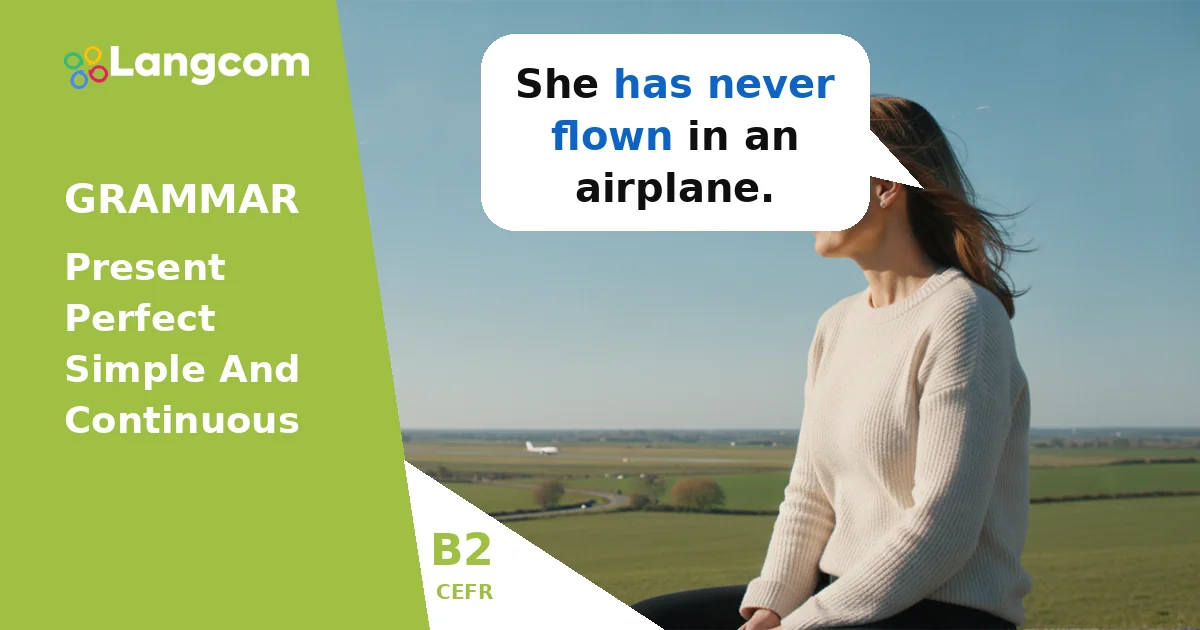
- She has never flown in an airplane.
- I have already finished my homework.
- How long have you been learning English?
- They have been building that bridge for two years.
- My eyes hurt because I have been watching TV all evening.
- He has written three novels since last year.
- It's the most delicious meal I've ever eaten.
- We have lived in this city for a long time.
Prática
Pronto para receber seu certificado?
O curso Langcom prepara os alunos para os exames de Cambridge, IELTS, TOEFL, DELE, SIELE e Michigan.
Comece a usar o LangcomErros comuns entre falantes de espanhol
Spanish speakers often make specific mistakes with the present perfect tenses:
- Using Simple Past instead of Present Perfect: In Spanish, the simple past (e.g., comí) is often used for recent actions. In English, for actions with a present result or unspecified past experiences, the Present Perfect Simple is usually required.
Incorreto: I ate breakfast. (If referring to a recent action with present relevance, e.g., 'so I'm not hungry now').
Correto: I have eaten breakfast. - Incorrectly using Continuous with State Verbs: As mentioned, state verbs cannot be continuous.
Incorreto: I have been having this car for five years.
Correto: I have had this car for five years. - Confusing 'for' and 'since': Remember, for is for a period of time (for two hours), and since is for a starting point (since Monday).
Perguntas frequentes
What is the basic difference between Present Perfect Simple and Continuous?
O Present Perfect Simple focuses on the result or completion of an action, or an experience. The Present Perfect Continuous focuses on the duration or ongoing nature of an activity.
Can I use the Present Perfect Continuous with 'always'?
Sim, você pode usar always with the Present Perfect Continuous to talk about an action that has been happening continuously or repeatedly for a long time, sometimes to express annoyance. For example, He has always been complaining.
When should I use 'for' and 'since'?
Uso for to specify a period of time (e.g., for three years). Use since to specify a starting point in time (e.g., since 2020). Both are common with both Present Perfect Simple e Continuous.
Are there verbs that cannot be used in the continuous form?
Yes, state verbs (verbs describing states, not actions) like know, love, believe, understand, want, have (for possession), and be are generally not used in any continuous form, including the Present Perfect Continuous.

0 Comentários