

O que são orações substantivas com palavras interrogativas?
As orações substantivas são grupos de palavras que funcionam como um substantivo. Elas podem ser o sujeito de um verbo, o objeto de um verbo, o objeto de uma preposição ou um complemento.
Quando essas orações começam com uma palavra interrogativa, elas introduzem uma pergunta ou afirmação indireta. Elas não formulam uma pergunta direta.
- I wonder what time it is. (Complemento do verbo wonder)
- How they solved the problem is a mystery. (Sujeito do verbo is)
✍️ Não sabe em que nível você está?
Faça nosso teste de nivelamento gratuito e receba um feedback personalizado de examinadores certificados pela Cambridge.
Faça nosso teste de nivelamento GRATUITOComo funcionam as orações substantivas com palavras interrogativas?
O segredo para formar corretamente essas orações é lembrar-se da ordem das palavras. Ao contrário das perguntas diretas, as orações substantivas seguem a ordem das palavras usada nas frases declarativas.
- Palavra interrogativa + sujeito + verbo: Essa é a estrutura padrão.
- Não há inversão entre sujeito e verbo.
- Não se usa ponto de interrogação no final da frase, a menos que a oração principal seja uma pergunta.
Considere este exemplo:
- Pergunta direta: Where is the nearest exit?
- Oricla: Could you tell me where the nearest exit is?
Quais palavras interrogativas você pode usar?
Você pode usar as palavras interrogativas mais comuns para introduzir orações substantivas. Cada palavra ajuda a apresentar um tipo específico de informação.
- What: Refere-se a uma coisa ou ideia. I don't understand what you mean.
- Who/Whom: Refere-se a uma pessoa. She asked who was coming to the party. (Whom é mais formal).
- Where: Refere-se a um lugar. He knows where they hid the treasure.
- When: Refere-se a um momento. Let's decide when we should meet.
- Why: Refere-se a um motivo. Can you explain why you were late?
- How: Refere-se a uma forma ou método. They showed us how to use the new software.
- Which: Usado quando há uma escolha entre um número limitado de opções. Tell me which book you prefer.
O uso de 'Whether' ou 'If' em perguntas de sim ou não
Quando a pergunta direta original for do tipo “sim/não” (sem palavra interrogativa), usa-se whether ou if para introduzir a oração substantiva.
- Whether é, em geral, mais formal e pode ser usado com or not.
- If é mais comum na linguagem cotidiana.
Exemplos:
- Pergunta direta: Is she coming?
- Oricla: I wonder if she is coming. OU I wonder whether she is coming.
- Oração substantiva com or not: Let me know whether or not you can attend.
Orações substantivas x orações relativas: qual é a diferença?
No nível C1, é importante distinguir entre orações substantivas e orações relativas, já que ambas podem começar com palavras semelhantes.
- Orações substantivas funcionam como substantivos. São partes essenciais da estrutura da frase (sujeito, objeto, complemento).
- Orações relativas (também chamadas de orações adjetivas) descrevem ou fornecem mais informações sobre um substantivo ou pronome que as precede. Elas funcionam como adjetivos.
Compare estas frases:
- Oricla: I know what he said. (What he said é o objeto de know.)
- Oração relativa: I read the book that he recommended. (That he recommended descreve the book.)
| Pergunta direta | Oração substantiva (pergunta indireta) |
|---|---|
| Where is the report? | Do you know where the report is? |
| When will they arrive? | I wonder when they will arrive. |
| What did he say? | Tell me what he said. |
| Is she ready? | I need to know if she is ready. |
| How can we improve? | Let's discuss how we can improve. |
Exemplos
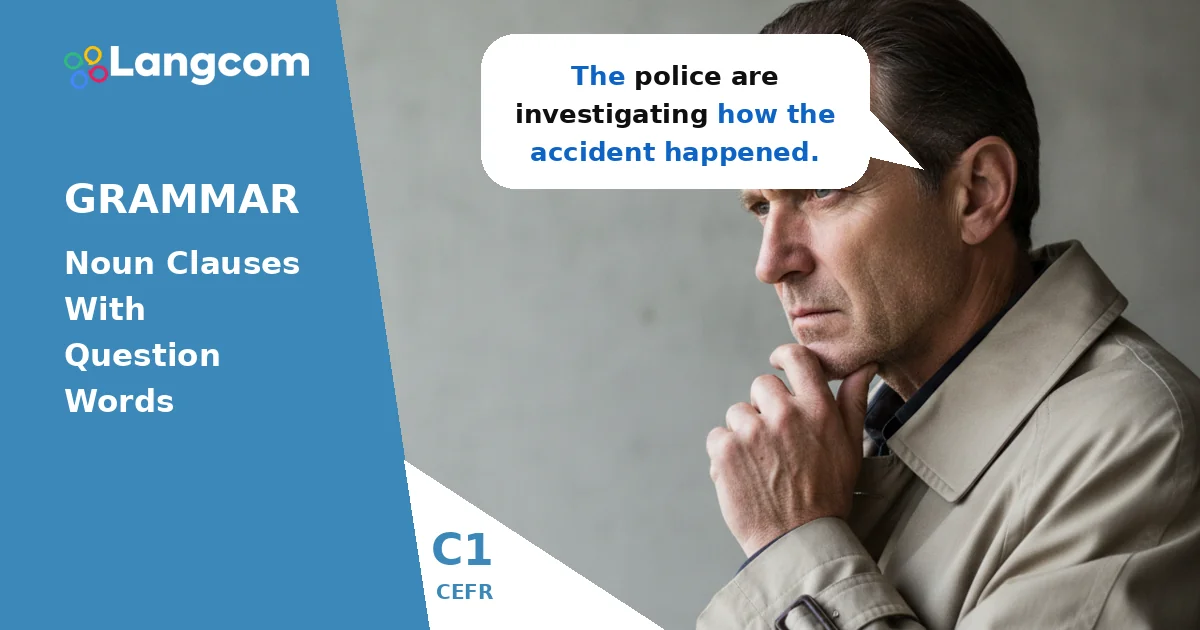
- The police are investigating how the accident happened.
- What you decide to do next is entirely up to you.
- Could you tell me who is responsible for this project?
- They haven't announced when the new policy will take effect.
- I'm not sure whether we should proceed with the plan.
- It's important to understand why these changes are necessary.
- She explained which option would be best for our situation.
Prática
Pronto para receber seu certificado?
O curso Langcom prepara os alunos para os exames de Cambridge, IELTS, TOEFL, DELE, SIELE e Michigan.
Comece a usar o LangcomErros comuns entre falantes de espanhol
Os falantes de espanhol costumam cometer dois erros principais com as orações substantivas: a ordem das palavras e a confusão entre elas e as orações relativas.
1. Incorrect Word Order (Inversion)
A common error is to use question word order (inversion of subject and verb) inside the noun clause, similar to direct questions in Spanish.
- Incorreto: Do you know where is the museum?
- Correto: Do you know where the museum is? (Subject the museum comes before verb is)
2. Confusing with Relative Clauses
Sometimes, learners confuse noun clauses with relative clauses, especially with words like what e that.
- Incorreto: I don't know the thing that he wants. (While grammatically possible, it's less natural and often a sign of over-complication.)
- Correto: I don't know what he wants. (What he wants acts as the object.)
Perguntas frequentes
Qual é a regra principal para a ordem das palavras em orações substantivas com palavras interrogativas?
The main rule is to use statement word order: the question word is followed by the subject, then the verb. For example, I asked what time it was, e não what time was it.
Uma oração substantiva com uma palavra interrogativa pode ser o sujeito de uma frase?
Yes, absolutely. For example, in the sentence How they managed to escape is still a mystery, the entire clause How they managed to escape functions as the subject of the verb is.
Quando devo usar 'whether' em vez de 'if' em uma oração substantiva?
Whether is often preferred in more formal contexts, before an infinitive (whether to go), or when followed by or not. If is more common in everyday speech and less formal situations, especially when the meaning is 'in case that'.
Como posso evitar confundir orações substantivas com orações relativas?
Remember that a noun clause acts as a noun (subject, object, complement) and often replaces a noun phrase. A relative clause, however, describes a noun that is already present in the sentence. For example, I heard what she said (noun clause) vs. I heard the story that she told (relative clause describing 'story').

0 Comentários