

Why is Family Vocabulary Important in English?
Knowing family vocabulary is very useful for A2 English learners. It helps you talk about your life and understand others.
- Daily Conversations: You can introduce your family members and ask about other people’s families.
- A2 Key Exam: In the speaking part of the A2 Key exam, you might need to describe a picture of a family or answer questions about your own family. Using the correct words shows you can communicate well.
✍️ Não sabe em que nível você está?
Faça nosso teste de nivelamento gratuito e receba um feedback personalizado de examinadores certificados pela Cambridge.
Faça nosso teste de nivelamento GRATUITOYour Immediate Family: Core Words
These are the people in your closest family unit:
- Mother: Your female parent.
- Father: Your male parent.
- Parents: Your mother e father.
- Son: Your male child.
- Daughter: Your female child.
- Children: Your sons e daughters.
- Brother: A male with the same parents as you.
- Sister: A female with the same parents as you.
- Siblings: Your brothers e sisters.
- Husband: A man who is married.
- Wife: A woman who is married.
Your Extended Family: More Connections
These words describe other relatives in your family:
- Grandmother (ou grandma, granny): Your mother's mother ou father's mother.
- Grandfather (ou grandpa, grandad): Your mother's father ou father's father.
- Grandparents: Your grandmother e grandfather.
- Aunt: Your mother's sister ou father's sister. Also, your uncle's wife.
- Uncle: Your mother's brother ou father's brother. Also, your aunt's husband.
- Cousin: The child of your aunt ou uncle. This word is for both male and female.
- Grandson: The son of your son ou daughter.
- Granddaughter: The daughter of your son ou daughter.
- Grandchildren: Your grandsons e granddaughters.
How to Use Possessive 's with Family Members
To show that something belongs to a family member, or to show a relationship, we use 's.
- This is Maria's sister. (Maria has a sister.)
- My father's name is David. (The name belongs to my father.)
- Are these your grandparents' photos? (The photos belong to your grandparents.)
Remember, for plural nouns ending in -s, we just add the apostrophe: my parents' house.
| Family Member | Relationship |
|---|---|
| Mother | Female parent |
| Father | Male parent |
| Parents | Mother and father |
| Brother | Male sibling |
| Sister | Female sibling |
| Siblings | Brothers and sisters |
| Son | Male child |
| Daughter | Female child |
| Children | Sons and daughters |
| Husband | Married man |
| Wife | Married woman |
| Grandmother / Grandma | Parent's mother |
| Grandfather / Grandpa | Parent's father |
| Grandparents | Grandmother and grandfather |
| Aunt | Parent's sister or uncle's wife |
| Uncle | Parent's brother or aunt's husband |
| Cousin | Child of an aunt or uncle |
| Grandson | Child's son |
| Granddaughter | Child's daughter |
| Grandchildren | Grandsons and granddaughters |
Exemplos
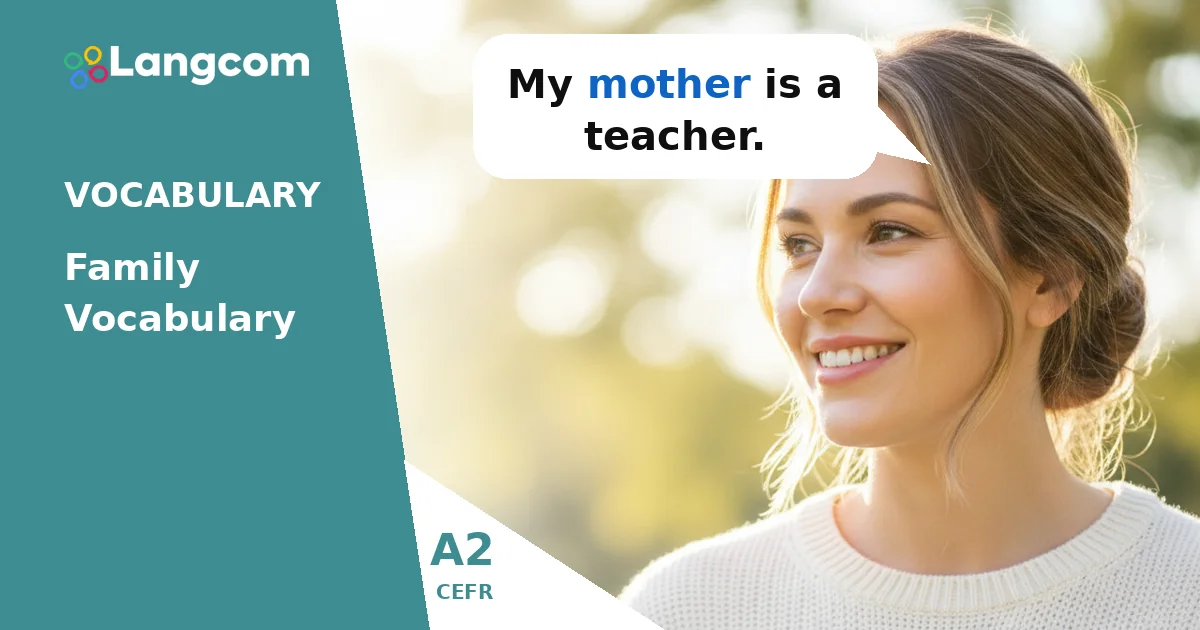
- My mother is a teacher.
- His father works in an office.
- They have two children, a son and a daughter.
- My brother is older than me.
- She lives with her sister.
- My grandparents live in a big house.
- My aunt and uncle are coming to visit.
- I have many cousins.
- Her husband is very kind.
- His wife likes to read.
Prática
Pronto para receber seu certificado?
O curso Langcom prepara os alunos para os exames de Cambridge, IELTS, TOEFL, DELE, SIELE e Michigan.
Comece a usar o LangcomErros comuns entre falantes de espanhol
Common Mistakes with Family Vocabulary
Os falantes de espanhol às vezes cometem estes erros:
- Parents vs. Relatives: In Spanish, 'parientes' means 'relatives' (family members in general). In English, parents means only your mother e father.
- Errado: My parents are my aunt and uncle.
- Direita: My relatives are my aunt and uncle. OU My parents are my mother and father.
- Son vs. Sun: These words sound similar but have different meanings. Son is a male child. Sun is the star in the sky. Be careful with pronunciation and spelling.
- Errado: The sun is playing in the garden.
- Direita: My son is playing in the garden.
Perguntas frequentes
What is the difference between 'grandma' and 'granny'?
Ambos grandma e granny mean grandmother. Grandma is very common and friendly. Granny is also friendly but can sound a little older or more traditional, often used by young children. Both are correct.
How can I talk about my family in the A2 Key exam?
In the A2 Key speaking exam, you might be asked to describe your family. Use the vocabulary you learned here. For example, you can say: I have one brother and one sister. My mother is a doctor. Or, if you see a picture of a family, you can say: I see a mother, a father, and two children.
Are there other words for 'parents'?
The most common and correct word for your mother e father é parents. Sometimes, in very informal situations, people might say folks, but parents is always best for A2 level.

0 Comentários