
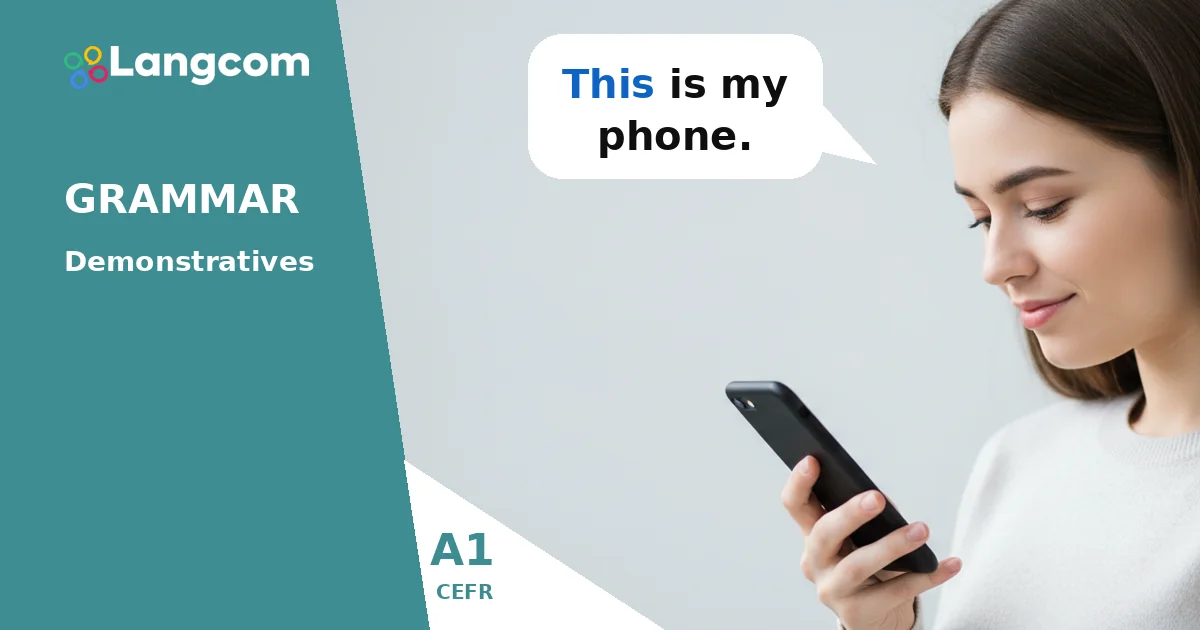

What Are Demonstratives?
Demonstratives are words that help us show *which* person or thing we are talking about. Think of them like a finger pointing!
They give us two important pieces of information:
- Distance: Is the thing near us or far from us?
- Number: Is it one thing (singular) or many things (plural)?
🎓 Aprenda inglês com o método misto
Grupos pequenos · Tutor de IA 24 horas por dia, 7 dias por semana · Preparação para os exames de Cambridge
Planos de $39 $79 por mês
When to Use This e These?
We use this e these for things that are close to the person speaking.
- Use this for one thing (singular) that is near.
- Use these for many things (plural) that are near.
Imagine you can touch the item or it is very close to you.
When to Use That e Those?
We use that e those for things that are far from the person speaking.
- Use that for one thing (singular) that is far.
- Use those for many things (plural) that are far.
Imagine you need to point with your arm because the item is not close to you.
Demonstratives as Adjectives or Pronouns
Demonstratives can work in two ways:
- As a pronoun: They stand alone and replace a noun. For example: This is my book. (This replaces ‘the book’).
- As an adjective: They come before a noun to describe it. For example: This book is mine. (This describes ‘book’).
Both ways are correct and common in English.
| Distance | Número | Demonstrative |
|---|---|---|
| Near | Singular (one) | This |
| Near | Plural (many) | These |
| Far | Singular (one) | That |
| Far | Plural (many) | Those |
Examples
- This is my phone. (singular, near)
- These are my keys. (plural, near)
- That is your car. (singular, far)
- Those are her friends. (plural, far)
- Do you like this shirt? (singular, near, adjective)
- Can you pass me those apples? (plural, far, adjective)
Practice
💬 Precisa de orientação personalizada?
Como Centro Autorizado de Preparação para os Exames de Cambridge, podemos orientá-lo na escolha do curso e da certificação mais adequados. Entre em contato com nossos orientadores hoje mesmo.
Converse com um consultor pelo WhatsAppCommon mistakes for Spanish speakers
Spanish speakers sometimes make these mistakes with demonstratives:
- Omitting the demonstrative: In Spanish, you can often say “Es mi coche” (It’s my car). But in English, you must say This is my car ou That is my car to point to it. You cannot say Is my car.
- Confusing singular and plural: Spanish has more forms (este/esta/estos/estas, ese/esa/esos/esas). Remember in English: this e that are always for one thing. These e those are always for many things.
- Using articles instead of demonstratives: Sometimes Spanish uses “el/la/los/las” where English needs a demonstrative to specify. For example, instead of “Dame el libro” (Give me the book), if you are pointing to a specific book, you might need Give me that book.
Perguntas frequentes
What is the main difference between ‘this’ and ‘that’?
The main difference is distance. We use this for one thing that is near us. We use that for one thing that is far from us.
Can I use demonstratives for people?
Yes, you can use demonstratives for people. For example: This is my friend, Maria. (if Maria is near you) or Those are my parents. (if they are a bit further away).
How do I know if something is ‘near’ or ‘far’?
It depends on your perspective. ‘Near’ means close enough to touch or easily reach. ‘Far’ means you would need to walk or stretch to reach it, or it is across the room or street.
What is the plural of ‘this’?
The plural of this is these. For example, this apple (one, near) becomes these apples (many, near).




0 Comentários