por Raúl | ago 2, 2026 | A2 Key (KET)
To sound natural in English, remember that the word can has two different pronunciations, and can’t has a distinct strong pronunciation. In most positive sentences and questions, can is pronounced with a short, weak sound, like /kən/. This is because it’s...
por Raúl | ago 2, 2026 | A2 Key (KET)
To talk about what you are able to do now, use can. To talk about what you are not able to do now, use can’t. These words are modal verbs. They help us express present ability. For example, if you say I can speak English, it means you have the skill or knowledge...
por Raúl | ago 2, 2026 | A2 Key (KET)
Learning music vocabulary helps you talk about your favorite songs and artists in English! At A2 level, you will learn words for different types of music, called genres, like pop, rock, and jazz. You will also learn names for people who make music, such as a singer or...
por Raúl | ago 2, 2026 | A2 Key (KET)
The Past Continuous tense describes actions that were in progress at a specific moment or over a period of time in the past. Imagine you are looking back at a past event and seeing an action happening. We form it with was or were (the past form of to be) and the -ing...
por Raúl | ago 2, 2026 | A2 Key (KET)
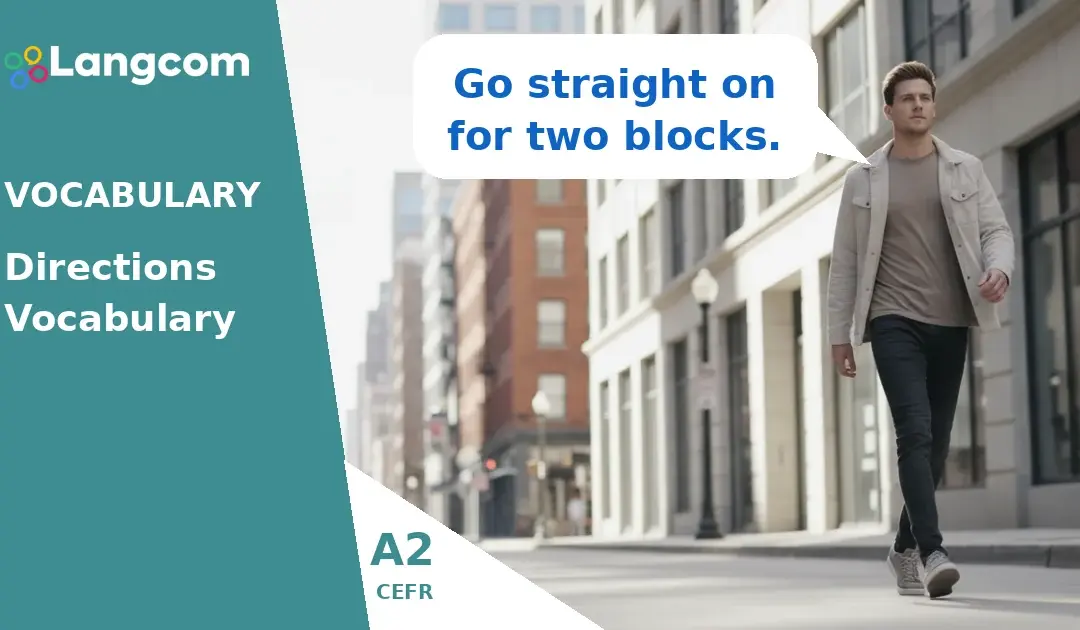
Learning English directions vocabulary helps you navigate new places confidently. When you travel or meet new people, you might need to ask for help to find a shop, a park, or a friend’s house. Knowing words like turn left, go straight, or traffic lights is...

por Raúl | ago 2, 2026 | A2 Key (KET)
Imperatives are verbs used to give direct commands, instructions, advice, or warnings. They tell someone to do something or not to do something. In English, we form positive imperatives using the base form of the verb, without ‘to’ and without a subject....
