

Why is Specific Body Parts Vocabulary Important?
At the B2 level, your English needs to be more precise. Knowing specific body parts helps you describe things accurately.
- For Descriptions: You can give detailed descriptions of people, characters, or even art.
- For Health: When talking about injuries, pain, or medical conditions, exact vocabulary is essential.
- For Exams: Exams like B2 First (FCE) often require you to describe images or discuss health and lifestyle topics, where this vocabulary is very useful.
- For Idioms: Many English idioms use body parts, so understanding the literal meaning helps with the figurative one.
✍️ Não sabe em que nível você está?
Faça nosso teste de nivelamento gratuito e receba um feedback personalizado de examinadores certificados pela Cambridge.
Faça nosso teste de nivelamento GRATUITOEssential B2 Body Parts: Head to Toe
Let's explore some key body parts that are important for B2 learners. Pay attention to their definitions and how they are used.
-
Eyebrows: The strips of hair above your eyes. They help protect your eyes from sweat and are used for expressions.
Exemplo: She raised her eyebrows in surprise.
-
Jaw: The bone that forms the lower part of your mouth and holds your teeth. It moves when you speak or eat.
Exemplo: He clenched his jaw when he was angry.
-
Chest: The upper front part of your body, between your neck and your stomach, containing your heart and lungs.
Exemplo: He felt a sharp pain in his chest.
-
Waist: The narrow part of your body between your ribs and your hips.
Exemplo: She tied a belt around her waist.
-
Elbow: The joint in the middle of your arm where it bends.
Exemplo: He rested his elbows on the table.
-
Wrist: The joint connecting your hand to your forearm.
Exemplo: She wore a watch on her left wrist.
-
Thigh: The upper part of your leg, between your hip and your knee.
Exemplo: The runner had strong thigh muscles.
-
Knee: The joint in the middle of your leg that allows it to bend.
Exemplo: He fell and scraped his knee.
-
Ankle: The joint connecting your foot to your leg.
Exemplo: She twisted her ankle playing football.
Using Body Parts in Common Phrases and Idioms
Many English expressions use body parts. Learning these can make your language more natural.
-
To raise an eyebrow: To show surprise or disapproval.
Exemplo: His strange comment made everyone raise an eyebrow.
-
Jaw-dropping: Extremely surprising or impressive.
Exemplo: The view from the mountain was absolutely jaw-dropping.
-
To get something off your chest: To talk about something that has been worrying you for a long time.
Exemplo: I need to talk to you; I have to get something off my chest.
-
Elbow room: Enough space to move or work comfortably.
Exemplo: The office was so crowded, there was no elbow room.
-
Knee-jerk reaction: A quick, automatic response without much thought.
Exemplo: His decision was a knee-jerk reaction to the news.
| Body Part | Location / Description |
|---|---|
| Eyebrows | Strips of hair above the eyes. |
| Jaw | Lower part of the face, moves when you speak/eat. |
| Chest | Upper front part of the torso, contains heart/lungs. |
| Waist | Narrow part of the body between the ribs and hips. |
| Elbow | The joint in the middle of the arm. |
| Wrist | The joint connecting the hand to the forearm. |
| Thigh | Upper part of the leg, between hip and knee. |
| Knee | The joint in the middle of the leg. |
| Ankle | The joint connecting the foot to the leg. |
Exemplos
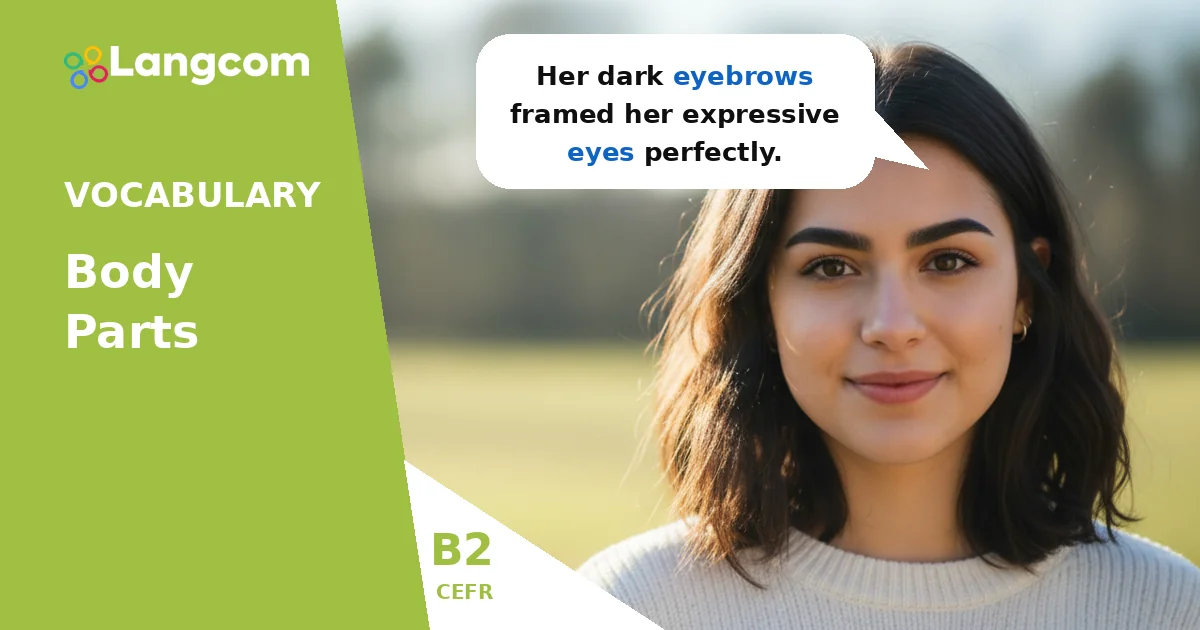
- Her dark eyebrows framed her expressive eyes perfectly.
- The boxer took a punch directly to the jaw.
- He crossed his arms over his chest, deep in thought.
- She wore a dress that was fitted at the waist.
- Be careful not to hit your elbow on the door frame.
- The doctor examined his wrist after the fall.
- Cyclists often have very strong thighs.
- He knelt down on one knee to tie his shoe.
- She wore supportive boots to protect her ankles.
Prática
Pronto para receber seu certificado?
O curso Langcom prepara os alunos para os exames de Cambridge, IELTS, TOEFL, DELE, SIELE e Michigan.
Comece a usar o LangcomErros comuns entre falantes de espanhol
Spanish speakers sometimes confuse certain body parts due to similar-sounding words or different conceptual groupings:
- Leg vs. Thigh: In Spanish, 'pierna' can refer to the whole leg. In English, leg is the entire limb, while thigh is specifically the upper part between the hip and the knee. Don't say My leg hurts if you mean My thigh hurts.
- Arm vs. Elbow vs. Wrist: While 'brazo' is the general term for arm, remember elbow is the middle joint and wrist is the joint connecting the hand. Make sure to use the specific term when needed.
- Chest vs. Breast: For women, chest refers to the general upper front part of the body, while breast refers to the mammary glands. For men, chest is the common term.
- Singular vs. Plural: Remember that some body parts come in pairs and are often used in plural, like eyebrows. If you only mean one, specify one eyebrow.
Perguntas frequentes
Why is this vocabulary important for the B2 First (FCE) exam?
For the B2 First (FCE) exam, especially in the Speaking and Writing papers, you may need to describe people's appearance, discuss health issues, or talk about physical activities. Knowing specific terms like jaw, thigh, e wrist allows you to provide more detailed and accurate descriptions, which contributes to a higher score for vocabulary range and accuracy.
How can I remember new body part words?
To remember new body part vocabulary, try these methods:
- Visualisation: Point to the body part on yourself or a picture as you say the word.
- Flashcards: Write the English word on one side and a definition or a small drawing on the other.
- Contextual sentences: Create your own sentences using the new words.
- Labeling: Find diagrams of the human body and label the parts in English.
- Use in daily life: Try to describe people you see or talk about minor aches and pains using the new vocabulary.
Are there other common body part idioms I should know at B2 level?
Yes, many idioms use body parts. Beyond those mentioned, some common ones include: to pull someone's leg (to joke with someone), to cost an arm and a leg (to be very expensive), to keep an eye on something (to watch something carefully), to give someone the cold shoulder (to ignore someone), and to have a strong stomach (to be able to tolerate unpleasant things).




0 Comentários