
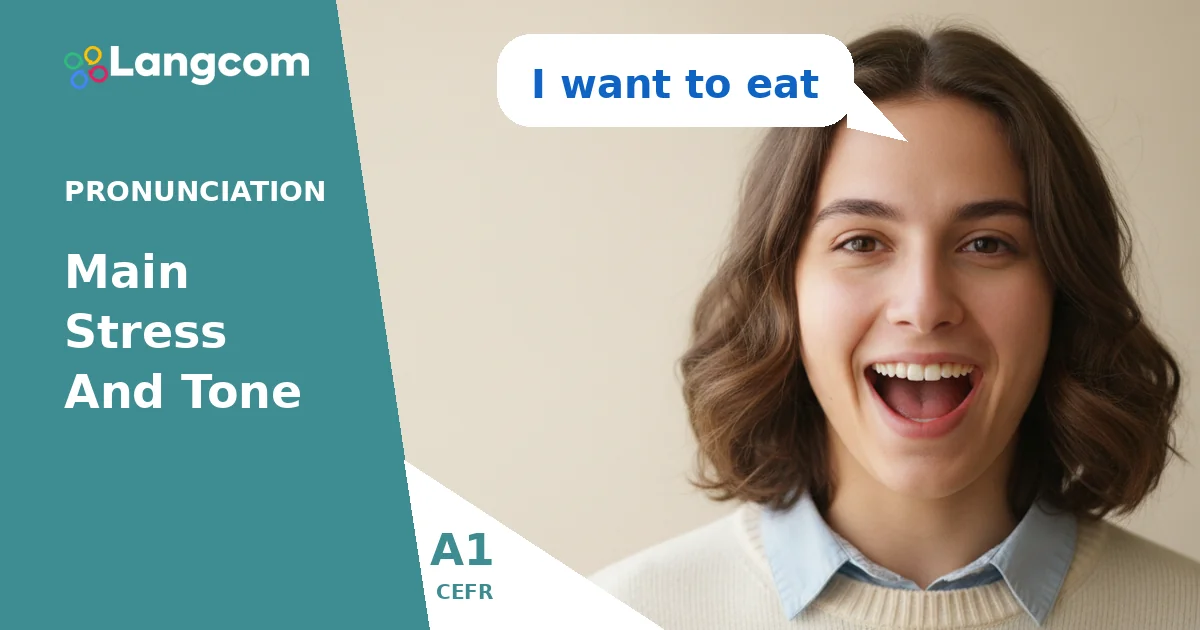

What is Main Stress in English?
Every English word has one main stress. But in a sentence, one word is usually the most important. This word gets the main stress.
- It means you say the word louder.
- You say it longer.
- Your voice might go a little higher on that word.
Usually, main stress goes on content words. These are words that carry the main meaning.
- Nouns (e.g., book, teacher)
- Main verbs (e.g., eat, sleep)
- Adjectives (e.g., happy, big)
- Adverbs (e.no-translation>g., quickly, very)
🎓 Aprenda inglês com o método misto
Grupos pequenos · Tutor de IA 24 horas por dia, 7 dias por semana · Preparação para os exames de Cambridge
Planos de $39 $79 por mês
How Does Tone Work in English?
Tone is the musical part of your voice. It tells listeners if you are asking a question, making a statement, or expressing surprise.
There are two main types of tone for A1 learners:
- Rising Tone: Your voice goes up at the end of the sentence. We use it for yes/no questions.
- Exemplo: Are you happy? (Your voice goes up on “happy”)
- Falling Tone: Your voice goes down at the end of the sentence. We use it for statements e Wh- questions.
- Example (statement): I like coffee. (Your voice goes down on “coffee”)
- Example (Wh- question): Where is the book? (Your voice goes down on “book”)
Why is Main Stress and Tone Important for A1 Learners?
Learning main stress e tone is very helpful. It makes your English easier to understand for others.
- Clearer Communication: People will understand your message better.
- Sound More Natural: You will sound more like a native English speaker.
- Avoid Misunderstandings: The right tone can change the meaning of what you say.
| <span data-no-translation>Tone Type</span> | <span data-no-translation>When to Use</span> | <span data-no-translation>Example</span> |
|---|---|---|
| Rising Tone | Yes/No Questions | Are you ready? |
| Falling Tone | Statements | I am ready. |
| Falling Tone | Wh- Questions | When are you ready? |
Examples
- I want to eat.
- She is a good teacher.
- Do you like pizza?
- What is your name?
- It’s a beautiful day.
Practice
💬 Precisa de orientação personalizada?
Como Centro Autorizado de Preparação para os Exames de Cambridge, podemos orientá-lo na escolha do curso e da certificação mais adequados. Entre em contato com nossos orientadores hoje mesmo.
Converse com um consultor pelo WhatsAppCommon mistakes for Spanish speakers
Spanish speakers sometimes make mistakes with main stress e tone.
- No Clear Stress: In Spanish, words often have more equal stress. In English, one word must stand out.
- Wrong: I am from Spain. (Stress on every word)
- Correct: I am from Spain. (Main stress on “Spain”)
- Flat Tone: Sometimes, learners use a flat tone for everything. This can make English sound less natural.
- Wrong: Are you happy? (Flat tone, sounds like a statement)
- Correct: Are you happy? (Rising tone, clearly a question)
- Wrong Tone for Questions: Using a rising tone for Wh- questions.
- Wrong: Where is the book? (Rising tone)
- Correct: Where is the book? (Falling tone)
Perguntas frequentes
What is the difference between stress and tone?
Stress is about one word being louder and longer. Tone is about your voice going up or down at the end of a sentence.
Do all words have stress?
Every word has a natural stress pattern on one syllable. But in a sentence, only the most important word gets the main stress.
When do I use a rising tone?
You mainly use a rising tone for yes/no questions, like Is it cold?
When do I use a falling tone?
You use a falling tone for statements e Wh- questions, like I like tea. ou What time is it?


0 Comentários