
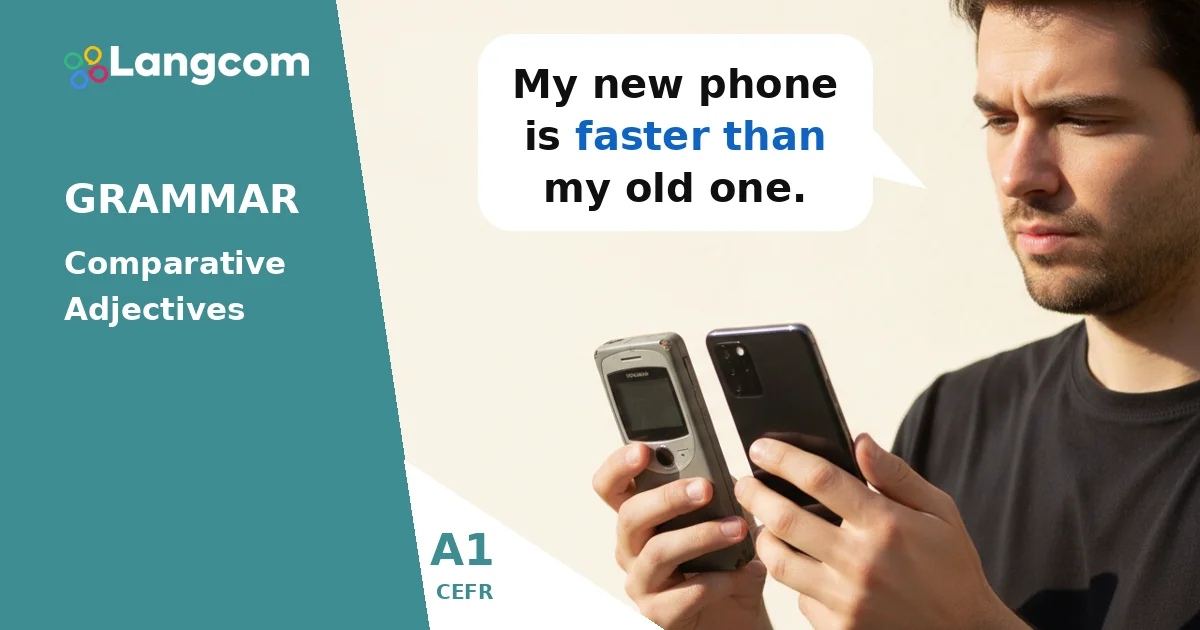

To compare two things in English, we use comparative adjectives. These special words help us say that one thing has more of a quality than another. For example, if you have two apples, one might be bigger than the other. We change the adjective to show this comparison. For short adjectives, we usually add -er to the end, like small torna-se smaller. For longer adjectives, we put the word more before the adjective, such as beautiful torna-se more beautiful. Remember to use than after the comparative adjective when you name the two things you are comparing. This is a basic but very important part of English grammar for everyday conversations.
What Are Comparative Adjectives?
Comparative adjectives help us compare two nouns (people, places, things, ideas). They show which of the two has a certain quality to a greater degree.
Think about two cars. One car might be faster than the other. Or one book might be more interesting than another book.
🎓 Aprenda inglês com o método misto
Grupos pequenos · Tutor de IA 24 horas por dia, 7 dias por semana · Preparação para os exames de Cambridge
Planos de $39 $79 por mês
How Do We Form Comparative Adjectives?
We change the adjective's form to make it comparative. There are two main rules:
- For most short adjectives (1 or 2 syllables), we add -er.
- For most long adjectives (3 or more syllables), we add more antes do adjetivo.
Short Adjectives: Add -er
If an adjective is short, usually one or two syllables, we add -er to the end.
- old → older
- fast → faster
- nice → nicer (if it ends in 'e', just add 'r')
Long Adjectives: Use "more"
If an adjective is long, usually three or more syllables, we put the word more before it.
- beautiful → more beautiful
- expensive → more expensive
- important → more important
Using "than" with Comparatives
When you compare two specific things, you almost always use the word than after the comparative adjective.
It tells us what the first thing is being compared to.
- My car is faster than your car.
- This book is more interesting than that movie.
Special Spelling Rules
Sometimes, we need to change the spelling of an adjective before adding -er.
- If an adjective ends in -y, alterar y para i and then add -er: happy → happier, noisy → noisier.
- If a short adjective ends in a consonant-vowel-consonant pattern, we often double the last consonant before adding -er: big → bigger, hot → hotter.
What About Superlative Adjectives?
When you compare three or more things and want to say which one has the most of a quality, you use a superlative adjective.
Para superlatives, we usually add -est to short adjectives (e.g., oldest, biggest) and use the most for long adjectives (e.g., the most beautiful).
Lembre-se de usar the before the superlative adjective.
Exemplo: Lisa is small. Lulu is bigger than Lisa. But Lenny is the biggest!
| Adjetivo | Comparative | Superlative |
|---|---|---|
| old | older | oldest |
| big | bigger | biggest |
| nice | nicer | nicest |
| happy | happier | happiest |
| expensive | more expensive | most expensive |
| beautiful | more beautiful | most beautiful |
Exemplos
- My new phone is faster than my old one.
- This book is more interesting than that movie.
- The mountain is higher than the hill.
- Learning English is easier with Langcom.
- Cities are often noisier than the countryside.
- Today's weather is hotter than yesterday's.
Prática
💬 Precisa de orientação personalizada?
Como Centro Autorizado de Preparação para os Exames de Cambridge, podemos orientá-lo na escolha do curso e da certificação mais adequados. Entre em contato com nossos orientadores hoje mesmo.
Converse com um consultor pelo WhatsAppErros comuns entre falantes de espanhol
Os falantes de espanhol às vezes cometem estes erros:
- Using "more" with short adjectives: In Spanish, you often use "más" for all comparisons. In English, remember to use -er para adjetivos curtos.
-
Incorreto: My house is more big than yours.
-
Correto: My house is bigger than yours.
- Forgetting "than": When comparing two specific things, you need than.
-
Incorreto: She is taller him.
-
Correto: She is taller than him.
Perguntas frequentes
What is the main difference between comparative and superlative adjectives?
Comparative adjectives compare two things (e.g., taller). Superlative adjectives compare three or more things and show which one has the most of a quality (e.g., the tallest).
Do all adjectives follow the -er / more rule?
Most do! But there are a few irregular ones, like good → better, e bad → worse. You will learn these as you continue studying English.
When do I use "the" with comparative adjectives?
You usually don't use the directly before a comparative adjective when comparing two things (e.g., He is taller than me, e não the taller). We use the com superlative adjectives (e.no-translation>He is the tallest).




0 Comentários