

What are Verbs?
Verbs are words that show an action or a state. They are very important in every sentence.
- Think of verbs as the ‘doing’ words.
- For example, in I eat an apple, the verb is eat. It shows an action.
- In She is happy, the verb is is. It shows a state.
🎓 Aprenda inglês com o método misto
Grupos pequenos · Tutor de IA 24 horas por dia, 7 dias por semana · Preparação para os exames de Cambridge
Planos de $39 $79 por mês
Meet Your First English Verbs!
Here are eight common verbs that you can use to talk about your daily life. These are all in their base form (infinitive without ‘to’).
- live: To have your home in a place.
- work: To do a job.
- study: To learn about a subject, often at school or university.
- speak: To talk in a language.
- go: To move from one place to another.
- teach: To give lessons to students.
- play: To do an activity for fun, like a sport or game.
- meet: To see and talk to someone for the first time or by arrangement.
How to Use These Verbs in Simple Sentences?
At A1 level, you can use these verbs to make simple sentences about yourself and others. We often use them with I, you, we, e they.
- For I, you, we, they, the verb form does not change.
- For he, she, it, we add -s ou -es to the verb. This is very important!
Look at these examples:
Verbs for Your Daily Routine
These verbs are perfect for describing what you do every day. Think about your morning, afternoon, and evening.
- What do you do in the morning? I go to work.
- Where do you live? I live in a city.
- What languages do you speak? I speak Spanish and English.
| Verb | Meaning |
|---|---|
| live | To have your home in a place |
| work | To do a job |
| study | To learn about a subject |
| speak | To talk in a language |
| go | To move from one place to another |
| teach | To give lessons to students |
| play | To do an activity for fun |
| meet | To see and talk to someone |
Examples
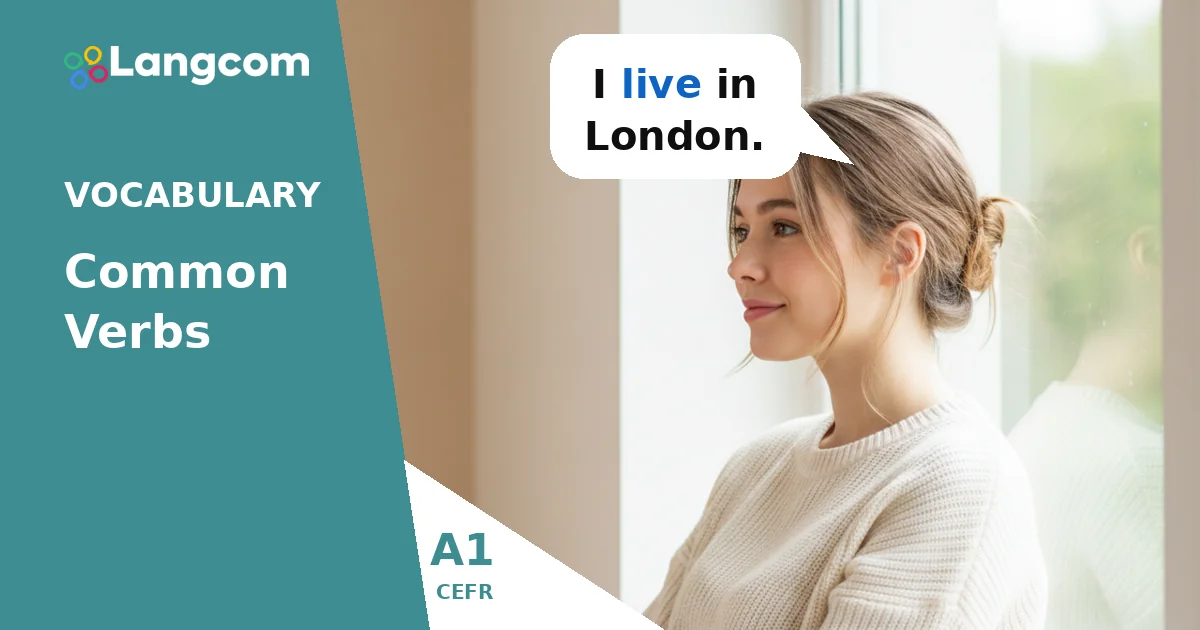
- I live in London.
- We work in an office.
- She studies at university.
- They speak Japanese.
- He goes to the gym every day.
- I teach young children.
- We play tennis on Sundays.
- She meets her friends for coffee.
Practice
💬 Precisa de orientação personalizada?
Como Centro Autorizado de Preparação para os Exames de Cambridge, podemos orientá-lo na escolha do curso e da certificação mais adequados. Entre em contato com nossos orientadores hoje mesmo.
Converse com um consultor pelo WhatsAppCommon mistakes for Spanish speakers
A common mistake for Spanish speakers at A1 level is forgetting to add -s to verbs when talking about he, she, or it.
- Incorrect: He live in a big house.
- Correct: He lives in a big house.
- Incorrect: She work in a factory.
- Correct: She works in a factory.
- Incorrect: It go fast.
- Correct: It goes fast.
Remember this rule: for he, she, it, the verb needs an -s (or -es for some verbs like go).
Perguntas frequentes
What is the most important thing to remember about verbs?
The most important thing is that verbs show actions or states. They tell you ‘what happens’ or ‘what something is like’. Every sentence needs a verb.
Do all verbs change when I use ‘he’, ‘she’, or ‘it’?
Yes, in the simple present tense, most verbs add an -s (or -es) when the subject is he, she, or it. For example, I live but he lives.
How can I practice these verbs?
The best way to practice is to make sentences about your own life. For example, write about where you live, what you study, or what languages you speak. You can also listen to English and try to identify the verbs.
Are these verbs useful for English exams?
Yes, these common verbs are fundamental for A1 level exams. You will use them in speaking tasks to describe yourself and your daily routine, and in writing tasks to form simple sentences.



0 Comentários