

What are Indefinite Pronouns?
Indefinite pronouns do not point to a specific person, thing, or place. They are general.
They are very useful when you don’t know exactly who or what you are talking about, or when it’s not important to be specific.
- For people, we use -one ou -body (e.g., someone, anyone).
- For things, we use -thing (e.g., something, anything).
- For places, we use -where (e.g., somewhere, anywhere).
✍️ Não sabe em que nível você está?
Faça nosso teste de nivelamento gratuito e receba um feedback personalizado de examinadores certificados pela Cambridge.
Faça nosso teste de nivelamento GRATUITOWhen Do We Use 'Some-' Words?
We use indefinite pronouns with some- (like someone, something, somewhere) mainly in positive sentences.
- Uso someone ou somebody for an unknown person.
- Uso something for an unknown thing.
- Uso somewhere for an unknown place.
Também utilizamos some- words in questions when we expect a 'yes' answer, or when we are making an offer or a request.
When Do We Use 'Any-' Words?
We use indefinite pronouns with any- (like anyone, anything, anywhere) in questions and negative sentences.
- Uso anyone ou anybody in questions or negative sentences about people.
- Uso anything in questions or negative sentences about things.
- Uso anywhere in questions or negative sentences about places.
Sometimes, any- words can also be used in positive sentences to mean 'it doesn't matter who/what/where'.
When Do We Use 'No-' Words?
Indefinite pronouns with no- (like no one, nobody, nothing, nowhere) mean 'zero' or 'not any'.
It is important to use a positive verb with no- words. This is because the no- word itself makes the sentence negative.
- No one e nobody mean 'not a single person'.
- Nothing means 'not a single thing'.
- Nowhere means 'not a single place'.
When Do We Use 'Every-' Words?
Indefinite pronouns with every- (like everyone, everybody, everything, everywhere) mean 'all' or 'all people/things/places'.
- Everyone e everybody mean 'all people'.
- Everything means 'all things'.
- Everywhere means 'all places'.
Remember that even though every- words refer to many people or things, they always take a singular verb.
| People | Things | Places | |
|---|---|---|---|
| Some- | someone / somebody | something | somewhere |
| Any- | anyone / anybody | anything | anywhere |
| Every- | everyone / everybody | everything | everywhere |
| No- | no one / nobody | nothing | nowhere |
Exemplos
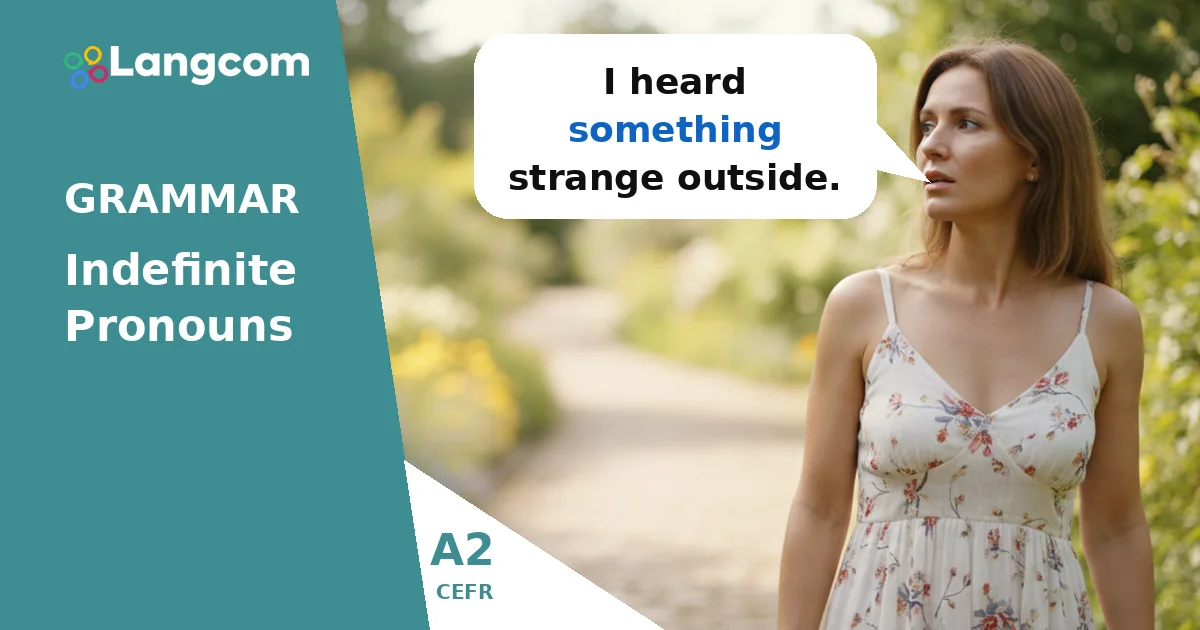
- I heard something strange outside.
- Is there anyone home?
- Nobody came to the party.
- Everything is ready for the trip.
- Would you like something to drink?
- I can't find my keys anywhere.
- Everyone needs a break sometimes.
- There's somebody at the door.
Prática
Pronto para receber seu certificado?
O curso Langcom prepara os alunos para os exames de Cambridge, IELTS, TOEFL, DELE, SIELE e Michigan.
Comece a usar o LangcomErros comuns entre falantes de espanhol
Spanish speakers sometimes make mistakes with indefinite pronouns, especially with negative sentences.
- Double Negatives: In Spanish, you can say 'no tengo nada' (I don't have nothing). But in English, you cannot use two negative words together. You must say I don't have anything ou I have nothing. You cannot say I don't have nothing.
- Verb Agreement with 'Every-' words: Remember that everyone, everybody, e everything always take a singular verb. For example, it's Everyone is happy, e não Everyone are happy.
- Using 'some-' in questions: Only use some- words in questions when you expect a 'yes' answer or are making an offer/request. For general questions, use any- words. For example, Do you have anything to say? (general question) vs. Would you like something to eat? (offer).
Perguntas frequentes
What is the difference between 'someone' and 'anyone'?
Utilizamos someone in positive sentences and in questions where we expect a 'yes' answer or are making an offer. We use anyone in questions and negative sentences.
Can I use 'nobody' and 'not' in the same sentence?
No, you cannot. Nobody already makes the sentence negative. For example, say Nobody came, e não Nobody didn't come.
Do 'everyone' and 'everything' take a singular or plural verb?
They always take a singular verb. For example, Everyone is here e Everything looks good.
How can understanding indefinite pronouns help me in the A2 Key exam?
Knowing how to correctly use indefinite pronouns will help you understand questions and texts, especially in Reading and Listening parts, and express yourself clearly in Writing and Speaking tasks, avoiding common grammatical errors.



0 Comentários