

What Exactly Are Fronting Adverbials?
An adverbial is a word or phrase that gives more information about the verb, adjective, or another adverb. It often tells us about place, time, manner, or frequency.
When we talk about fronting adverbials, we mean moving one of these adverbial phrases to the very beginning of a sentence. This changes the natural word order and draws attention to the adverbial itself.
- Normally, the old castle stood on the hill. (Adverbial at the end)
- On the hill stood the old castle. (Fronting adverbial)
✍️ Não sabe em que nível você está?
Faça nosso teste de nivelamento gratuito e receba um feedback personalizado de examinadores certificados pela Cambridge.
Faça nosso teste de nivelamento GRATUITOWhy Use Fronting Adverbials in English?
Fronting adverbials are not just a grammatical trick; they serve a specific stylistic purpose. They are common in formal writing, literature, and journalism.
- For Emphasis: They highlight the information in the adverbial. For example, Never before had I seen such beauty. emphasizes the uniqueness of the experience.
- For Dramatic Effect: They can build suspense or create a more vivid image. Into the dark forest walked the brave knight. sounds more dramatic than The brave knight walked into the dark forest.
- To Link Ideas: They can connect sentences smoothly, especially in narratives. After a long journey, came the moment of truth.
- To Avoid Repetition: They can vary sentence structure, making your writing more engaging and less monotonous.
When Do We Invert the Subject and Verb?
This is the trickiest part of fronting adverbials. Inversion (where the verb comes before the subject) happens only in specific situations, primarily when there is no direct object.
- With the verb be: If the main verb is be, we invert.
- In the envelopes are crisp new dollar bills. (Not In the envelopes crisp new dollar bills are.)
- Beyond the mountains lies a hidden village. (Not Beyond the mountains a hidden village lies.)
- With verbs of place or movement: If the main verb indicates placement (sit, lie, stand) or movement (come, go, fly, waft, rush), we invert. This is common with adverbials of place.
- On the tablecloth lies a stack of red envelopes.
- Through the kitchen door wafts the smell of fresh dumplings.
- Up the hill rolled the enormous boulder.
- Important Note: This inversion happens only if the subject is a noun phrase. If the subject is a pronoun, we generally do not invert.
- Into the room walked John. (Inversion)
- Into the room he walked. (No inversion with pronoun 'he')
When Do We NOT Invert the Subject and Verb?
In many cases, even with a fronting adverbial, the word order remains Subject + Verb. This is crucial to remember.
- When there is a direct object: If the main verb takes a direct object, we do not invert. The structure is Fronting Adverbial, Subject + Verb + Direct Object.
- In the garden, she placed a little ceramic frog near the door for good luck. (Here, 'a little ceramic frog' is the direct object of 'placed'.)
- Throughout the house, we put up decorations. (Here, 'decorations' is the direct object of 'put up'.)
- With most other verbs: If the verb is not be or a verb of place/movement (and there is no direct object), inversion is less common or incorrect.
- With adverbials of time or manner: While they can be fronted for emphasis, they usually do not cause inversion.
- Suddenly, the music stopped.
- Carefully, she opened the old box.
Summary of Fronting Adverbial Patterns
To simplify, remember these two main patterns for fronting adverbials:
- Pattern 1: Inversion (Verb + Subject)
Used when:- The adverbial is of place or movement.
- The verb is be or a verb of place/movement (sit, stand, come, go, etc.).
- There is NO direct object.
- The subject is a noun phrase.
Exemplo: Under the ancient oak tree sat a wise old owl.
- Pattern 2: No Inversion (Subject + Verb)
Used when:- The adverbial is of time, manner, or other types.
- There IS a direct object.
- The verb is not be or a verb of place/movement.
- The subject is a pronoun.
Exemplo: In the library, we found many old books.
| Condition | Example with Inversion | Example without Inversion |
|---|---|---|
| No Direct Object, Verb of Place/Movement/Be | On the table lay the old book. | Behind the curtain, she stood. (Pronoun subject) |
| Direct Object Present | N/A (Inversion not used) | In the library, we found many old books. |
| Adverbial of Time/Manner | N/A (Inversion not typically used) | Suddenly, the door opened. |
Exemplos
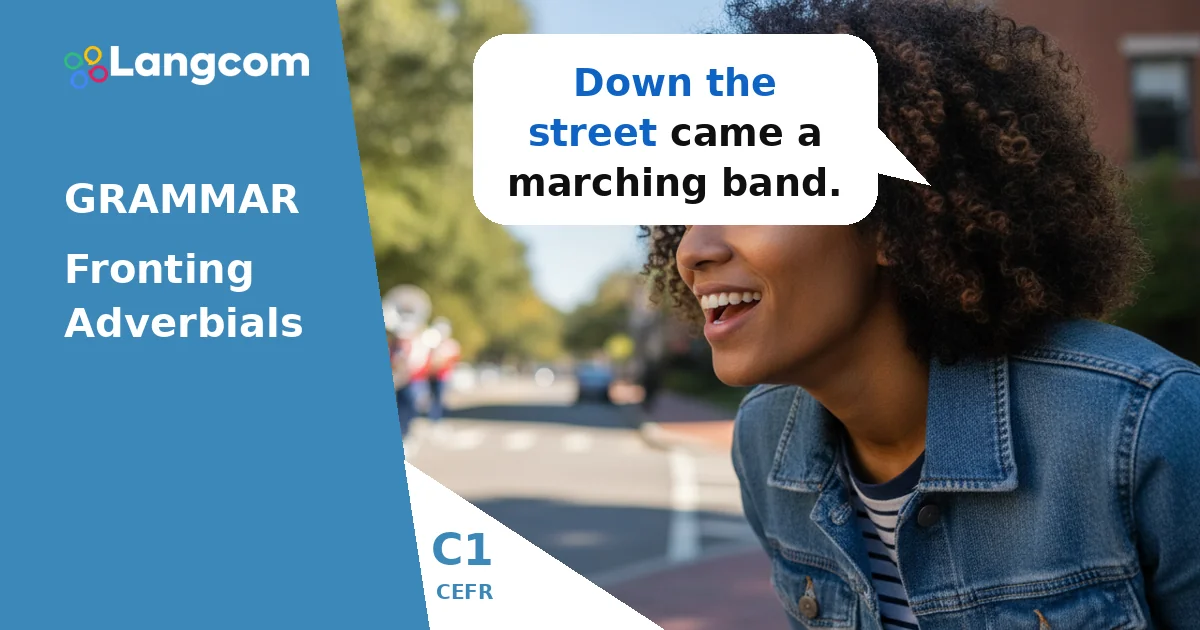
- Down the street came a marching band.
- In the distance, stood the ruins of a medieval castle.
- From the living room wafted the sounds of the television.
- On the walls hung portraits of their ancestors.
- From the backyard floated the sounds of children playing.
- In the kitchen, people cooked traditional foods.
- Throughout the house, we put up decorations.
- Near the window, sat a small, fluffy cat.
- Only then did I understand the truth.
Prática
Pronto para receber seu certificado?
O curso Langcom prepara os alunos para os exames de Cambridge, IELTS, TOEFL, DELE, SIELE e Michigan.
Comece a usar o LangcomErros comuns entre falantes de espanhol
Spanish speakers, and learners from other languages, often make mistakes with inversion because English rules are quite strict compared to more flexible word orders in other languages.
- Incorrect Inversion with a Direct Object: A very common error is inverting the subject and verb when there is a direct object. Remember, if there's a direct object, no inversion!
- Incorreto: In the library, found we family portraits.
- Correto: In the library, we found family portraits. ('family portraits' is the direct object)
- Failure to Invert When Necessary: Sometimes learners forget to invert when the conditions for inversion are met.
- Incorreto: On the hill an old castle stood.
- Correto: On the hill stood an old castle. (No direct object, verb of place)
- Inverting with Pronoun Subjects: Inversion typically does not happen when the subject is a pronoun.
- Incorreto: Into the room walked he.
- Correto: Into the room he walked.
- Overuse in Informal Contexts: Fronting adverbials, especially with inversion, sound formal. Using them too much in casual conversation can sound unnatural.
Perguntas frequentes
What is the main purpose of using a fronting adverbial?
The main purpose is to add emphasis, create a dramatic effect, or achieve a more formal and literary style in your writing or speech. It highlights the information in the adverbial phrase.
When should I invert the subject and verb after a fronting adverbial?
You should invert the subject and verb when the adverbial is of place or movement, the main verb is be or a verb of place/movement (sit, stand, come, etc.), and there is no direct object in the sentence. Also, the subject should be a noun phrase, not a pronoun.
When should I NOT invert the subject and verb?
Do not invert if the sentence contains a direct object. Also, if the subject is a pronoun, or if the adverbial is of time or manner, inversion is generally not used. The word order remains Fronting Adverbial, Subject + Verb (+ Direct Object).
Are fronting adverbials common in everyday conversation?
While you might hear simple fronting adverbials (like Suddenly, it started to rain.) in conversation, the more complex forms involving inversion are generally more common in formal writing, literature, news reports, and speeches. Using them appropriately shows a high level of English proficiency.
How can I practice using fronting adverbials for C1 exams?
For C1 exams like CAE or IELTS, practice incorporating fronting adverbials into your essays or reports where appropriate. Pay close attention to the inversion rules. Look for opportunities to rewrite sentences for dramatic effect or emphasis, especially in descriptive writing tasks. For example, instead of A solution appeared after much thought, try After much thought, appeared a solution.


0 Comentários