

What Are Three-Word Phrasal Verbs?
Three-word phrasal verbs are a type of multi-word verb that includes a main verb, an adverb, and a preposition. Together, these three words form a single unit with an idiomatic meaning.
This meaning is often very different from the individual words. For example, get through to does not literally mean to ‘pass’ or ‘arrive’ through something. It means to make someone understand.
- They are usually inseparable. You cannot put an object between the verb and the adverb or the adverb and the preposition.
- They are common in both formal and informal English, making your language sound more natural and sophisticated.
✍️ Não sabe em que nível você está?
Faça nosso teste de nivelamento gratuito e receba um feedback personalizado de examinadores certificados pela Cambridge.
Faça nosso teste de nivelamento GRATUITOWhy Are They Important for C1 English?
At the C1 level, you need to understand and use a wide range of complex vocabulary. Three-word phrasal verbs are a significant part of this.
- Enhanced Fluency: Using these verbs helps you express yourself more naturally and precisely, like a native speaker.
- Better Comprehension: You will understand complex conversations, articles, and media more easily.
- Exam Success: They are frequently tested in advanced English exams, showing your mastery of idiomatic expressions.
- Nuanced Expression: They allow you to convey subtle differences in meaning that single verbs might not capture.
Common Three-Word Phrasal Verbs and Their Meanings
Let's explore some key three-word phrasal verbs that are useful for C1 learners:
- Face up to: To accept and deal with a difficult or unpleasant fact or situation. It means to confront reality.
- Put up with: To tolerate or accept an unpleasant situation or person without complaining. It means to endure.
- Get through to: To make someone understand what you are trying to say, especially when they are being difficult or slow to understand.
- Fall back on: To use or depend on something or someone when other things have failed or are not available. It means to rely on as a last resort.
- Stand up for: To support or defend a person or an idea that is being criticized or attacked. It means to advocate for.
| Phrasal Verb | Significado | Exemplo |
|---|---|---|
| face up to | Accept a difficult reality | You must face up to the truth about your grades. |
| put up with | Tolerate something unpleasant | I can't put up with this noise any longer. |
| get through to | Make someone understand | It's hard to get through to him when he's angry. |
| fall back on | Rely on as a last resort | She had to fall back on her savings after losing her job. |
| stand up for | Support or defend someone/something | It's important to stand up for your rights. |
Exemplos
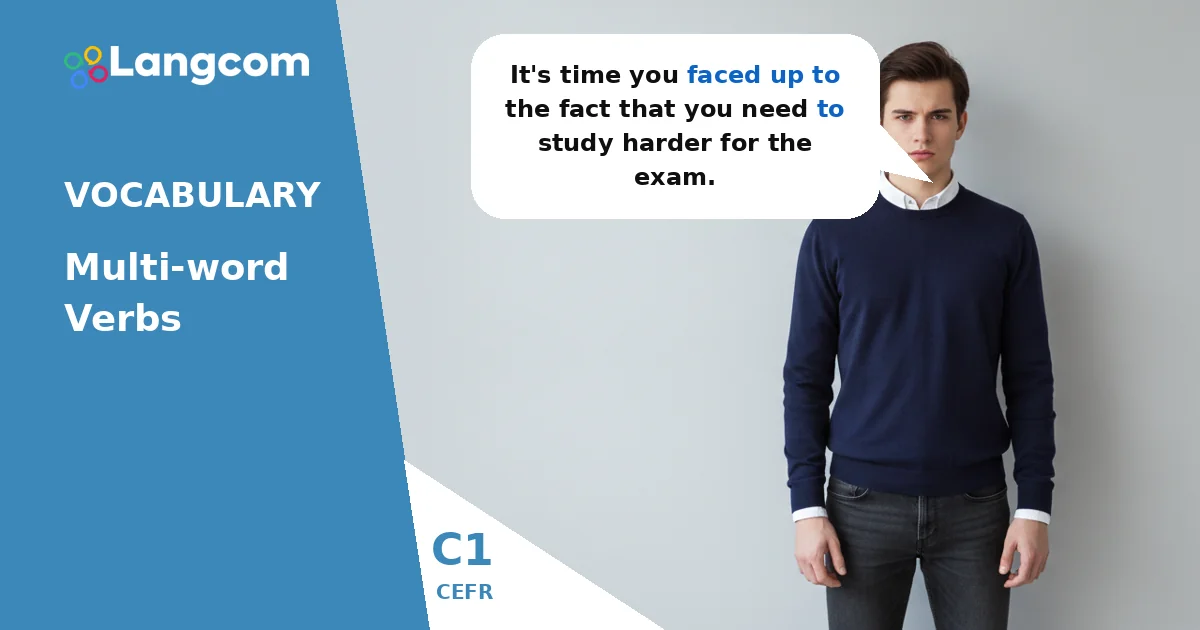
- It's time you faced up to the fact that you need to study harder for the exam.
- I don't know how she puts up with his constant complaining.
- I tried to explain the problem, but I just couldn't get through to him.
- If the business fails, we'll have to fall back on our savings.
- You should always stand up for what you believe in, even if it's unpopular.
Prática
Pronto para receber seu certificado?
O curso Langcom prepara os alunos para os exames de Cambridge, IELTS, TOEFL, DELE, SIELE e Michigan.
Comece a usar o LangcomErros comuns entre falantes de espanhol
Spanish speakers often make specific errors with three-word phrasal verbs:
- Direct Translation: Trying to translate each word literally from Spanish, which rarely works because phrasal verbs are idiomatic. For example, put up with does not mean 'poner arriba con'.
- Incorrect Prepositions: Using the wrong preposition is a common error. For instance, saying face up for em vez de face up to. The prepositions are fixed.
- Separability: Most three-word phrasal verbs are inseparable. You cannot place an object between the verb and its particles. For example, you cannot say I put his complaining up with; it must be I put up with his complaining.
- Overlooking the Idiomatic Meaning: Not recognizing that the entire phrase has a new, distinct meaning. Always learn them as a single unit.
Perguntas frequentes
Are three-word phrasal verbs always inseparable?
Yes, three-word phrasal verbs are almost always inseparable. This means you cannot place an object between the verb, adverb, or preposition. The object always comes after the entire three-word unit, as in We need to face up to the challenge.
How can I remember so many phrasal verbs?
The best way to remember three-word phrasal verbs is to learn them in context. Don't just memorize lists. Read, listen, and practice using them in full sentences. Create your own examples, and try to notice them in authentic English materials.
Are three-word phrasal verbs formal or informal?
Three-word phrasal verbs can appear in both formal and informal contexts. For example, face up to can be used in a serious discussion, while mess around with (from the audio) is more informal. Pay attention to the context to understand their register.
Do C1 exams test three-word phrasal verbs?
Yes, C1 level exams like Cambridge C1 Advanced (CAE) or IELTS often test your knowledge of phrasal verbs, including three-word ones. You might encounter them in reading comprehension, listening tasks, or be expected to use them appropriately in writing and speaking sections to demonstrate advanced vocabulary.



0 Comentários