

Why is the English Alphabet Important?
The English alphabet is the base of the language. It has 26 letters.
Learning the letters helps you read, write, and spell words correctly. It is very important for clear communication.
- You can spell your name or other words.
- You can understand when someone spells a word for you.
- Pode-se dizer que email addresses e phone numbers.
🎓 Aprenda inglês com o método misto
Grupos pequenos · Tutor de IA 24 horas por dia, 7 dias por semana · Preparação para os exames de Cambridge
Planos de $39 $79 por mês
How Do We Say the Letters?
Each letter in the English alphabet has a specific sound when we say it alone. These sounds are important for spelling.
- When you say your name, you often need to spell it out loud. For example, M-A-R-I-A.
- When you hear a new word, someone might spell it for you. For example, B-O-O-K.
Practice saying each letter clearly. This will help you understand and be understood.
What is Personal Information?
Personal information is basic data about you. It helps people identify you.
When you meet new people or fill out a form, you often share this information.
- Seu first name is the name given to you at birth.
- Seu last name (ou surname) is your family name.
- Seu email address is how people send you electronic messages.
- Seu phone number is how people call you.
How Do We Spell Names and Words?
Spelling is saying the letters of a word one by one. This is very common when names are difficult to understand.
- If your name is Juan, you might say: "My name is Juan. That's J-U-A-N."
- If someone asks for your last name, you might say: "My last name is Garcia. G-A-R-C-I-A."
Always speak slowly and clearly when spelling.
How Do We Say Email Addresses?
Email addresses use letters, numbers, and special symbols. You need to know how to say these symbols.
- The symbol @ is always called at.
- The symbol . (dot) is called dot.
- Sometimes, you see _ (underscore). This is called underscore.
Por exemplo, [email protected] is said as "maria dot gomez at langcom dot com."
| English Term | O que isso significa |
|---|---|
| First name | Your personal given name (e.g., Anna, David) |
| Last name / Surname | Your family name (e.g., Smith, Garcia) |
| Email address | Your address for electronic mail (e.g., [email protected]) |
| Phone number | Your number for telephone calls (e.g., 555-123-4567) |
| Spell | To say the letters of a word in order |
| @ (at) | A symbol used in email addresses |
| . (dot) | A symbol used in email addresses and websites |
Exemplos
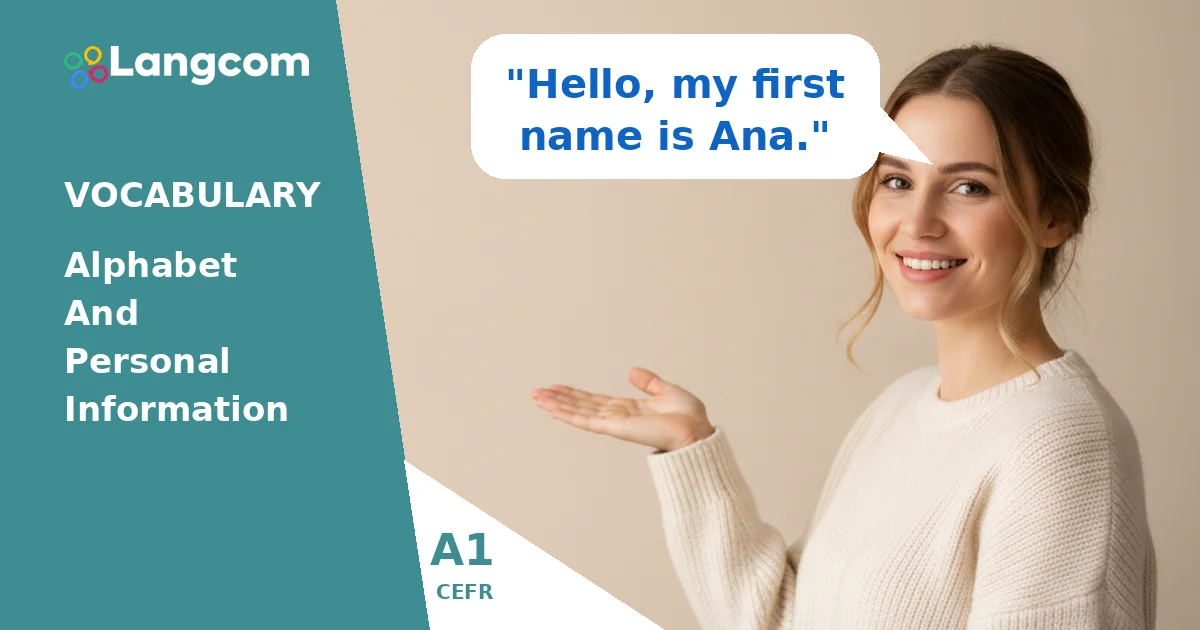
- "Hello, my first name is Ana."
- "What's your last name?"
- "Can you spell that, please?"
- "It's A-N-A."
- "My email address is [email protected]."
- "My phone number is 555-123-4567."
- "How do you spell 'book'? B-O-O-K."
Prática
💬 Precisa de orientação personalizada?
Como Centro Autorizado de Preparação para os Exames de Cambridge, podemos orientá-lo na escolha do curso e da certificação mais adequados. Entre em contato com nossos orientadores hoje mesmo.
Converse com um consultor pelo WhatsAppErros comuns entre falantes de espanhol
Many Spanish speakers make mistakes with certain English letter sounds:
- A vs. E: Em inglês, A sounds like 'ei' (as in 'day'), and E sounds like 'ii' (as in 'see'). Be careful not to confuse them.
- I vs. E: Inglês I sounds like 'ai' (as in 'my'), and English E sounds like 'ii'.
- J vs. Y: Inglês J sounds like 'dʒei' (as in 'jump'), while English Y sounds like 'wai' (as in 'yes').
- B vs. V: Em inglês, B is a 'b' sound (lips together), and V is a 'v' sound (teeth on lip).
For personal information, remember:
- Uso first name e last name (ou surname). Do not use 'apellido' directly.
- Always say at for @ e dot for . in email addresses.
Perguntas frequentes
What is the difference between 'first name' and 'last name'?
Seu first name is your personal given name, like Maria ou Juan. Your last name (also called surname) is your family name, like Gomez ou Smith.
How do I spell my name in English?
You say each letter of your name one by one, using the English pronunciation for each letter. For example, if your name is Sofia, you would say "S-O-F-I-A."
What do 'at' and 'dot' mean in an email address?
In an email address, at is the English word for the symbol @. Dot is the English word for the symbol . (period or full stop).
Why is it important to learn the alphabet sounds?
Learning the alphabet sounds helps you spell words correctly, understand when others spell words, and pronounce new words better. It is key for clear communication in English.


0 Comentários