

Why Use Advanced Verbs for Thinking?
In English, using specific verbs helps you express exactly what you mean. Instead of just saying “I think about the future,” you can use a more precise verb. This makes your English sound more natural and advanced, especially at a C1 level.
These verbs are important for many situations:
- Academic writing: When you need to explain research or arguments.
- Professional communication: When discussing strategies, problems, or solutions at work.
- Everyday conversations: When you want to share your opinions or plans clearly.
✍️ Não sabe em que nível você está?
Faça nosso teste de nivelamento gratuito e receba um feedback personalizado de examinadores certificados pela Cambridge.
Faça nosso teste de nivelamento GRATUITOVerbs for Predicting and Imagining
These verbs help you talk about what you expect or imagine will happen.
- Foresee: To know or expect something before it happens. It's about seeing the future.
- The company tried to foresee market changes.
- Envision: To imagine something as a future possibility. It's about creating a mental picture.
- She envisions a world with no pollution.
Verbs for Understanding and Judging
These verbs describe how you process information and form opinions.
- Analyze: To examine something in detail to understand its parts or structure.
- We need to analyze the data carefully.
- Evaluate: To judge the quality, importance, or value of something.
- The manager will evaluate our performance.
- Interpret: To explain the meaning of something, especially difficult text or data.
- It's hard to interpret these complex instructions.
Verbs for Reviewing and Changing Your Mind
Use these verbs when you look back at something or think about changing a decision.
- Review: To examine something again, often to check it or make changes.
- Let's review the plan before we start.
- Reconsider: To think about something again, especially a decision or opinion, with the possibility of changing it.
- Please reconsider your offer.
Verbs for Ignoring and Rejecting Ideas
These verbs describe how you deal with ideas or information you don't accept.
- Dismiss: To decide that something or someone is not important or not worth considering.
- He dismissed her concerns as unimportant.
- Disregard: To pay no attention to something; to ignore it.
- You should disregard his rude comments.
- Reject: To refuse to accept something or someone. It's a stronger refusal than dismiss.
- The committee rejected the proposal.
Verbs for Focusing and Assuming
These verbs describe how you concentrate or make assumptions.
- Fixate: To focus all your attention on one thing or idea, often in an unhealthy or obsessive way.
- Don't fixate on past mistakes.
- Presume: To suppose that something is true, without proof.
- I presume you're familiar with the rules.
| Verbo | Significado | Exemplo |
|---|---|---|
| Dismiss | To decide something is not important or worth considering. | She dismissed his concerns. |
| Disregard | To ignore something, often intentionally. | Please disregard the previous email. |
| Reject | To refuse to accept something firmly. | They rejected the proposal. |
Exemplos
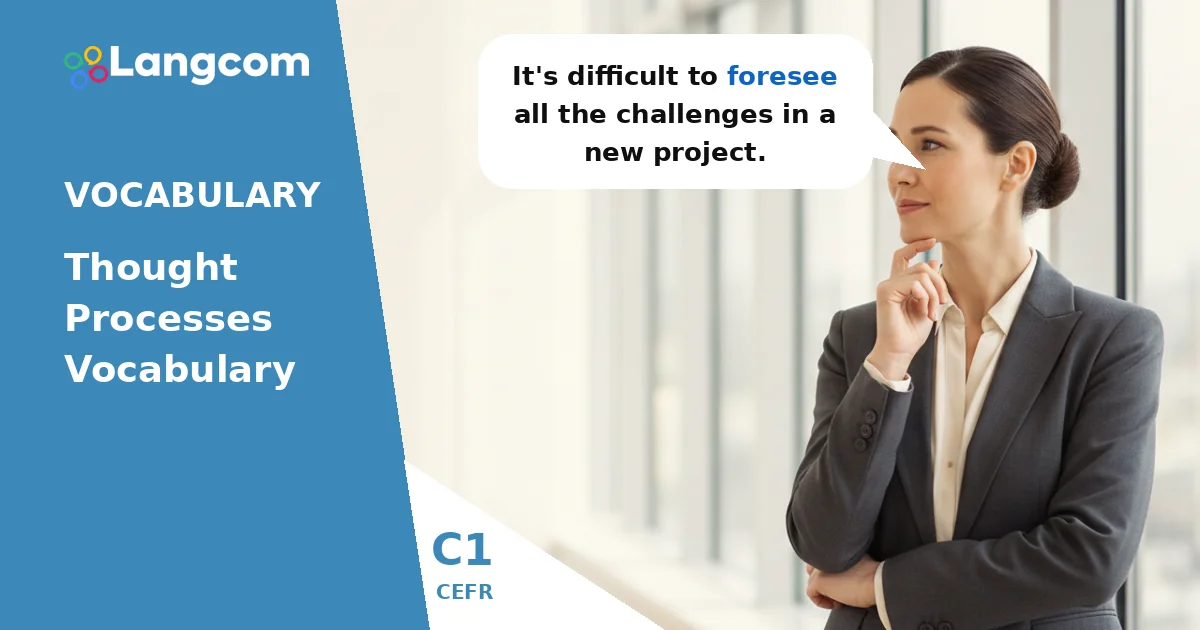
- It's difficult to foresee all the challenges in a new project.
- The architect envisions a building that blends with nature.
- Before making a decision, we must analyze all the available data.
- The board will evaluate the risks and benefits of the merger.
- Can you interpret the meaning of this abstract painting?
- After reviewing the report, I decided to reconsider my initial opinion.
- She tends to dismiss any ideas that are different from her own.
- Please disregard the previous email; it contained incorrect information.
- The university rejected his application because it was incomplete.
- He tends to fixate on minor details instead of the main goal.
- Don't presume that everyone knows the answer; always explain clearly.
Prática
Pronto para receber seu certificado?
O curso Langcom prepara os alunos para os exames de Cambridge, IELTS, TOEFL, DELE, SIELE e Michigan.
Comece a usar o LangcomErros comuns entre falantes de espanhol
Spanish speakers sometimes use general verbs like "think" or "consider" when a more precise English verb is needed. For example, instead of saying "I think about the problem very deeply," a C1 speaker would say "I analyze the problem."
Another common mistake is confusing verbs that have similar meanings, like dismiss, disregard, e reject:
- Dismiss means to decide something is not important.
- Incorreto: I rejected his idea because it was silly. (Possible, but dismissed is more common for 'silly' ideas.)
- Correto: I dismissed his idea as silly.
- Disregard means to ignore something, often intentionally.
- Incorreto: He dismissed the warning. (Possible, but disregarded implies actively choosing not to pay attention.)
- Correto: He disregarded the warning signs.
- Reject means to refuse to accept something. It's a firm refusal.
- Incorreto: The university disregarded his application. (Implies they just ignored it, not formally refused.)
- Correto: The university rejected his application.
Pay attention to the specific nuance of each verb to choose the most accurate one.
Perguntas frequentes
What is the difference between foresee and envision?
Foresee means to know or expect something will happen. Envision means to imagine something as a future possibility, often a desired one. You foresee a problem, but you envision a solution.
Can I use review and reconsider interchangeably?
Not exactly. You review information or a plan to check it. You reconsider a decision or opinion, meaning you think about changing it. You might review a report and then reconsider your strategy.
Are these verbs useful for C1 exams?
Yes, absolutely. Using precise vocabulary like analyze, evaluate, e interpret shows advanced language skills, which are highly valued in C1 exams like CAE or IELTS. They help you express complex arguments and opinions.
How can I remember all these new words?
Try to group them by meaning, as we did in this post. Practice using them in sentences about your own life or work. For example, "Today, I need to review my notes and analyze the results."


0 Comentários