
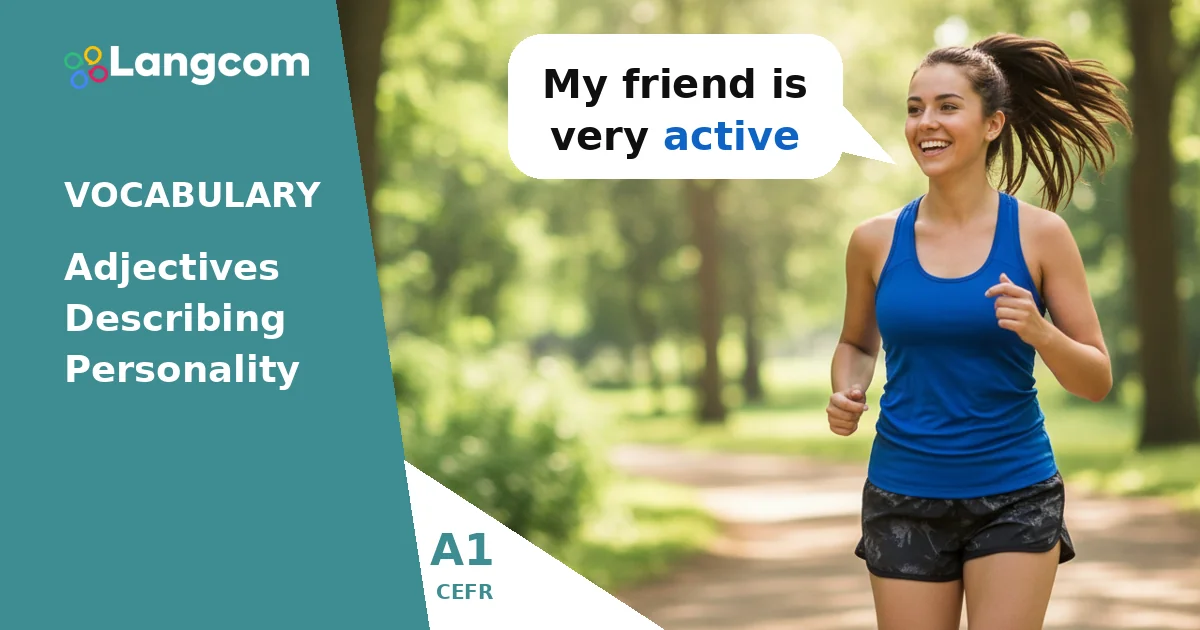

What Are Personality Adjectives?
Personality adjectives are words that describe a person’s character. They tell us about how someone behaves, thinks, or feels.
For example, if someone laughs a lot and is fun to be with, you can use a personality adjective to describe them.
🎓 Aprenda inglês com o método misto
Grupos pequenos · Tutor de IA 24 horas por dia, 7 dias por semana · Preparação para os exames de Cambridge
Planos de $39 $79 por mês
Meet Our Six Personality Adjectives
Here are six common A1 personality adjectives. Learn their meanings and see how to use them.
- Active: This describes someone who does many things or moves a lot. They like sports or physical activities.
My brother is very active. He plays football every day. - Lively: This describes someone who is full of energy and enthusiasm. They are often happy and fun.
Our new teacher is very lively. Her classes are never boring. - Sensitive: This describes someone who feels emotions deeply. They can be easily upset or understand other people's feelings well.
Please be kind to her; she is very sensitive. - Shy: This describes someone who is not confident, especially with new people. They might be quiet in groups.
He is a little shy, so he doesn't talk much in class. - Sociable: This describes someone who likes spending time with other people. They enjoy parties and meeting friends.
My sister is very sociable. She has many friends. - Talkative: This describes someone who talks a lot. They enjoy conversations.
My grandmother is very talkative. She can talk for hours!
How to Use Personality Adjectives in Sentences
You usually use personality adjectives with the verb to be (am, is, are).
- Subject + to be + Adjective
She is sociable. - You can also use them before a noun.
He is a shy person.
| Adjetivo | Significado |
|---|---|
| Active | Does many things; moves a lot |
| Lively | Full of energy and enthusiasm |
| Sensitive | Feels emotions deeply; easily upset |
| Shy | Not confident with new people; quiet |
| Sociable | Likes spending time with other people |
| Talkative | Talks a lot |
Exemplos
- My friend is very active. She loves sports.
- He is a shy boy. He doesn't talk much.
- Maria is sociable. She likes parties.
- Be careful, she is very sensitive.
- Our teacher is lively and fun.
- My neighbor is very talkative.
Prática
💬 Precisa de orientação personalizada?
Como Centro Autorizado de Preparação para os Exames de Cambridge, podemos orientá-lo na escolha do curso e da certificação mais adequados. Entre em contato com nossos orientadores hoje mesmo.
Converse com um consultor pelo WhatsAppErros comuns entre falantes de espanhol
Os falantes de espanhol às vezes cometem estes erros:
- Using the wrong verb: In Spanish, you might use 'tener' (to have) for some characteristics. In English, we use the verb to be.
❌ I have shy.
✅ I am shy. - Confuso sensitive e sensible: These words look similar but have different meanings.
Sensitive means easily upset or understanding feelings. Sensible means practical and logical.
❌ It's a sensitive idea to save money. (Incorrect, should be sensible)
✅ She is very sensitive to criticism.
✅ It's a sensible decision to study hard.
Perguntas frequentes
What is the main use of personality adjectives?
The main use is to describe a person's character or how they behave. For example, you can say My friend is sociable.
Can I use these adjectives for animals or things?
Generally, no. These adjectives are specifically for describing people's personalities. For animals, you might use words like 'playful' or 'friendly', but not typically 'talkative' or 'shy' in the same way.
Are some personality adjectives 'good' and others 'bad'?
Not always. Many adjectives, like shy ou talkative, are neutral. They just describe a characteristic. Whether it's 'good' or 'bad' often depends on the situation or your personal opinion.
How can I remember these new words?
The best way is to practice! Try to describe your friends, family, or even famous people using these adjectives. Use them in sentences and try to think of opposites, like shy vs. sociable.


0 Comentários