

What Are Common Objects?
Common objects are things we see and use every day. They are often found in our homes, schools, or offices. Learning their names in English is very useful for basic communication.
For example, in your living room, you might see a sofa, a television, e a lamp.
🎓 Aprenda inglês com o método misto
Grupos pequenos · Tutor de IA 24 horas por dia, 7 dias por semana · Preparação para os exames de Cambridge
Planos de $39 $79 por mês
Everyday Objects in Your Home
Let's look at some common objects you can find in different rooms.
- In the kitchen: a cup, a glass, a plate.
- In the living room: a chair, a table, a lamp, a picture.
- In the bedroom: a bed, a clock.
- For personal use: a book, a bag, a suitcase.
How Do We Use 'A' or 'An' with Objects?
In English, we use a ou an before a singular common object. These are called indefinite articles.
- Uso a before words that start with a consonant sound: a book, a chair, a lamp.
- Uso an before words that start with a vowel sound (a, e, i, o, u): an apple, an orange.
Remember, it's about the sound, not just the letter!
Singular and Plural Forms of Objects
Most common objects have singular (one) and plural (more than one) forms. We usually add -s ou -es to make a word plural.
- Add -s for most words: one book, two books; one chair, three chairs.
- Add -es para palavras que terminam em -s, -ss, -sh, -ch, -x, -z: one glass, two glasses; one box, many boxes.
| Singular | Plural |
|---|---|
| a book | books |
| a chair | chairs |
| a lamp | lamps |
| a glass | glasses |
| a box | boxes |
| a radio | radios |
| a clock | clocks |
| a picture | pictures |
Exemplos
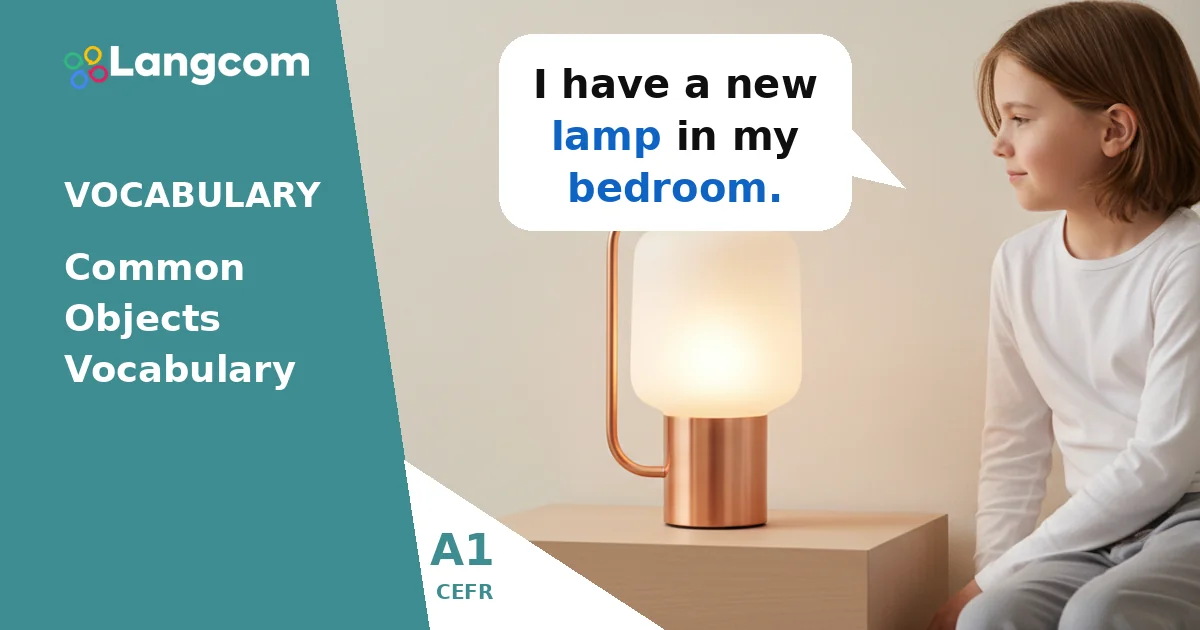
- I have a new lamp in my bedroom.
- There are two chairs in the kitchen.
- She is reading a book.
- Can I have a glass of water, please?
- My bag is on the table.
- The clock is on the wall.
- I saw a beautiful picture at the museum.
Prática
💬 Precisa de orientação personalizada?
Como Centro Autorizado de Preparação para os Exames de Cambridge, podemos orientá-lo na escolha do curso e da certificação mais adequados. Entre em contato com nossos orientadores hoje mesmo.
Converse com um consultor pelo WhatsAppErros comuns entre falantes de espanhol
Os falantes de espanhol às vezes cometem estes erros:
- Omitting 'a' or 'an': In Spanish, you often don't use an article for "a" or "an" when talking about general things. In English, it's usually necessary for singular countable nouns.
- Incorreto: I have book.
- Correto: I have a book.
- Confusing gender: English nouns do not have gender like in Spanish (e.g., "el libro," "la mesa"). All objects are "it."
- Incorreto: The table is big. He is brown. (referring to the table)
- Correto: The table is big. It is brown.
- Incorrect pluralization: Sometimes adding -es when only -s is needed, or vice-versa.
- Incorreto: Two glass.
- Correto: Two glasses.
Perguntas frequentes
Why is it important to learn common object names?
Learning common object names helps you describe your home, ask for things, and understand everyday conversations in English. It's basic vocabulary for A1 level.
How can I remember new object words easily?
Try labeling objects in your home with their English names. You can also draw pictures or use flashcards. Practice saying the words aloud often.
What is the difference between 'a' and 'an'?
Utilizamos a before words that start with a consonant sound (e.g., a book). We use an before words that start with a vowel sound (e.g., an apple).
Are there other words for 'picture'?
Yes, photograph is a common word for a picture taken with a camera. Painting is also a type of picture made with paint.


0 Comentários