

What is the ‘Flap T’ Sound?
について flap T is a specific sound in phonetics, represented as [ɾ]. It is an alveolar tap, which means your tongue quickly taps the ridge behind your upper front teeth.
It is not a full /t/ sound, which involves a release of air, nor is it a full /d/ sound, which holds the tongue longer. Instead, it’s a very brief, light touch.
When Does the Flap T Occur?
について flap T typically appears in American English under specific conditions. It is important to remember that these rules apply to *sounds*, not just letters.
- Between two vowel sounds: This is the most common situation. The t または tt must be between two vowel sounds, and the first vowel must be stressed or unstressed, but the second vowel must be unstressed.
- 例: water (wa-der), city (ci-dy), beautiful (beau-di-ful).
- 例: little (li-ddle), butter (bu-dder).
- After 'r' and before a vowel sound: When t follows an r and precedes an unstressed vowel sound, it often becomes a flap T.
- 例: party (par-dy), dirty (dir-dy), forty (for-dy).
- Linking 't' at the end of a word: If a word ending in t is followed by a word starting with a vowel sound, the t can link as a flap T.
- 例: What a good idea! (Wha-da good idea!)
- 例: Get up! (Ge-dup!)
American English vs. British English: The Flap T Difference
について flap T is a distinctive feature of American English pronunciation. It is much less common in British English (Received Pronunciation).
- In British English, the t in words like water または city is usually pronounced as a clear, aspirated /t/.
- Sometimes, British English uses a glottal stop [ʔ] ~のために t, especially before a consonant or at the end of a word, as in butter (bu'er). This is different from the flap T.
- Understanding this difference is key for C1 learners to navigate various English accents and improve their listening skills.
Why is the Flap T Important for C1 Learners?
- Enhanced Listening Comprehension: Native American English speakers use the flap T constantly. Recognizing this sound will significantly improve your ability to understand spoken English at a natural speed.
- More Natural Pronunciation: If you aim for an American accent, incorporating the flap T will make your speech sound much more natural and fluent.
- Improved Fluency: について flap T helps to smooth out the flow of speech, making transitions between words and syllables easier and more fluid.
| Word | American English (Flap T) | British English (Clear T) |
|---|---|---|
| Water | Sounds like 'wader' | Clear /t/ sound |
| City | Sounds like 'ciddy' | Clear /t/ sound |
| Little | Sounds like 'liddle' | Clear /t/ or glottal stop |
| Beautiful | Sounds like 'beaudiful' | Clear /t/ sound |
| Party | Sounds like 'pardy' | Clear /t/ sound |
例
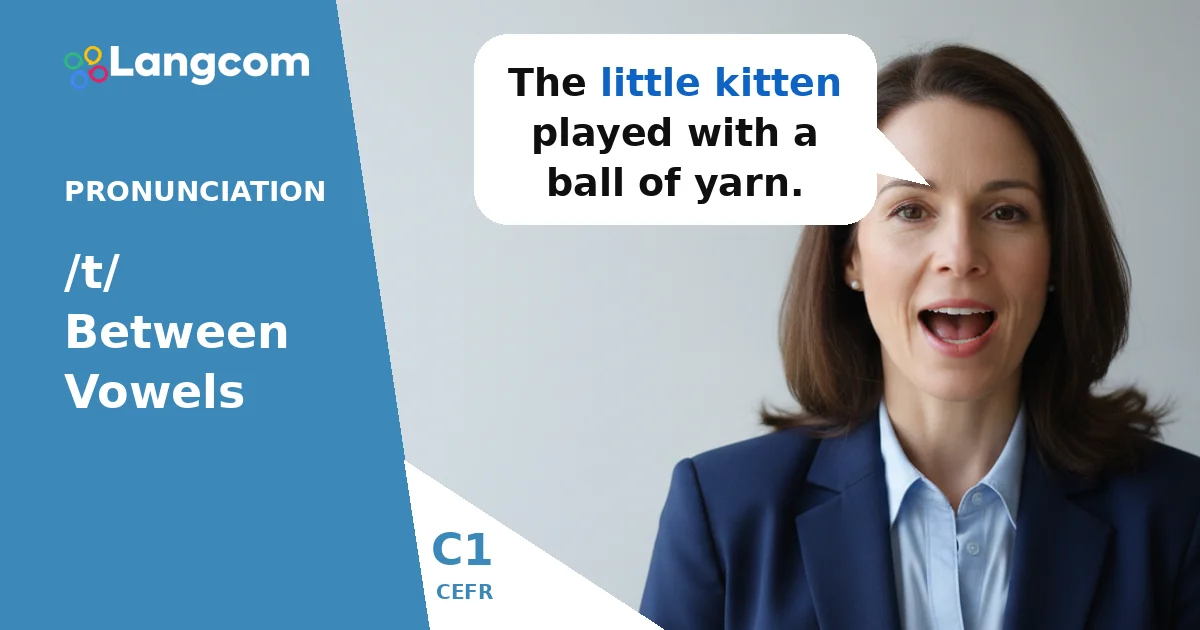
- The little kitten played with a ball of yarn.
- I need to get a new battery for my remote control.
- It's a beautiful day to go to the city park.
- Don't forget to put butter on your toast.
- We had a great party last Saturday night.
- What a fantastic idea for a project!
- She's pretty good at playing the guitar.
練習
スペイン語話者がよく犯す間違い
Spanish speakers often pronounce the English /t/ sound too hard, similar to their native /t/, which is typically dental. The flap T is much softer and quicker, an alveolar tap. It is not a full /d/ sound, but rather a very light one.
- 誤り: Pronouncing water with a strong, aspirated /t/ sound, like WA-TER.
- 正しい: Pronouncing water with a flap T, sounding like WA-DER.
- 誤り: Articulating city with a clear, crisp /t/.
- 正しい: Articulating city with a flap T, sounding like CI-DY.
Remember, the flap T is a quick, light touch, not a strong stop.
よくある質問
What is the 'flap T' sound?
について flap T is a quick, soft sound, like a very fast /d/, that occurs in American English when the letter 't' is between two vowel sounds or after an 'r' and before a vowel. It's phonetically represented as [ɾ].
Is the flap T used in British English?
No, the flap T is primarily a feature of American English. In British English, the 't' in similar positions is usually pronounced as a clear /t/ or sometimes a glottal stop [ʔ].
Does every 't' between vowels become a flap T?
Not always. The flap T typically occurs when the 't' is not at the beginning of a stressed syllable. For example, in attack または attain, the 't' is part of a stressed syllable, so it remains a clear /t/.
How can I practice the flap T?
The best way to practice is through active listening and shadowing. Listen to native American English speakers and try to imitate their pronunciation of words containing the flap T. Pay attention to how the sound feels in your mouth.
Why is understanding the flap T important for C1 English learners?
For C1 learners, mastering the flap T is crucial for advanced listening comprehension, as it's a very common sound in natural American English speech. It also helps you achieve a more natural and fluent pronunciation if you aim for an American accent, which is often tested in listening sections of advanced exams.



コメント 0 件