
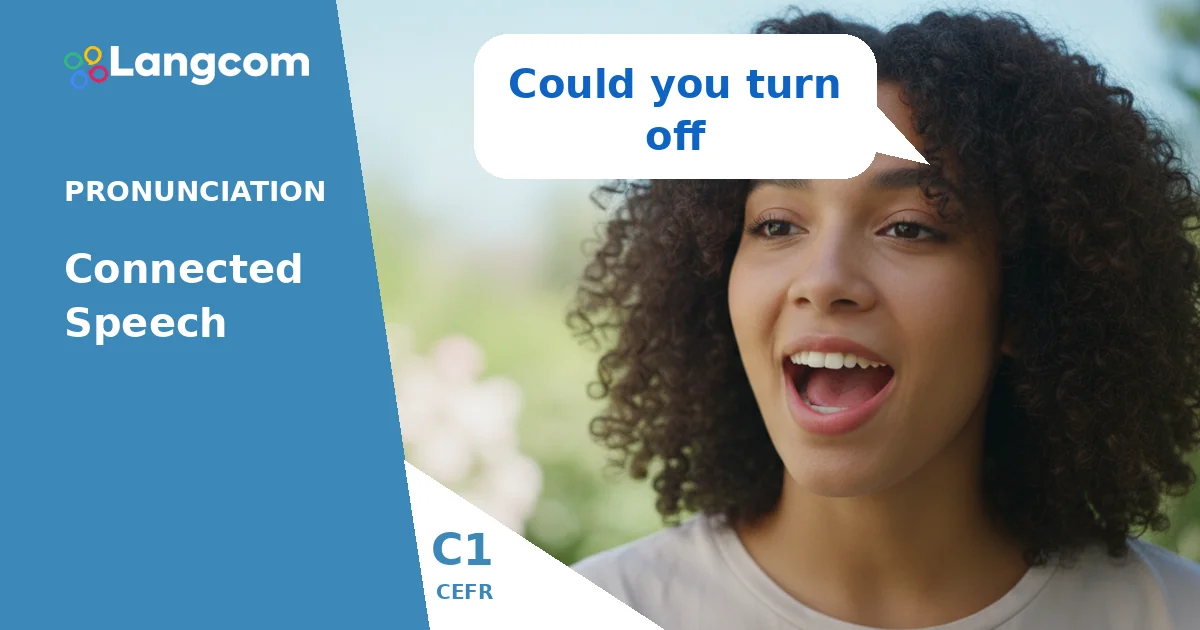

What Is Connected Speech and Linking?
When native English speakers talk, they often do not pronounce each word separately. Instead, words blend together. This is called connected speech.
One key feature of connected speech is linking. Linking happens when the final sound of one word joins with the initial sound of the next word.
- For C1 learners, understanding and using linking is essential.
- It helps you comprehend fast, natural English speech.
- It also makes your own spoken English sound more fluent and natural.
How Do Consonants and Vowels Link?
The most common type of linking occurs when a word ending in a consonant sound is followed by a word starting with a vowel sound.
The final consonant sound moves to the beginning of the next word, making them sound like one longer word.
- pick up sounds like pi-kup
- an apple sounds like a-napple
- turn off sounds like tur-noff
- what about sounds like wha-tabout
What About Linking Between Two Vowels? (Intrusive Sounds)
Sometimes, when one word ends in a vowel sound and the next word begins with a vowel sound, an extra sound appears between them. These are called intrusive sounds.
There are two main intrusive sounds: /j/ (a 'y' sound) and /w/ (a 'w' sound).
- Intrusive /j/ sound: This sound often appears after vowel sounds like /iː/ (as in see), /eɪ/ (as in say), /aɪ/ (as in my), or /ɔɪ/ (as in boy).
- she is sounds like she-yis
- my own sounds like my-yown
- say it sounds like say-yit
- Intrusive /w/ sound: This sound often appears after vowel sounds like /uː/ (as in do), /oʊ/ (as in go), or /aʊ/ (as in how).
- go out sounds like go-wout
- do it sounds like do-wit
- how often sounds like how-woften
Why Is Listening for Linking Important?
Developing your ear for linking is a crucial skill at the C1 level. It significantly impacts your ability to understand native speakers.
- Improved Comprehension: You will find it easier to follow conversations and lectures, even at faster speeds. Words that might sound unclear when heard separately become clear when you recognize their linked form.
- Better Fluency: When you start to hear these links, you will naturally begin to produce them in your own speech. This makes your English sound more natural and less choppy.
- Reduced Misunderstandings: Sometimes, linked words can sound very different from their individual pronunciations. Recognizing these patterns helps you avoid confusion.
| Linking Type | How it Works | 例 |
|---|---|---|
| Consonant + Vowel | A word ending in a consonant sound joins a word starting with a vowel sound. | take off sounds like tay-koff |
| Vowel + Vowel (Intrusive /j/) | An extra /j/ sound appears between two vowel sounds (e.g., after /iː/, /eɪ/, /aɪ/, /ɔɪ/). | she eats sounds like she-yeats |
| Vowel + Vowel (Intrusive /w/) | An extra /w/ sound appears between two vowel sounds (e.g., after /uː/, /oʊ/, /aʊ/). | go away sounds like go-waway |
例
- Could you turn off the lights, please?
- I think it's a good idea to go early.
- They go out for dinner every Saturday.
- She is always happy to help.
- We need to pick up some groceries.
- My idea is to start a new project.
練習
スペイン語話者がよく犯す間違い
Spanish speakers often pronounce each word distinctly, which is common in Spanish but makes English sound unnatural. This means they might not link words.
- Not linking Consonant + Vowel: Instead of take off sounding like tay-koff, they might say take (pause) off.
- Missing Intrusive Sounds: They might say go out as two separate words, without the natural /w/ sound, instead of go-wout. Similarly, she is might lack the /j/ sound, not becoming she-yis.
- Difficulty in Listening: Because they don't produce these links, they can struggle to hear them in fast English, leading to comprehension issues.
よくある質問
What is the main benefit of learning linking in English?
The main benefit is significantly improving your listening comprehension of natural, fast English speech and making your own spoken English sound more fluent and native-like. It helps you understand how words blend together, not just as separate units.
Is linking always necessary when speaking English?
While not strictly 'necessary' for basic communication, linking is a natural feature of fluent English. Using it makes your speech sound much more natural and easier for native speakers to understand. Not linking can make your speech sound choppy or hesitant.
How can I practice listening for linking?
Listen to authentic English materials like podcasts, movies, and interviews. Pay close attention to how words connect. Try to repeat sentences, focusing on blending words together. Shadowing (repeating audio immediately after hearing it) is also a very effective technique.
Does linking affect my accent?
Linking is a feature of connected speech, not an accent itself. However, mastering linking will make your pronunciation sound more natural and closer to a native English speaker's rhythm and flow, regardless of your specific accent.
Is understanding linking important for C1 English exams?
Yes, for C1 exams like CAE or IELTS, strong listening comprehension is vital. Recognizing linking helps you understand spoken texts, especially in listening tasks where speakers often use natural, connected speech. It also contributes to a higher score in speaking tasks for fluency and pronunciation.

コメント 0 件