

What are Countries and Nationalities?
A country is a place, like Mexico または Japan. It is a nation with its own government.
A nationality describes a person from that country. For example, someone from Mexico は Mexican. Someone from Japan は Japanese.
- We always write countries and nationalities with a capital letter.
- Mexico (country) → Mexican (nationality)
- Japan (country) → Japanese (nationality)
How Do We Use Them in Sentences?
You can use countries and nationalities to say where you or other people are from. There are two common ways to do this.
- To talk about your country:
I am from [Country].
例: I am from Colombia. - To talk about your nationality:
I am [Nationality].
例: I am Colombian.
You can also use these phrases for other people:
- She is from the United States.
- He is American.
- They are from China.
- They are Chinese.
Important Rules for Countries and Nationalities
Remember these simple rules for using countries and nationalities correctly:
- Always Capitalize: The first letter of every country and nationality word is always big (capital).
誤り: i am spanish.
正しい: I am Spanish. - Nationality as an Adjective: Nationalities often work like adjectives. They describe people.
例: He is a Spanish student. (Spanish describes the student.)
| Country | Nationality |
|---|---|
| Spain | Spanish |
| Mexico | Mexican |
| United States | American |
| Colombia | Colombian |
| China | Chinese |
| France | French |
| Germany | German |
| Italy | Italian |
| Japan | Japanese |
| Brazil | Brazilian |
例
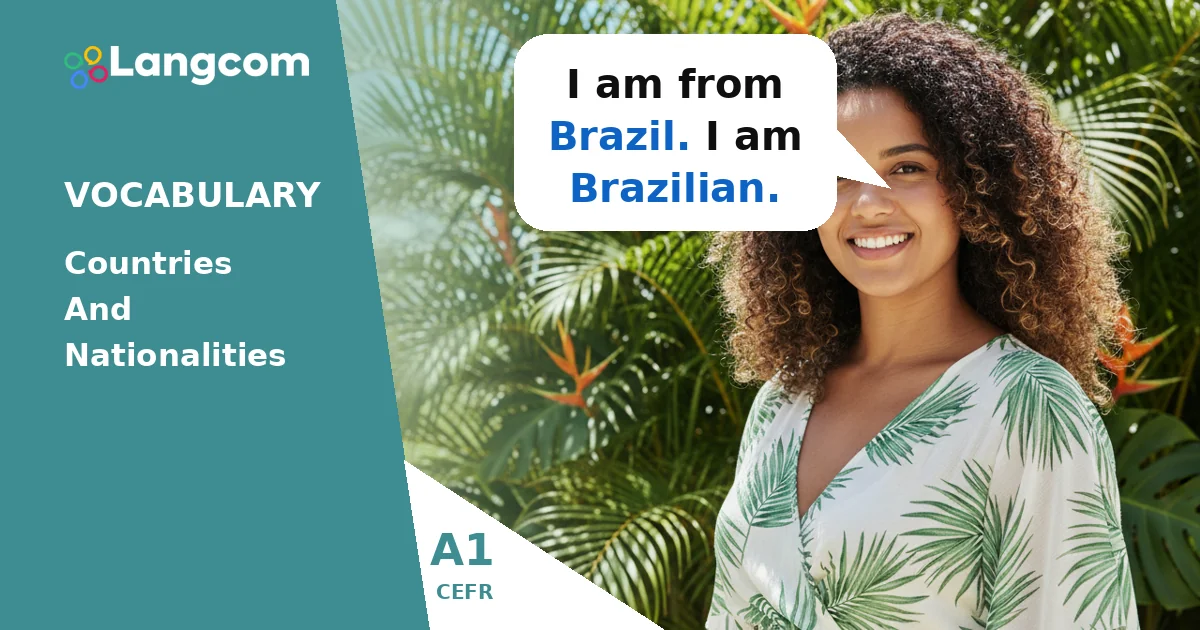
- I am from Brazil. I am Brazilian.
- She is from France. She is French.
- He is from Germany. He is German.
- They are from Italy. They are Italian.
- Are you from the UK? Are you British?
練習
💬 個別のアドバイスが必要ですか?
当校はケンブリッジ試験の公認準備センターとして、皆様に最適なコースや資格取得への道をご案内いたします。ぜひ今すぐアドバイザーにご相談ください。.
WhatsAppでアドバイザーとチャットスペイン語話者がよく犯す間違い
Spanish speakers sometimes make these mistakes:
- Not capitalizing: In Spanish, nationalities are not always capitalized. In English, they always are.
誤り: i am mexican.
正しい: I am Mexican. - Using the country name instead of the nationality:
誤り: I am Spain.
正しい: I am Spanish.
Remember, Spain is the country, Spanish is the nationality. - Using 'of' incorrectly:
誤り: I am a person of Spain.
正しい: I am from Spain. または I am Spanish.
よくある質問
Do I always capitalize countries and nationalities?
Yes, always. In English, both countries (like Canada) and nationalities (like Canadian) always start with a capital letter.
What is the difference between 'I am from...' and 'I am...'?
You use 'I am from...' with a country name, for example, 'I am from Argentina.' You use 'I am...' with a nationality, for example, 'I am Argentinian.' Both mean the same thing.
Can I use a nationality to describe a thing?
Yes, you can! Nationalities can describe things too. For example, 'Spanish food' または 'Japanese cars.'


コメント 0 件