

What Are Collocations in English?
Collocations are words that often go together. They sound ‘right’ to native English speakers. If you use a different word, it might sound unnatural or even wrong.
- For example, we say take a photo, ではなく make a photo.
- We say do homework, ではなく make homework.
These fixed pairs of words are important for speaking and writing English correctly.
Why Are Verb-Noun Collocations Important?
Learning verb-noun collocations helps you in several ways:
- Sound more natural: Your English will sound more like a native speaker's.
- Avoid mistakes: You will use the correct verb with the correct noun.
- Improve fluency: You will speak and write more quickly and confidently.
- Prepare for exams: Collocations are common in English exams like the A2 Key. Knowing them helps you understand questions and give better answers.
Common Verb-Noun Collocations for A2 Learners
Here are some common verbs and the nouns they often go with:
- Make: 当社では make for creating or producing something.
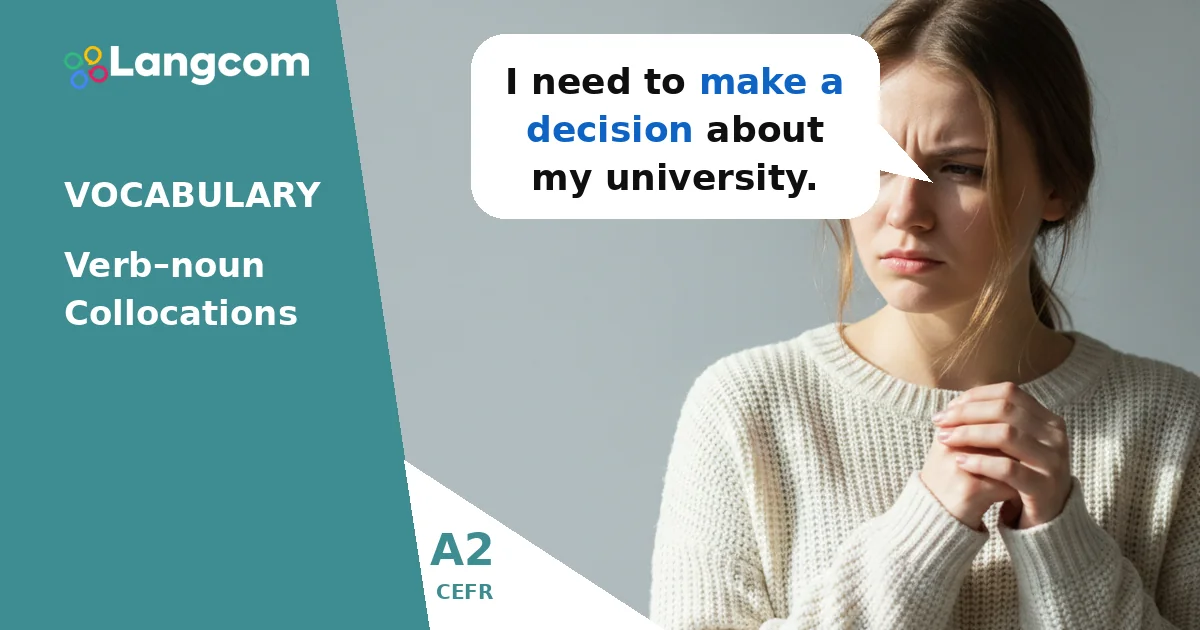
- make a decision
- make a noise
- make a mistake
- make friends
- Do: 当社では do for actions, tasks, or activities.
- do homework
- do the washing up
- do exercise
- do business
- Have: 当社では have for experiences, meals, or breaks.
- have a break
- have a shower
- have fun
- have a party
- Take: 当社では take for actions like moving something, accepting something, or capturing an image.
- take a photo
- take a rest
- take a bus
- take a look
- Keep: 当社では keep for maintaining something or holding onto it.
- keep a secret
- keep a promise
- keep in touch
- Break: 当社では break for not following rules or promises.
- break a promise
- break the rules
- break a record
- Spend: 当社では spend for using time or money.
- spend time
- spend money
How Can I Learn Verb-Noun Collocations?
Learning collocations takes practice. Here are some tips:
- Read and listen: Pay attention to how words are used together in books, articles, movies, and conversations.
- Keep a notebook: Write down new collocations you learn. Group them by verb (e.g., all collocations with make).
- Use them: Try to use new collocations in your speaking and writing. The more you use them, the more natural they will become.
- Context is key: Always learn collocations in full sentences, not just as single words.
| 動詞 | Noun Collocation |
|---|---|
| make | a decision, a noise, a mistake, friends |
| do | homework, the washing up, exercise, business |
| have | a break, a shower, fun, a party |
| take | a photo, a rest, a bus, a look |
| keep | a secret, a promise, in touch |
| break | a promise, the rules, a record |
| spend | time, money |
例
- I need to make a decision about my university.
- Please don't make a noise; the baby is sleeping.
- Did you do your homework last night?
- Let's have a break and get some coffee.
- Can you take a photo of us?
- She is good at keeping a secret.
- It's important not to break a promise.
- I like to spend time with my family on weekends.
練習
スペイン語話者がよく犯す間違い
Many Spanish speakers make mistakes with make そして do because they might translate directly from Spanish. For example:
- 誤り: I do a mistake.
- 正しい: I make a mistake. (In Spanish: cometer un error)
Another common error is with homework:
- 誤り: I make my homework.
- 正しい: I do my homework. (In Spanish: hacer los deberes)
Always remember to learn these pairs as a single unit to avoid direct translation errors.
よくある質問
What is a collocation?
A collocation is a pair or group of words that are often used together. They sound natural to native speakers. For example, heavy rain is a collocation, but strong rain is not.
Why are verb-noun collocations important for the A2 Key exam?
For the A2 Key exam, knowing verb-noun collocations helps you understand listening and reading texts better. In the speaking and writing parts, using correct collocations makes your English sound more natural and accurate, which can improve your score. For example, in Part 6 of the A2 Key Reading and Writing paper, you might need to choose the correct verb to complete a sentence with a noun.
Can I guess collocations?
Sometimes you might guess correctly, but often collocations are not logical. For example, why do we take a shower but have a bath? It's best to learn them as fixed phrases rather than trying to guess.
How can I remember new collocations?
Try writing new collocations in a special notebook. You can draw pictures, write example sentences, or group them by topic. Review them regularly and try to use them in your conversations and writing practice.



コメント 0 件