

What Are English Tenses and Why Do They Matter?
English tenses tell us when an action takes place. They are like time markers for verbs.
Learning tenses helps you:
- Talk about your daily routine.
- Describe events that happened in the past.
- Make plans or predictions for the future.
- Express yourself clearly and correctly.
When Do We Use the Present Simple?
We use the Present Simple for things that are always true, habits, or routines.
- Facts and general truths: The sun rises in the east.
- Habits and routines: I drink coffee every morning.
- Schedules and timetables: The train leaves at 7 PM.
When Do We Use the Present Continuous?
について Present Continuous describes actions happening right now, temporary situations, or future plans.
- Actions happening now: She is reading a book at the moment.
- Temporary situations: They are living in London this month.
- Future plans (fixed arrangements): We are meeting friends tonight.
What is the Difference: Present Simple vs. Present Continuous?
It is important to know when to use each present tense.
- 使用方法 Present Simple for things that are regular or always true.
- 使用方法 Present Continuous for actions happening at this exact moment or around now.
How Do We Talk About the Past: Past Simple?
について Past Simple is for actions that started and finished in the past at a specific time.
- 過去に完了したアクション: I visited my grandparents last weekend.
- A series of past actions: She woke up, ate breakfast, and went to work.
How Do We Talk About Ongoing Past Actions: Past Continuous?
We use the Past Continuous for actions that were in progress at a specific time in the past.
- Action in progress at a past moment: At 8 PM yesterday, I was watching TV.
- An action interrupted by another: While I was studying, my phone rang.
What is the Difference: Past Simple vs. Past Continuous?
These two tenses often work together.
- 使用方法 Past Continuous for the longer, ongoing action.
- 使用方法 Past Simple for the shorter, completed action that interrupted it.
Talking About Past Experiences: Present Perfect?
について Present Perfect connects the past to the present. It is formed with have/has + past participle.
- Experiences in your life (when is not important): I have visited Paris twice.
- Actions that started in the past and continue now: She has lived here for five years.
- Actions that finished recently with a result now: I have lost my keys. (So I can't open the door now.)
What is the Difference: Past Simple vs. Present Perfect?
This is a common point of confusion for A2 learners.
- 使用方法 Past Simple for actions that finished at a specific time in the past (e.g., yesterday, last year).
- 使用方法 Present Perfect for actions where the time is not specific, or the action continues to the present, or its result is important now.
How Do We Talk About the Future: Future Simple (will)?
We use the Future Simple with will for predictions, sudden decisions, or promises.
- Predictions: I think it will rain tomorrow.
- Sudden decisions: I'm thirsty. I'll get a glass of water.
- Promises and offers: I will help you with your homework.
| Tense | 使用方法 | 例 |
|---|---|---|
| Present Simple | Habits, facts, routines | She drinks tea every day. |
| Present Continuous | Actions happening now, temporary situations, future plans | They are studying English. |
| Past Simple | Finished actions at a specific past time | I watched a movie yesterday. |
| Past Continuous | Actions in progress at a past time | He was sleeping at 10 PM. |
| Present Perfect | Experiences, actions from past to now, result now | I have never been to Japan. |
| Future Simple (will) | Predictions, sudden decisions, promises | It will be sunny tomorrow. |
例
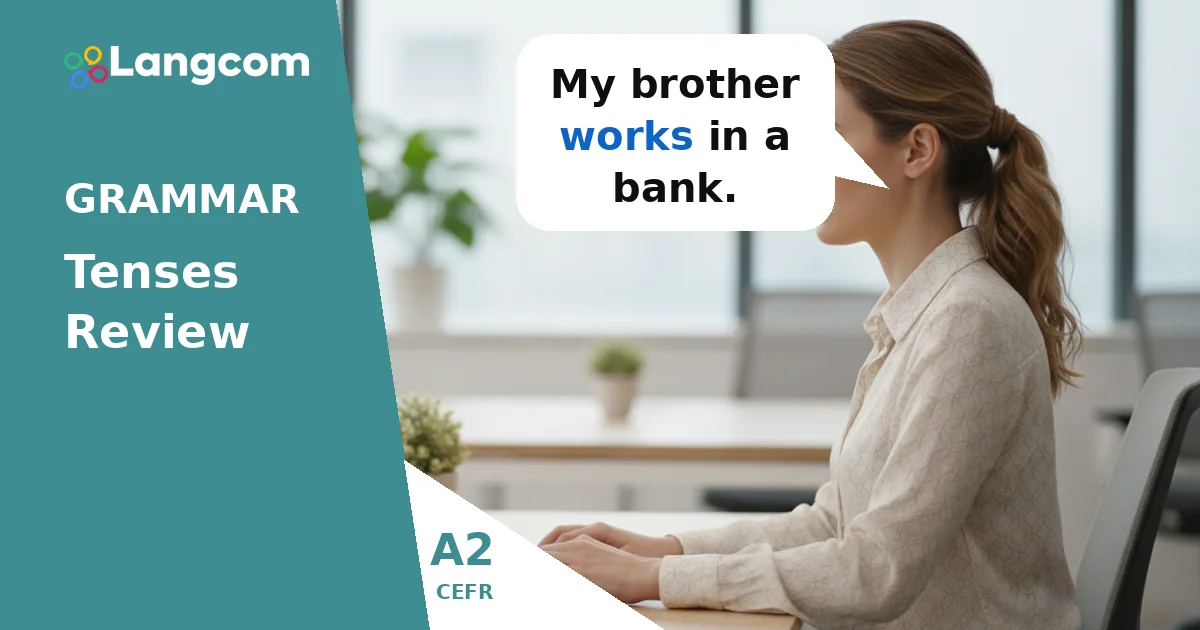
- My brother works in a bank.
- Look! It is snowing outside.
- They went to the beach last summer.
- What were you doing at 3 PM yesterday?
- Have you ever eaten sushi?
- Don't worry, I'll call you later.
練習
スペイン語話者がよく犯す間違い
スペイン語話者が犯しがちな間違い
- Using Present Simple for actions happening now: In Spanish, you might say "Yo como ahora" but in English, it's I am eating now, ではなく I eat now.
- Confusing Past Simple and Present Perfect: Spanish often uses the perfect tense more broadly. Remember, Past Simple needs a finished time (e.g., I saw him yesterday). Present Perfect is for experiences or actions connected to now (e.g., I have seen that movie before).
- Forgetting 'to be' with Past Continuous: It's I was reading, ではなく I reading.
よくある質問
What is the most important tense for A2 English learners?
All the basic tenses (Present Simple, Present Continuous, Past Simple, Present Perfect, Future Simple) are important. However, mastering the difference between Past Simple そして Present Perfect is often a key challenge for A2 learners.
How can I practice English tenses?
You can practice by writing sentences about your day, describing past events, or making plans. Try to use different tenses in your stories. Reading English books and listening to English conversations will also help you see how tenses are used naturally.
Do I need to know all tenses for the A2 Key (KET) exam?
For the A2 Key (KET) exam, you need a good understanding of the basic tenses: Present Simple, Present Continuous, Past Simple, Present Perfect, 、および Future Simple. You will need to use them correctly in writing and speaking tasks, such as describing events or giving personal information.
What is the difference between 'will' and 'going to' for the future?
At A2, will is mainly for predictions or decisions made at the moment of speaking. Going to is for plans you have already made or predictions based on present evidence. For example, I will call you later (decision now) vs. I am going to visit my aunt next week (a plan).

コメント 0 件