

What is the Possessive ‘s for?
The possessive ‘s is a small but powerful part of English grammar. We use it to show ownership or a relationship between a person and a thing.
- It answers the question “Whose is it?”
- It tells us who something belongs to.
Think of it as a shortcut to say “the book of John” or “the car of my father.”
How do we form the Possessive 's?
It is very simple to form the possessive 's with singular nouns and names.
- Take the name of the person or the singular noun.
- Add an apostrophe (') and then the letter s.
- Then, add the thing they own.
Look at these examples:
Possessive 's with Names
When someone's name is singular, we add 's to the end of their name.
- This is Mary's bag. (The bag belongs to Mary.)
- That is Tom's ball. (The ball belongs to Tom.)
Even if a name ends in s, 例えば James, we still add 's. For example: James's car.
Possessive 's with Singular Nouns
また、当社は 's with singular nouns that are not names, like teacher または dog.
- This is the teacher's desk. (The desk belongs to the teacher.)
- That is the dog's bone. (The bone belongs to the dog.)
Remember, this rule is for singular nouns only. We will learn about plural nouns later.
| Owner | フォーム | 例 |
|---|---|---|
| A singular person's name | Name + 's | John's book |
| A singular noun (person/animal) | Noun + 's | The girl's hat |
例
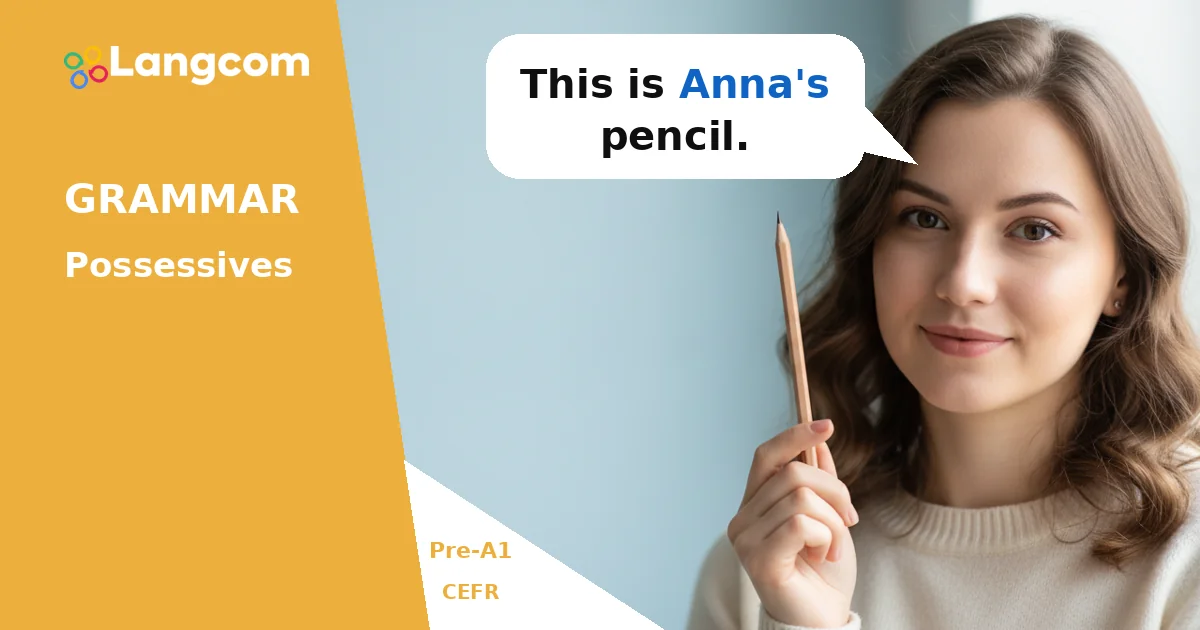
- This is Anna's pencil.
- That is my father's car.
- Where is the cat's toy?
- Is this Peter's book?
- The girl's hat is red.
練習
💬 個別のアドバイスが必要ですか?
当校はケンブリッジ試験の公認準備センターとして、皆様に最適なコースや資格取得への道をご案内いたします。ぜひ今すぐアドバイザーにご相談ください。.
WhatsAppでアドバイザーとチャットスペイン語話者がよく犯す間違い
スペイン語を話す人たちは、次のような間違いを犯すことがあります:
- Using "of" instead of 's: In Spanish, you might say "el libro de Juan." In English, we use 's.
- 誤り: The book of John.
- 右: John's book.
- Forgetting the apostrophe: The apostrophe ' is very important. Without it, Johns book looks like a plural word, not a possessive.
- 誤り: This is Marias bag.
- 右: This is Maria's bag.
- Confusing it's そして its: It's とは it is または it has. Its is a possessive pronoun (like his または her).
- 誤り: The dog wants it's bone.
- 右: The dog wants its bone.
- 右: It's a big dog. (It is a big dog.)
よくある質問
What does the possessive 's mean?
The possessive 's means that something belongs to someone. For example, Sarah's phone means "the phone of Sarah."
Can I use 's for things that are not people?
はい、ご利用いただけます 's for animals, like the dog's toy. Sometimes you can use it for places or time, but for Pre-A1, focus on people and animals.
Is "its" the same as "it's"?
No, they are different! It's is a short form for it is または it has. Its shows possession for things or animals, like The cat likes its food.
Why is the apostrophe important in 's?
The apostrophe ' tells you that 's means possession. Without it, the word might look like a plural (more than one) or a verb. For example, dogs means many dogs, but dog's means something belonging to one dog.


コメント 0 件